

Hidden Tunnels, Fake Walls, Double Books: How China's Deadliest Mine in 16 Years Was Allowed to Happen
New details from China's ongoing investigation into the Liushenyu coal mine explosion are painting a disturbing picture of deliberate, systematic fraud. Hidden tunnels, fabricated walls, falsified maps, and untracked workers point to an operation specifically designed to evade safety oversight — with devastating consequences. At least 90 miners are confirmed dead, and two remain unaccounted for.

.
UPDATE — This article follows our earlier report published on udumbara.net. For initial coverage, see: Death Toll Surges to 90: China's Coal Mine Disaster Becomes Deadliest in Over 16 Years.
.
The Investigation Uncovers Layers of Deception
When the gas explosion tore through the Liushenyu coal mine in Shanxi province on the evening of May 22, it was immediately clear that something had gone badly wrong. What is now becoming apparent, as investigators publish their preliminary findings, is that the disaster was not simply the result of negligence — it was the predictable outcome of a calculated, multi-layered deception scheme designed to keep regulators in the dark.
State media reports published Tuesday, May 26, reveal that the mine — operated by Shanxi Tongzhou Coal Coking Group — maintained two entirely separate sets of technical drawings and two separate surveillance systems. One set accurately reflected the real underground layout. The other was prepared exclusively for official inspections, presenting a sanitized version of reality that concealed entire sections of the mine's actual operations.
In Chinese mining circles, this practice has a name: "yin-yang drawings" — one version kept in the light for inspectors, one kept in the shadows for production.
Fake Walls, Coal Ash, and a Lookout at the Entrance
Among the most striking findings emerging from the probe: mine operators constructed fake doors using wire mesh and woven plastic sacks coated in sprayed mortar. From a distance — or in the dim light of a tunnel — they were indistinguishable from solid rock walls.
The system was operational and rehearsed. Whenever inspectors arrived at the site, a lookout stationed outside would alert workers underground. The fake doors were shut, coal ash was smeared across the surfaces to blend them with the surrounding passage, and the concealed sections simply ceased to exist — officially.
Coal extracted from these hidden tunnels never appeared in official production figures. It was never taxed. The profits flowed freely, while the safety risks remained invisible to the authorities tasked with managing them.
123 Workers Who Officially Weren't There
The most stark illustration of the fraud's scale comes in a single number: 123.
When the explosion occurred, official entry logs recorded 124 workers underground. The true number was 247 — nearly double. The additional 123 workers had been hired through subcontracting arrangements and never registered in any official system. They were also never provided with the location trackers that Chinese mine safety regulations explicitly require all underground workers to carry. These trackers allow authorities to monitor where miners are at any given moment — including in emergencies.
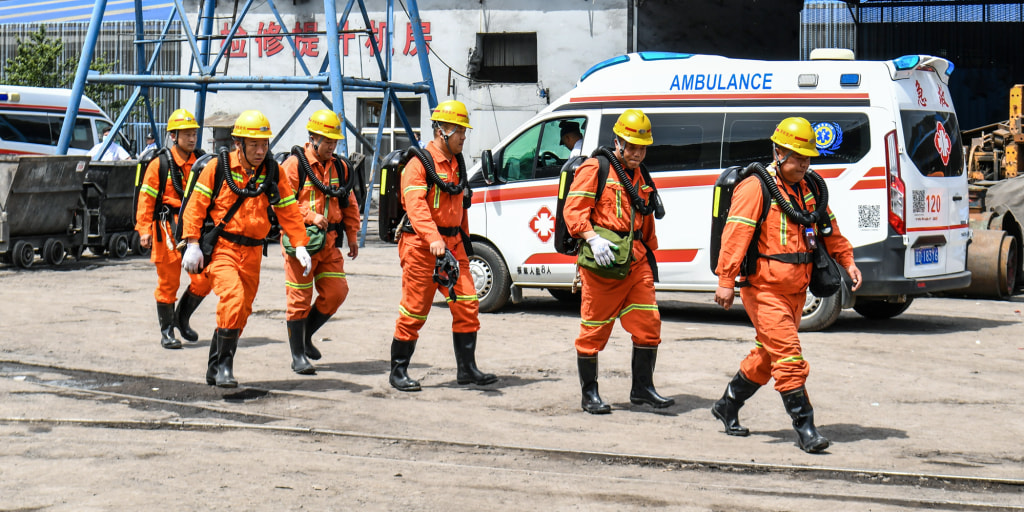
When rescuers arrived in the aftermath of the blast, they had neither accurate maps of the mine's actual layout nor any reliable information about how many people were inside or where they might be. State media has acknowledged that this directly and severely hampered rescue efforts.
A "High-Gas Mine" That Removed Its Own Gas Monitors
The Liushenyu mine carried an official classification as a "high-gas mine" — a designation that recognizes elevated methane explosion risk and triggers a specific set of mandatory safety requirements, including the installation of gas-monitoring equipment throughout the underground workings.
Investigators found that the mine had deliberately avoided installing that equipment. The stated reason, according to state broadcaster reports, was to further evade regulatory oversight. In other words: the mine's operators understood the danger and systematically removed the tools that would have measured it.
This was not a blind spot that regulators had missed entirely. In 2025, just one year before the explosion, the mine operator had been fined after regulators discovered concealed working areas during an inspection. The fine was apparently insufficient to alter behavior. Illegal production continued, unchanged.
Accountability Arrives — After Ninety People Are Dead
Executives of Shanxi Tongzhou Coal Coking Group have been detained. Chinese President Xi Jinping has ordered a full investigation and demanded accountability under the law. Premier Li Qiang has called for transparent and timely information disclosure. Shanxi provincial authorities have deployed hundreds of rescue and medical personnel.
This is a familiar sequence. As we noted in our earlier coverage, China's response to major disasters follows a recognizable pattern: arrests, investigations, pledges, and public commitments — after the cameras are rolling. The structural conditions that enable disasters like this one — the financial ties between local governments and mine operators, the weakening of independent oversight, the production pressures that incentivize cutting corners — remain unaddressed.
China's own national mine safety administration has stated that "yin-yang" double-bookkeeping practices are not uncommon across the country's coal industry, despite repeated crackdowns. That admission is significant. It means the Liushenyu disaster is not an isolated failure of one rogue company. It is a window into an industry-wide problem.
The Numbers, the History, the Unanswered Question
At least 90 miners are confirmed dead. Two remain unaccounted for. More than 100 were hospitalized. The blast is the deadliest mining accident in China since 2009, when a gas explosion at the Xinxing Mine in Heilongjiang Province killed 108 people.
In our earlier report, we traced the broader history of Chinese mining disasters — from the 214 killed in Liaoning in 2005, to the 684 who perished in the Laobaidong explosion under Mao Zedong in 1960, a death toll that went largely unreported for decades. The Liushenyu explosion now takes its place in that grim record.
Some Chinese mines have halted or reduced production in the wake of the disaster for safety inspections. Whether those inspections will reach the hidden tunnels, ghost workers, and falsified documents that appear to be commonplace throughout the industry — and not merely a feature of one company in Shanxi — is the question that matters most.
For the families of those who did not come back from the night shift on May 22, no investigation changes what happened. But for everyone still working underground across China, the answer to that question could mean everything.
.
Sources
- Reuters — "Hidden tunnels, fake doors: China probes mining tragedy that killed 82," May 26, 2026: https://www.reuters.com/world/china/hidden-tunnels-fake-doors-china-probes-mining-tragedy-that-killed-82-2026-05-26/
- Xinhua News Agency — cited within Reuters reporting on preliminary investigation findings (May 26, 2026)
- CCTV State Broadcaster — footage and reports cited within Reuters (May 26, 2026)
- udumbara.net — "Death Toll Surges to 90: China's Coal Mine Disaster Becomes Deadliest in Over 16 Years": https://udumbara.net/death-toll-surges-to-90-chinas-coal-mine-disaster-becomes-deadliest-in-over-16-years/
.
What's Your Reaction?
 Like
0
Like
0
 Dislike
0
Dislike
0
 Love
0
Love
0
 Funny
0
Funny
0
 Wow
0
Wow
0
 Sad
0
Sad
0
 Angry
0
Angry
0










Comments (0)