PEI Passes Bill to Make Land Investigations Public Amid Chinese Interference Concerns

PEI Passes Bill to Make Land Investigations Public Amid Chinese Interference Concerns

.

The Prince Edward Island legislature has passed a bill that will make land investigation reports public, aiming to restore trust in provincial institutions following concerns over extensive land holdings by some groups on the island.

The bill, brought forward by Green Party Leader Matt MacFarlane, was passed with unanimous support at the P.E.I. legislature on Nov. 12. It amends the province’s Lands Protection Act (LPA) to require that reports from land investigations conducted by the Island Regulatory and Appeals Commission (IRAC) be submitted to the responsible minister and tabled in the legislature within 15 days, making the documents publicly accessible.
.
P.E.I. Premier Rob Lantz, when announcing last month that he had asked the RCMP to investigate foreign interference in the province, said that the issue of land ownership is specifically being investigated by the IRAC.
.
Lantz made the comments while calling for federal probes into public allegations presented by former security and intelligence officials regarding China’s interference operations on the island.
The allegations were made in an October press conference in Ottawa by Garry Clement, former national director of the RCMP’s proceeds-of-crime program, who outlined the findings of an investigation he conducted with former Canadian Security Intelligence Service manager Michel Juneau-Katsuya into how Beijing exploited immigration loopholes and leveraged elite capture to infiltrate P.E.I. The two have published their findings in a newly published book, “Canada Under Siege: How PEI Became a Forward Operating Base for the Chinese Communist Party.”
.
Premier Lantz said the allegations involving the groups referenced in Clement and Juneau-Katsuya’s investigation about China’s ambitions to acquire land in the province “build on years of public speculation and uncertainty.”
.
“These allegations strike at the heart of our democratic values and the trust Islanders place in their institutions,” Lantz said in an Oct. 16 press release.
The RCMP last month said it would review allegations of foreign interference and money laundering in the province in light of the new information.

Land Holdings

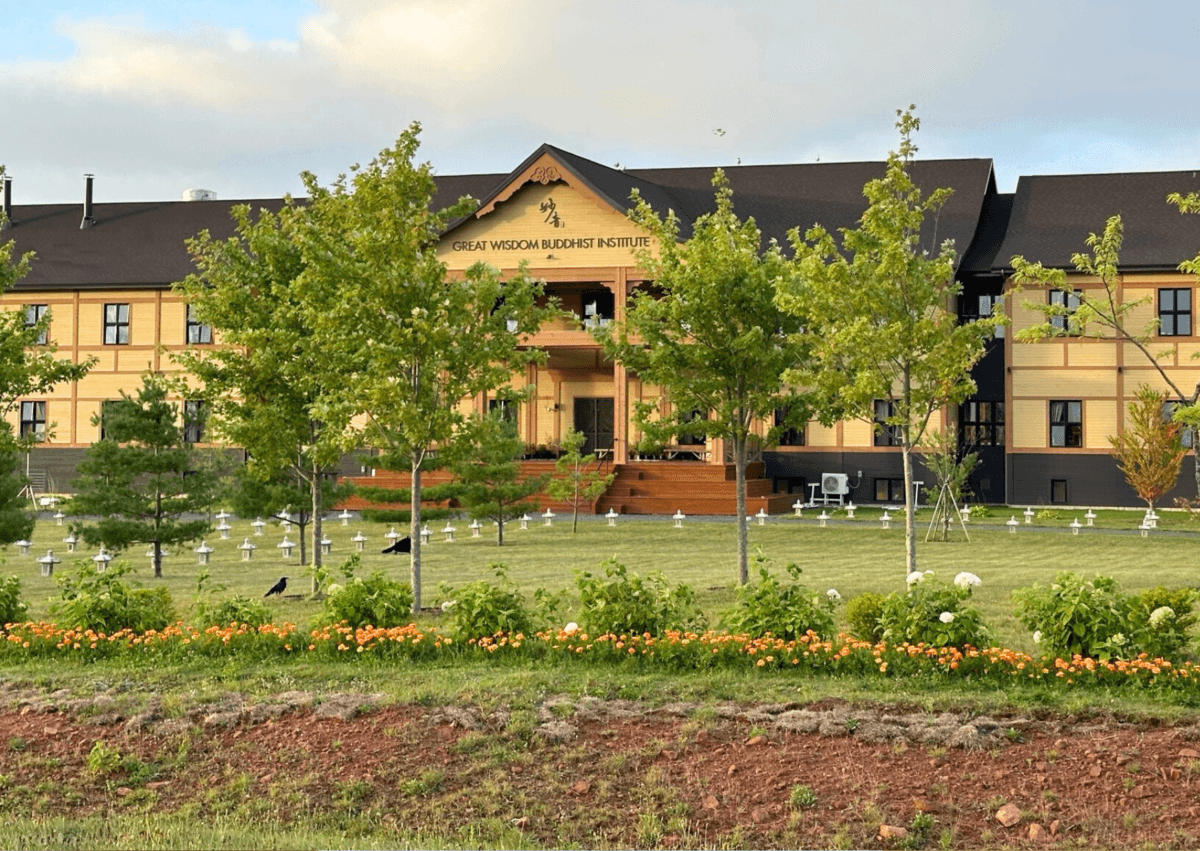
Among the organizations under scrutiny for land holdings are the Great Enlightenment Buddhist Institute Society (GEBIS) and the Great Wisdom Buddhist Institute (GWBI), two monasteries that operate under the Taiwan-based Bliss and Wisdom Buddhist organization. The groups have faced scrutiny in media reports about China ties, which they have denied.
.
GWBI says on its website that “there is no big business or government controlling GWBI, GEBIS, or Bliss and Wisdom,” and that allegations that their spiritual leader, teacher Zhen-Ru, has close links to the Beijing regime are false. In a recent statement to The Epoch Times, GEBIS stressed that it has “absolutely no affiliation with the Chinese government.”
.
A Bliss and Wisdom facility in rural Prince Edward Island on Aug. 29, 2024. Omid Ghoreishi/The Epoch Times
.

Meanwhile, both monasteries were identified as the focus of the IRAC investigation launched in February, when then-Housing Minister Steven Myers announced the probe into their land holdings, alongside other land-related measures.

“Islanders have valid concerns about who owns land and how it is being used, especially since we are a small province with limited land,” said Myers in a Feb. 12 press release. “But it’s important too that these discussions are based on evidence, not assumptions.”
.
Amid increased scrutiny, GWBI has published comments related to its land holdings, noting it owns approximately 670 acres—below the 3,000-acre limit for corporations under the LPA. GEBIS is also said to own less than the legal limit.
.
However, the Greens’ MacFarlane has expressed concerns that the combined land holdings of the two monasteries, which he suggested may be attributed to a single legal owner, could exceed the regulatory threshold and thus be considered a circumvention of the law, according to CTV News.

Regarding the need for extensive land, GWBI says that wide areas of green space and agricultural land help create an environment conducive to their practice.

“These large patches of greenery and farmland aid in our contemplative practice as we are not surrounded by commercial buildings or overdevelopment,” GWBI says on its website.

MacFarlane said that during consultations on his bill, GEBIS—which he noted was reportedly among the subjects of IRAC’s 2016 investigation—expressed its full support for the proposed amendment to the Act.

New Legislation

The passing of the new legislation follows last month’s disclosure through a legislative committee subpoena that an IRAC investigation launched in 2016 into the land holdings of the groups was never completed.

MacFarlane noted that under current regulations, IRAC is not required to make investigation results public and reports go to the minister only if the investigation is minister-initiated. He said this means such investigations could remain entirely hidden from the public, limiting accountability.

“The bill is intended to give Islanders the comfort and the guarantee that IRAC land investigation reports will, in fact, be made public,” he said at the legislature on Nov. 12, adding that the current reporting mechanism has led to a “loss of trust” among Islanders.

“The only way that we are going to be able to work through that and attempt to rebuild that trust is to require IRAC to show its work through transparency and public accountability.”

Housing Minister Cory Deagle supported the bill, saying that while he had concerns about its privacy implications, based on issues flagged by the province’s privacy commissioner, he understood the need to balance privacy protection and the public’s right to know.

“We want transparency in all aspects, and I guess what I will say is I’m going to support your bill as it is now,” Deagle told MacFarlane ahead of the vote.

The Epoch Times reached out to IRAC for comment but didn’t hear back by publication time.

.