

One Month After Launch, Hainan Free Trade Port Remains CCP’s Internal Experiment: Analysts


.
The Chinese regime has released data in recent days to tout its success with the Hainan Free Trade Port (FTP) since its launch a month ago. However, the official data doesn’t match local business owners’ and residents’ lived experience, as they have continued to complain about the sluggish economy and the soaring prices of daily necessities.
Since the official launch of the Hainan FTP on Dec. 18, 2025, the total number of visitors and the number of registered foreign businesses have reached a historical high, according to the Chinese regime’s Hainan provincial authorities.
The Chinese regime has designated Hainan, a southern Chinese island province, as a duty-free zone, separating it from mainland China in an attempt to attract foreign investment amid the sluggish economy and wave of withdrawals of foreign companies from China. The Hainan FTP is open to the outside world but closed off by a tariff barrier from other regions within China.
The increase in the official number of registered companies does not necessarily indicate a corresponding increase in orders, logistics, settlements, and trade from overseas markets, nor does it prove that Hainan is developing internationally competitive industrial chains, according to professionals in China’s business circles. The official data is more of a result of administrative mobilization rather than a reflection of market choices, they told the Chinese-language edition of The Epoch Times.
Mr. Zhou, a former financial journalist who recently returned to Hong Kong from Hainan and only gave his last name due to safety concerns, said on Jan. 23 that he saw few travelers in Sanya Airport. He also said after examining ownership structures that some investments being touted as “new projects” were merely internal transfers of domestic capital. Most entities entering Hainan are not focused on long-term industrial development but rather on short-term calculations based on duty-free policies, tax differences, and policy loopholes, he added.
“Under the CCP system, the so-called opening up has always been limited to a controllable scope. The system does not give decision-making power to the market, but instead, through layers of approval, registration, and administrative interpretations, it pulls economic activities back into the domestic circulation track,” Zhou said.
In essence, the Hainan FTP is merely another policy experimental zone, he said.
Mr. Jin, a scholar specializing in international trade research in Zhejiang Province, who also didn’t give his full name due to safety reasons, said that the Hainan FTP “ultimately is about concentrating resources through defining boundaries and creating institutional exceptions, allowing power to allocate those resources.” He said the experiences of Shanghai and Shenzhen have already proven that “once the rules are constantly compromised and political conditions have been added on, the so-called special zones will quickly degenerate into arenas for collusion between power and capital for money grabbing.”
Wu Ting, a scholar from Shandong who studies regional legal systems, said that Hainan still completely follows the legal system of mainland China, which is a fundamental difference from a true free port.
“The key to Hong Kong’s long-term success as an international financial and trade center was not tax incentives, but a relatively independent and predictable legal system, including clear property rights protection, relatively independent judicial operations, and stable business rules,” he said.
In Hainan, businesses still face an environment dominated by political power dynamics subject to unpredictable policy shifts, which does not meet the expectations of international capital, Ting said.
Slow Business, Rising Cost of Living
Footage shared on social media has revealed a very different situation in Hainan from what the official data portray after a month of becoming an FTP.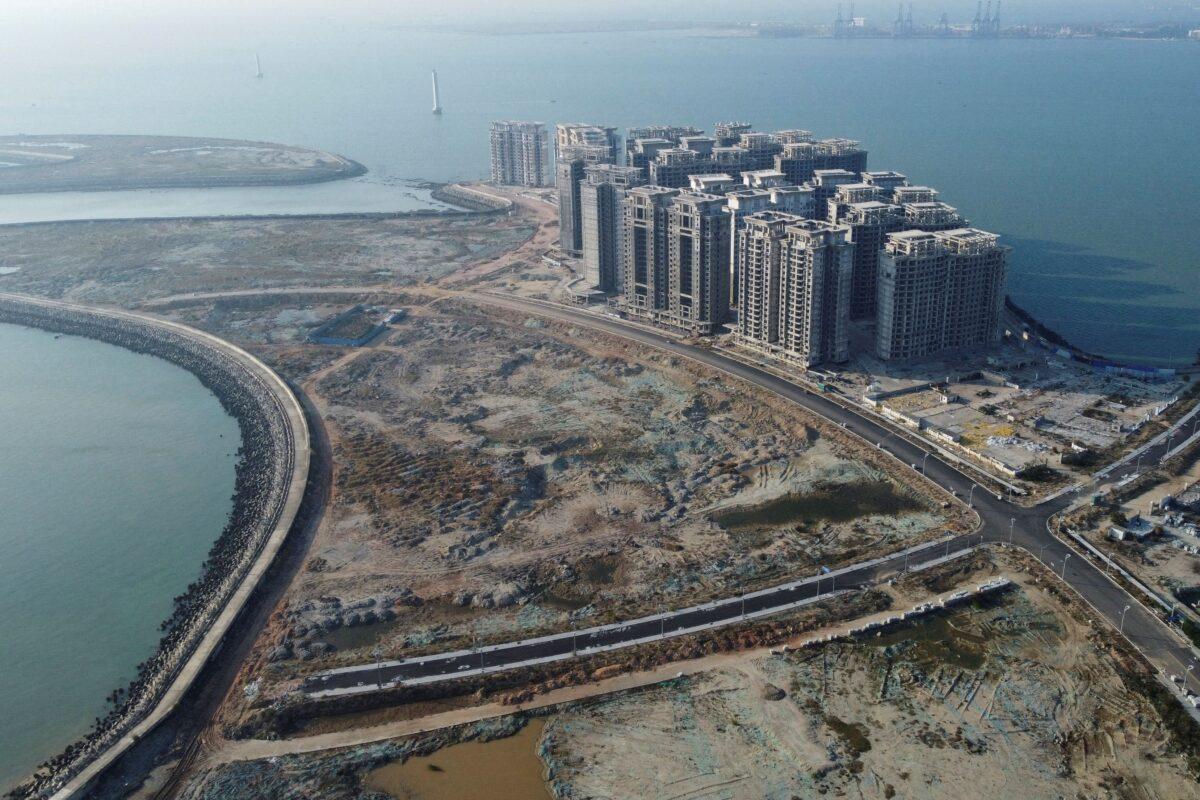
Many residents have complained on social media that the biggest problem after Hainan became an FTP is the high cost of living, which is much higher than in mainland China
“Water costs 6 yuan ($0.86) per ton, electricity costs 1.5 yuan ($0.22) per kilowatt-hour; and then there’s the high cost of fuel and food,” one post read.
Su Xinnian, a senior media professional in Qingdao, Shandong Province, pointed out that the key to a free trade port lies in “connectivity.”
“International experience has long shown that for a free trade zone to truly function, the prerequisite is that capital, goods, rules, and information can connect with the global market without political interference, rather than simply redistributing resources within administrative boundaries,” he told The Epoch Times.
“What we see now, however, is a desolate and almost stagnant scene. Fewer tourists are going to Hainan, local residents are complaining about high prices, and some are even starting to consider leaving the capital Haikou, where they have lived for many years.”
What's Your Reaction?
 Like
0
Like
0
 Dislike
0
Dislike
0
 Love
0
Love
0
 Funny
0
Funny
0
 Wow
0
Wow
0
 Sad
0
Sad
0
 Angry
0
Angry
0
















Comments (0)