

Hong Kong Court Set to Decide Fate of Tiananmen Vigil Leaders in Test of Beijing's Grip
A Hong Kong court is expected to deliver its verdict on Friday against two veteran pro-democracy activists who spent decades organizing the city's Tiananmen Square vigil. Lee Cheuk-yan and Chow Hang-tung face up to ten years in prison under a Beijing-imposed security law that critics say has dismantled Hong Kong's last remaining space for dissent. The case is widely seen as another marker of how far the Chinese Communist Party has moved to erase memory and silence opposition in the former British colony.

.
A Verdict Years in the Making
Lee Cheuk-yan, a 69-year-old former trade unionist, and Chow Hang-tung, a 41-year-old human rights barrister, have been held without bail since September 2021. Their trial, delayed repeatedly, finally opened in January 2026 and wrapped up its closing arguments that May, faster than the court's own 75-day estimate.
Both are charged with "inciting subversion" under the national security law Beijing imposed on Hong Kong in 2020. A conviction carries a maximum ten-year prison term. A panel of three government-vetted judges, rather than a jury, will decide the case — standard practice in national security trials in the city.
A third co-defendant, veteran activist Albert Ho, pleaded guilty when the trial began and is awaiting separate sentencing.
.
The Vigil Beijing Could Not Tolerate
For three decades, Lee and Chow led the Hong Kong Alliance in Support of Patriotic Democratic Movements of China, the group behind the only large-scale public commemoration of the 1989 Tiananmen Square massacre ever permitted on Chinese soil.
On the night of June 3 to 4, 1989, Chinese troops opened fire on unarmed, student-led pro-democracy demonstrators in Beijing, killing hundreds and by some estimates thousands. The event remains one of the most tightly censored topics inside mainland China to this day.
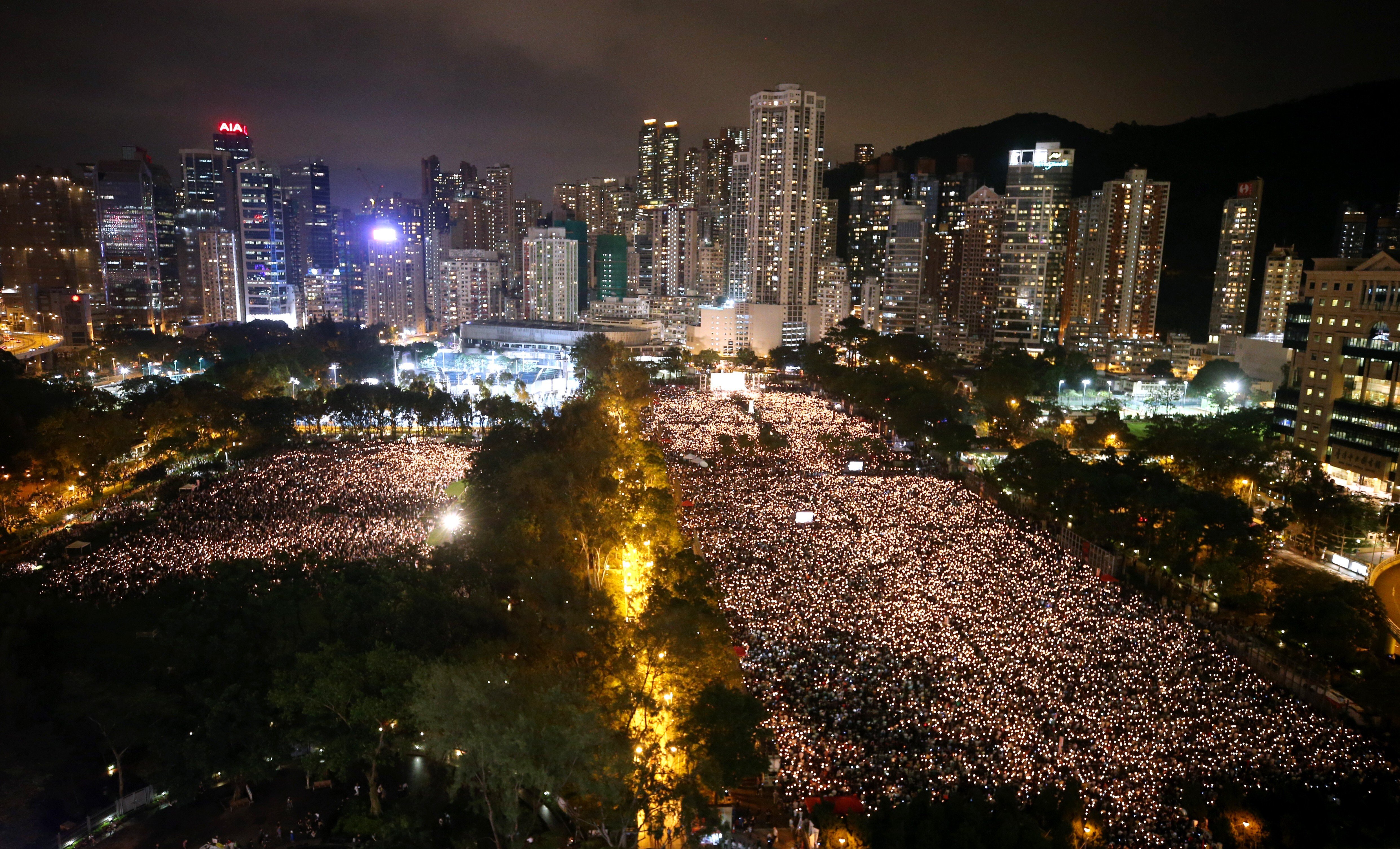
Each year until 2020, tens of thousands of people gathered in Hong Kong's Victoria Park to light candles for the victims — a ritual impossible anywhere else under Communist Party rule. Authorities banned the gathering in 2020, officially citing the coronavirus pandemic. Weeks later, Beijing imposed the national security law that would eventually be used to prosecute the Alliance's leadership. The organization voted to dissolve itself the same month its leaders were charged.
.
"Ending One-Party Rule": The Charge at the Heart of the Case
Prosecutors argue that the Alliance's long-standing call to "end one-party rule" amounted to incitement to overthrow the Communist Party's leadership and China's constitutional order. During closing arguments, a government prosecutor told the court that rights to free speech, assembly and association were not, in his words, absolute guarantees that could override national security law.
The defense rejected that framing entirely. Lawyers for Lee argued the slogan was a call for peaceful democratic reform, not a summons to unlawful action, and that prosecutors never produced evidence the Alliance told anyone to break the law. Chow, representing herself, told the court the case had turned the legal system upside down: seeking accountability was being redefined as subversion, and speaking the truth as incitement. She warned the judges that failing to limit the law's reach could turn the court itself into what she called an accomplice.
.
Rights Groups Call the Trial a Test of What's Left of Hong Kong
International organizations have followed the case closely and repeatedly condemned it. Amnesty International has designated both defendants prisoners of conscience and called the prosecution's legal theory vague and overly broad. The International Trade Union Confederation described the proceedings as another sign of shrinking space for civil liberties and trade union rights in the city, and renewed its call for the pair's release. A group of United Nations human rights experts separately raised formal concerns with Hong Kong authorities over the case in early 2026.
Legal scholars note that "inciting subversion" is the same charge historically used inside mainland China to imprison dissidents, lawyers and intellectuals — including the late Nobel Peace Prize laureate Liu Xiaobo. Analysts say the outcome will show how closely Hong Kong's ostensibly independent judiciary now tracks the party-controlled courts across the border.
The case fits a broader pattern. Hong Kong's most prominent independent publisher, Jimmy Lai, was sentenced to 20 years in prison in December 2025 on national security charges tied to his newspaper's coverage. The U.S. State Department's 2026 Hong Kong Conditions Report concluded that defendants in security-law cases can no longer expect a fair trial in the city.
The pressure extends beyond politics into religious life. According to Freedom House's 2026 assessment of Hong Kong, practitioners of the Falun Dafa spiritual discipline — banned and violently suppressed on the mainland since 1999 — are still able to meditate and hand out literature publicly in the city, one of the few places in China where this remains possible. But the same report documents that these practitioners face regular intimidation and counter-demonstrations from groups with ties to the Communist Party, a reminder of how far Beijing's influence now reaches into civic and spiritual life once protected by Hong Kong's autonomy.
.
What Comes Next
If convicted, Lee and Chow will likely be sentenced at a later hearing rather than on the day of the verdict itself. Given the maximum ten-year penalty and the years both have already spent in pre-trial detention, any sentence is expected to weigh heavily on both the length of proceedings and the court's assessment of their remarks in court.
Whatever the outcome, observers say the symbolism is already clear: the space that once allowed Hong Kong to mourn Tiananmen's victims in public no longer exists, and the people who kept that memory alive for thirty years are the ones now standing trial for it.
.
Sources
- Associated Press – "What to know about the trial of former Tiananmen vigil organizers before a verdict" — https://apnews.com/article/tiananmen-trial-hong-kong-activists-what-to-know-39a3bac8937f44c55bf4cf24b560b540
- Freedom House – "Hong Kong: Freedom in the World 2026 Country Report" — https://freedomhouse.org/country/hong-kong/freedom-world/2026
- Amnesty International USA – "Hong Kong: Activists' Unjust Trial for Peaceful Tiananmen Commemoration Resumes" — https://www.amnestyusa.org/press-releases/hong-kong-activists-unjust-trial-for-peaceful-tiananmen-commemoration-resumes/
- International Trade Union Confederation – "Lee Cheuk-yan: Critical moment for rights and freedoms in Hong Kong as trial concludes" — https://www.ituc-csi.org/lee-cheuk-yan-critical-moment-for-rights
- U.S. Consulate General Hong Kong & Macau – "2026 Hong Kong Policy Act Report" — https://hk.usconsulate.gov/2026hkpar/
- Hong Kong Free Press – "Explainer: What to know about Hong Kong's past Tiananmen commemorations and nat. security trial of vigil leaders" — https://hongkongfp.com/2026/06/04/explainer-what-to-know-about-hong-kongs-past-tiananmen-commemorations-and-nat-security-trial-of-vigil-leaders/
.
What's Your Reaction?
 Like
0
Like
0
 Dislike
0
Dislike
0
 Love
0
Love
0
 Funny
0
Funny
0
 Wow
0
Wow
0
 Sad
0
Sad
0
 Angry
0
Angry
0










Comments (0)