

Masked Men Dump Anti-China Caskets Across Manila, Sparking Diplomatic Standoff
Five caskets bearing anti-China and anti-Communist Party messages appeared overnight in five separate districts of Metro Manila, including one outside the Chinese embassy. Philippine police have launched an investigation, while Beijing has lodged a formal protest calling the display a "political provocation." The incident lands amid already strained relations between the Philippines and China over the South China Sea.

.
A Coordinated Predawn Operation
Philippine police discovered the five wooden caskets scattered across the capital region in the early hours of Friday, August 7. According to the National Capital Region Police Office (NCRPO), the caskets were left in Santa Cruz (Manila), Barangay 54 in Caloocan City, two locations in Quezon City, and along a major avenue in Makati City.
Investigators say masked individuals arrived in white and gray vans between roughly 2 a.m. and 4 a.m. to abandon the caskets before disappearing. Police have secured the caskets and accompanying banners as evidence and are reviewing surveillance footage in an effort to identify those responsible.
One casket was placed directly outside the Chinese embassy in Makati.
.
What the Caskets Said
The banners attached to the caskets combined criticism of the Chinese Communist Party with references to the Communist Party of the Philippines and its armed wing, the New People's Army. Messages included blunt accusations such as "Chinese Communist Party greedy" alongside a Tagalog word for "plague" or "scourge."
One casket displayed photographs of three prominent figures: Chinese President Xi Jinping, Foreign Minister Wang Yi, and China's ambassador to the Philippines, Jing Quan, labeled with the word "greedy."
Police have not identified any group or individual behind the display, and no organization has publicly claimed responsibility.
.
Manila Draws a Line, Beijing Cries Foul
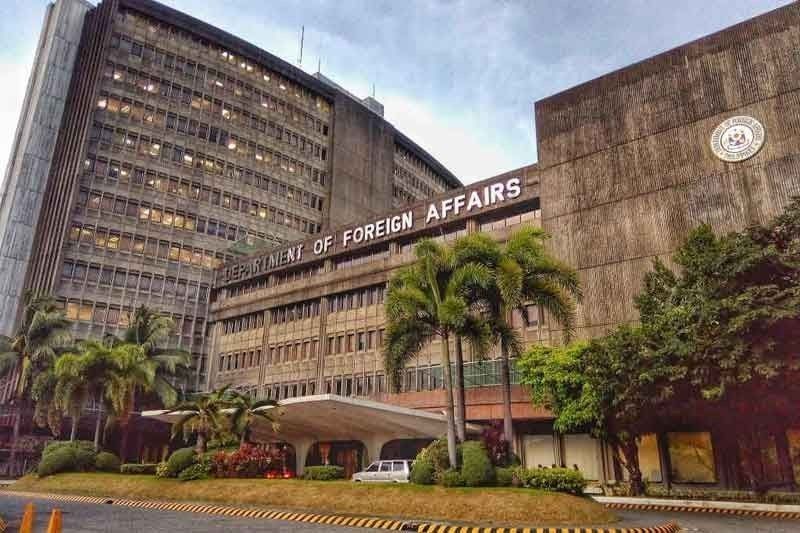
The Philippine Department of Foreign Affairs (DFA) moved quickly to distance the government from the incident while defending the right to political expression. The department said the country does not tolerate threats or acts of violence against any individual, foreign nationals and officials included, citing its obligations under the Vienna Conventions on diplomatic and consular relations.
At the same time, the DFA drew a clear distinction between free speech and intimidation. Freedom of expression, the department stressed, does not extend to threats of violence or actions that put anyone's safety at risk. Officials added that the caskets do not represent how the Philippine government conducts foreign relations, nor how ordinary Filipinos typically voice political grievances.
China's embassy in Manila responded with its own statement, filing what it called a "solemn representation" with the Philippine government. Embassy spokesperson Ji Lingpeng argued the caskets were designed to stir hostility between Filipino and Chinese communities, while insisting the stunt would not shake the broader relationship between the two nations. Beijing has urged Philippine authorities to identify and prosecute those responsible.
.
Backdrop: A Relationship Already Under Strain
The casket incident did not occur in a vacuum. Manila and Beijing have clashed repeatedly in recent years over the South China Sea, where China claims sovereignty over roughly 90 percent of the waters through its so-called nine-dash line — a claim an international tribunal in The Hague rejected in 2016, though Beijing has never accepted that ruling.
Confrontations between Chinese and Philippine vessels near contested reefs and shoals, including Scarborough Shoal and Second Thomas Shoal, have become a recurring flashpoint, fueling public frustration in the Philippines toward Beijing's regional conduct. Against this backdrop, Chinese Communist Party symbolism has increasingly become a target for public anger — anger the Philippine government is now trying to keep separate from actual threats of violence.
.
What Comes Next
The NCRPO has pledged a full investigation, with police stating that criminal charges will be filed once those responsible are identified. For now, the case underscores a broader tension facing Manila: managing legitimate public frustration with Chinese Communist Party policy while avoiding any perception of condoning intimidation against diplomats — at a moment when Philippine-Chinese relations remain fragile over unresolved maritime disputes.
.
Sources
- Reuters – https://www.reuters.com/world/china/philippines-says-it-does-not-condone-threats-violence-after-anti-china-caskets-2026-08-07/
- Philstar.com – https://www.philstar.com/headlines/2026/08/07/2547661/five-caskets-anti-china-anti-communist-messages-dumped-around-metro-manila
- Philippine Daily Inquirer – https://newsinfo.inquirer.net/2279534/police-5-caskets-with-anti-china-anti-cpp-messages-found-across-ncr
- Manila Bulletin – https://mb.com.ph/2026/08/07/authorities-probe-caskets-with-anti-china-anti-rebel-banners-in-metro-manila
.
What's Your Reaction?
 Like
0
Like
0
 Dislike
0
Dislike
0
 Love
0
Love
0
 Funny
0
Funny
0
 Wow
0
Wow
0
 Sad
0
Sad
0
 Angry
0
Angry
0













Comments (0)