

Taiwan's Envoy Skips Nagasaki Memorial After Seating Dispute Reignites China Tensions
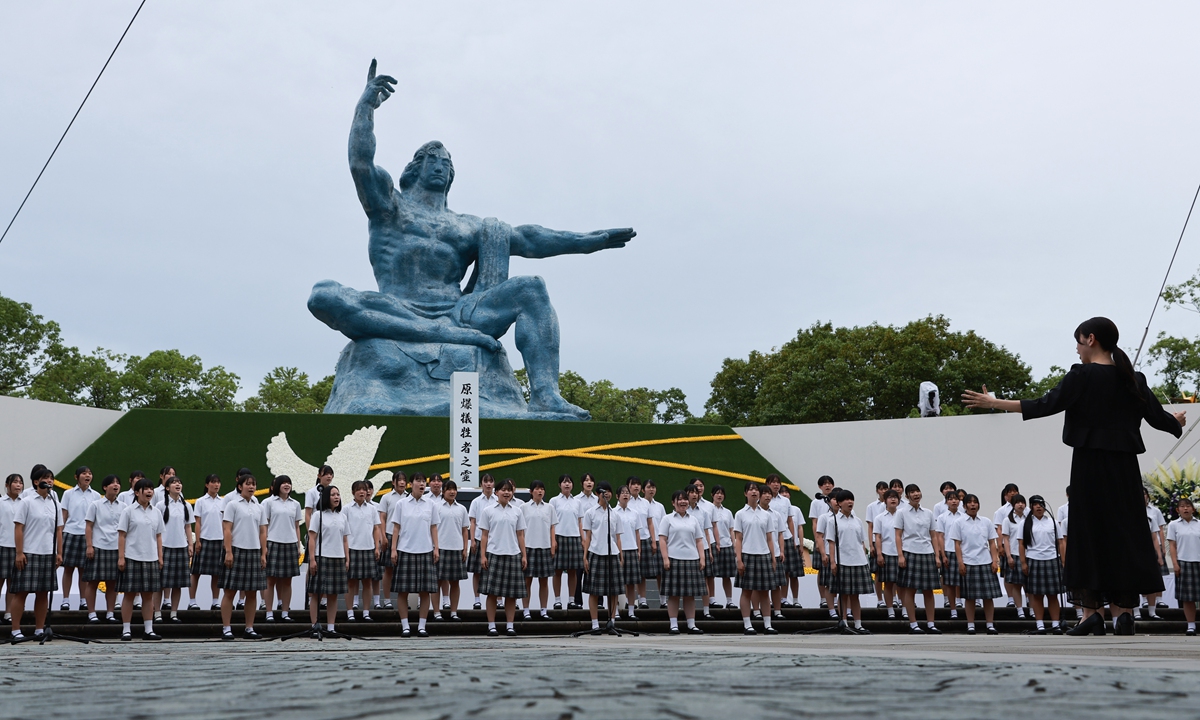
Taiwan's top representative in Japan boycotted this year's Nagasaki atomic bombing memorial after officials seated his delegation among non-diplomatic guests rather than with foreign missions. The snub, which Taipei says reflects Beijing's pressure campaign, comes just days after Taiwan's delegation was welcomed as equals at the Hiroshima ceremony.

.
A Boycott Over Seat Placement
Lee Yi-yang, head of the Taipei Economic and Cultural Representative Office in Tokyo, refused to attend Sunday's ceremony marking the 81st anniversary of the U.S. atomic bombing of Nagasaki. He said the seats assigned to his delegation were not among those reserved for diplomatic missions, but were instead grouped with international non-governmental organizations.
Lee and two deputy representatives stayed away in protest. In their place, Taipei sent a lower-ranked official, Chen Ming-chun, director of the office's Fukuoka branch.
"I think there shouldn't be any discrimination at a place where we pray together for a world without war or nuclear weapons," Chen told Japanese broadcaster Nippon Television.
.
Taipei Accuses Nagasaki of Bowing to Beijing
In a strongly worded statement, Lee's office accused the city of acting as a tool for China's campaign to deny Taiwan's sovereignty. Lee said the arrangement "deliberately denied Taiwan's status as a nation" and disregarded the island's dignity.
He argued that Taiwan has long positioned itself as a peace-committed democracy, in contrast to what he described as China's expanding military and nuclear ambitions in the region. According to Focus Taiwan (CNA), Lee also reiterated Taipei's long-standing position that the Republic of China is a sovereign state that has never been governed by the People's Republic of China.
Nagasaki Mayor Shiro Suzuki rejected the accusation. "We have courteously accommodated their attendance," he told reporters, insisting the city was not bowing to Chinese pressure and calling Taiwan "a partner with strong ties with Nagasaki."
City officials said the seats given to the Taiwanese delegation were part of a section for foreign attendees who could not be fit into the smaller area reserved for ambassadors and senior Japanese officials, according to Japan's Asahi newspaper.
.
A Different Welcome in Hiroshima
The dispute stands in contrast to Lee's experience just days earlier. At the Hiroshima memorial on August 6, he was seated alongside other foreign envoys and treated as an equal, according to his own statement. Some reports noted his delegation was placed near representatives of Paraguay, the Holy See, India and Armenia — countries with formal ties to Taiwan or a history of diplomatic sympathy toward it.
That contrast is central to Taipei's complaint: the same representative received markedly different treatment within a single week, in two cities marking the same historical tragedy.
.
Background: No Formal Ties Since 1972
Japan and China normalized diplomatic relations in 1972, a move that ended Tokyo's official recognition of Taipei. Since then, Japan and Taiwan have maintained close economic and trade relations, but without formal diplomatic status. This is why Taiwanese representatives are generally treated differently from accredited ambassadors at Japanese state functions.
Nagasaki's current invitation policy was shaped by an earlier controversy. In 2024, the ceremony was boycotted by then-U.S. Ambassador Rahm Emanuel and diplomats from five other G7 countries after Israel was left off the guest list amid the Gaza conflict. In response, Nagasaki adopted a policy of inviting any country, region or organization with a diplomatic mission in Japan or at the United Nations — a category that includes North Korea, but not Taiwan.
Because Taiwan does not formally qualify under that policy, its presence at the ceremony has depended on case-by-case accommodation. According to the South China Morning Post, Taiwan's delegation attended for the first time last year, and Lee has said he hopes for an annual presence going forward.
.
Wider Context: Japan-China Relations Under Strain
The seating dispute lands at a sensitive moment for Japan-China relations. Chinese state-affiliated commentary framed Taiwan's complaint as an attempt to seek unearned international status, arguing that Nagasaki's arrangement was consistent with diplomatic norms tied to the one-China principle — underscoring how routine ceremonial details have become entangled in the broader dispute over Taiwan's status.
Lee took up his post in Tokyo in September 2024. Last year, he became the first Taiwanese representative to attend both the Hiroshima and Nagasaki ceremonies, and was given the same seating arrangement in Nagasaki without publicly objecting, saying at the time he wanted to prioritize goodwill.
.
Outlook
Taiwan's government has since lodged a formal protest with Nagasaki, according to Focus Taiwan. Whether the city adjusts its seating policy for future ceremonies remains unclear, but the episode is likely to keep drawing attention to how Japanese municipalities navigate ties with Taiwan without provoking Beijing — particularly as cross-strait tensions and Taiwan-friendly sentiment in parts of Japan's political establishment continue to grow.
.
Sources
- Associated Press — https://apnews.com/article/japan-nagasaki-taiwan-lee-memorial-ceremony-china-19ab601ed82fd0989fc7dd653ad185f4
- Focus Taiwan (CNA) — https://focustaiwan.tw/politics/202608090006
- South China Morning Post — https://www.scmp.com/news/china/diplomacy/article/3321319/china-japan-ties-are-improving-could-taiwanese-official-test-trend
- Taipei Times — https://www.taipeitimes.com/News/front/archives/2026/08/10/2003862219
.
What's Your Reaction?
 Like
0
Like
0
 Dislike
0
Dislike
0
 Love
0
Love
0
 Funny
0
Funny
0
 Wow
0
Wow
0
 Sad
0
Sad
0
 Angry
0
Angry
0














Comments (0)