

As a Rocket Burns Over Hainan, Beijing's Space Fairy Tale Shows Its Cracks
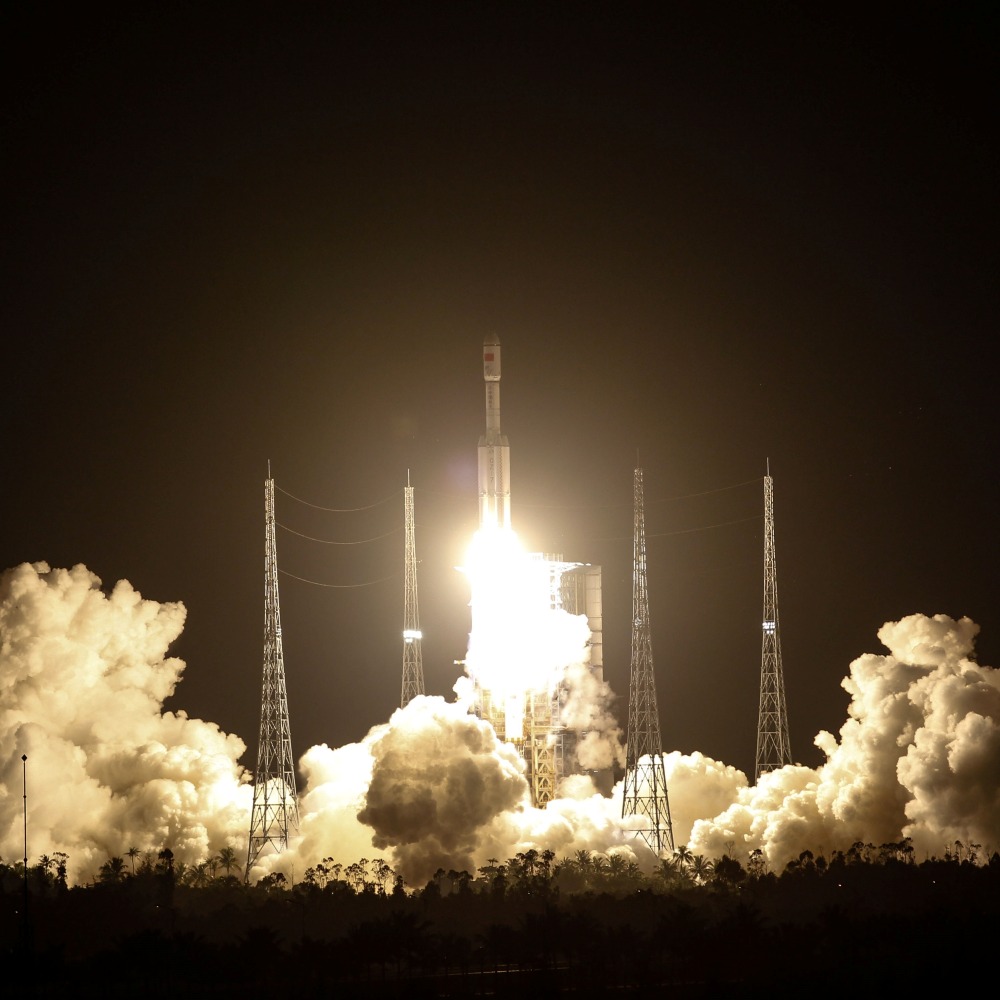
Thousands of tourists cheered as a Chinese rocket lit up the night sky over Hainan island in August 2026 — then watched it explode. The moment captured something larger than a single launch failure: a Communist Party that has turned space spectacle into a substitute for the harder work of earning public trust. Behind the fireworks lies a program built on secrecy, military control, and a decades-old strategy of manufacturing pride to paper over cracks in the Party's legitimacy.

.
A Fireball Over the Beach
On the evening of August 10, thousands of spectators packed the beaches near the Wenchang Space Launch Site on China's southern island of Hainan. Phones raised, they waited for the Long March 7A rocket to light up the sky, carrying the Zhongxing-4B communications satellite toward orbit.
Roughly 85 seconds after liftoff, the rocket broke apart in a fireball, according to footage that circulated widely online. Chinese state media and the state-owned China Aerospace Science and Technology Corporation (CASC) took hours to confirm what onlookers had already filmed.
Many in the crowd kept cheering anyway, apparently unaware anything had gone wrong. The scene captured, in miniature, how thoroughly China's space program has become public entertainment — even when it fails.
.
From Desert Secrecy to Beach Spectacle
For decades, Chinese rocket launches took place far from public view, deep in remote deserts. That has changed. Wenchang, opened in 2016 on a tropical coastline, was designed from the outset to be watched. Tour operators now sell "rocket-viewing" packages, and space imagery has spread into museums, films, art installations and toy franchises across the country.
That shift tracks a broader arc in China's program: crewed spaceflight in 2003, a first spacewalk in 2008, a completed space station by 2022, and the first-ever sample return from the moon's far side. Beijing has set its sights on a crewed lunar landing by 2030 and, eventually, Mars — explicitly framed as a race against the United States.
.
Propaganda by Design
Researchers who study China's space program describe its public role in blunt terms: legitimacy management. A widely cited assessment prepared for the U.S.-China Economic and Security Review Commission notes that the Chinese Communist Party's hold on power now rests less on Marxist ideology than on an informal bargain with its citizens — rising living standards and national pride in exchange for political obedience, and space achievements are marketed as proof the bargain is being kept.
That strategy has roots that predate the space program itself. Two years after the 1989 Tiananmen Square crackdown, the Party launched a nationwide "patriotic education" campaign built around the narrative of China's "century of humiliation" at the hands of foreign powers — casting the Party as the nation's redeemer. Academic research on China's lunar program describes space achievements as a direct extension of that same legitimacy project, engineered above all to shape domestic opinion rather than to impress the outside world.
Under Xi Jinping, Berlin's Mercator Institute for China Studies has noted a further shift: away from the older promise of simply getting rich, and toward patriotism, nationalism and military strength as the new foundation of Party legitimacy.
.
Even Spirituality Wasn't Off-Limits
The reach of this propaganda strategy extends further than rocket launches and museum exhibits. According to research on Chinese Communist Party propaganda imagery, space achievements have even been deployed in materials aimed at Falun Gong practitioners — an attempt to use the prestige of state-sponsored science to paint the peaceful spiritual practice as backward "superstition" and lure adherents back into ideological line.
Falun Gong, known in the West also as Falun Dafa, has faced a sweeping persecution campaign in China since 1999, one that human rights groups have documented for decades. That the Party would reach even for rocket launches as a tool against a meditation practice illustrates how total its ambition for ideological control really is — nothing, not even outer space, is treated as apolitical.
.
A Program Built on Secrecy
Despite the public spectacle, the machinery behind China's rockets remains opaque and firmly under military control. The People's Liberation Army oversees the country's major launch infrastructure, and CASC — the state contractor behind most Chinese rockets — routinely stays silent on failures for hours, or longer.
The August 10 explosion was not an isolated embarrassment. The Long March 7A's very first flight, in 2020, also ended in a mid-air failure. And the YF-100 engine implicated in the latest incident powers a large share of China's active rocket fleet, including the Long March 5 booster slated to carry the Chang'e-7 lunar south pole mission — raising the possibility that one exploding satellite could delay China's broader moon ambitions.
Earlier in 2026, a separate engine failure grounded two rocket families for roughly five months. Analysts have also begun asking whether Beijing's breakneck launch cadence is outrunning its own quality controls.
.
Washington Watches, Too
China's space theater plays out against the backdrop of a revived American effort. Under President Donald Trump, NASA has pushed to return astronauts to the moon by 2028 and establish a permanent base near the lunar south pole, explicitly framed by officials as a contest with Beijing. "America doesn't just compete, we dominate," Trump said after the Artemis II crew's lunar flyby earlier this year, and NASA officials have repeatedly vowed the United States will beat China back to the moon.
Whether Washington can deliver on that timeline given its own budget fights is an open question. But the rhetoric on both sides reflects the same underlying truth: for Beijing and Washington alike, who reaches the moon first is treated as a measure of a political system's legitimacy, not just its engineering.
.
Outlook: Spectacle Has Its Limits
None of this means China's space program isn't real or technically capable — it plainly is. But the events on that Hainan beach are a reminder that the Party's version of progress is inseparable from its need to be seen making progress. A booming firework in the night sky plays well on state television; a silent, hours-long refusal to explain what went wrong does not.
As China's economy slows and youth unemployment remains a persistent worry, the pressure on Beijing to keep manufacturing moments of national pride is unlikely to ease. But spectacle is a fragile substitute for substance — and a regime that increasingly needs rockets to do the work that economic performance and political trust once did may find that the cracks are getting harder to hide, one failed launch at a time.
.
Sources
- Reuters – "In China, rocket launches fuel tourism and space-age dreams" (bereitgestelltes Ausgangsmaterial)
- SCMP – https://www.scmp.com/news/china/military/article/3363574/chinas-long-march-7a-rocket-explodes-after-launch-satellite-lost
- CNN – https://www.cnn.com/2026/08/11/china/china-long-march-rocket-failure-intl-hnk
- Space.com – https://www.space.com/space-exploration/launches-spacecraft/chinese-rocket-explodes-less-than-90-seconds-after-liftoff
- SpaceNews – https://spacenews.com/chinese-long-march-7a-rocket-explodes-shortly-after-liftoff/
- USCC Annual Report, Chapter 2 – https://www.uscc.gov/sites/default/files/Annual_Report/Chapters/Chapter%202,%20Section%202%20-%20China's%20Space%20and%20Counterspace%20Programs.pdf
- Chinese Posters (Stefan Landsberger Collection, academisches Propaganda-Archiv) – https://chineseposters.net/themes/space-program
- The Diplomat – https://thediplomat.com/2025/09/deep-space-deep-strategy-chinas-cosmic-calculus/
- Salon – https://www.salon.com/2026/04/09/trumps-race-to-the-moon-is-about-dominance-over-china-not-discovery/
- Fox News – https://www.foxnews.com/media/nasa-chief-declares-america-absolutely-back-space-race-says-us-beat-china-moon
.
What's Your Reaction?
 Like
0
Like
0
 Dislike
0
Dislike
0
 Love
0
Love
0
 Funny
0
Funny
0
 Wow
0
Wow
0
 Sad
0
Sad
0
 Angry
0
Angry
0












Comments (0)