

How Trump's Tariff Pressure Reshaped Global Manufacturing — One Factory at a Time
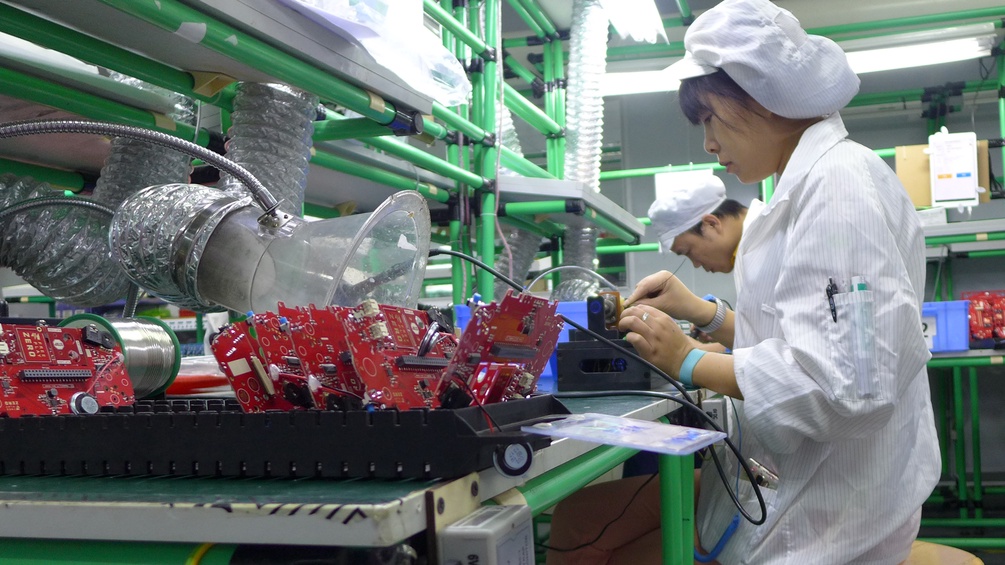
When U.S. President Donald Trump launched his sweeping "Liberation Day" tariffs on April 2, 2025, the goal was clear: force a restructuring of global trade and reduce American dependence on Chinese manufacturing. One year on, the results are more complicated — and more revealing — than either side expected. The story of Agilian Technology, a $30-million-a-year electronics manufacturer in Dongguan, southern China, offers a rare on-the-ground look at how Trump's strategy played out in real time — and why the pressure, while painful, may ultimately be working in ways the headlines miss.

.
A Chinese Electronics Maker's Wild Ride Through Trade War, Rare Earth Warfare, and a Fragile Truce
When U.S. President Donald Trump launched his sweeping "Liberation Day" tariffs on April 2, 2025, the goal was clear: force a restructuring of global trade and reduce American dependence on Chinese manufacturing. One year on, the results are more complicated — and more revealing — than either side expected.
The story of Agilian Technology, a $30-million-a-year electronics manufacturer in Dongguan, southern China, offers a rare on-the-ground look at how Trump's strategy played out in real time — and why the pressure, while painful, may ultimately be working in ways the headlines miss.
Panic, Pileups, and a Factory Floor in Chaos
In the months before Trump's re-election in late 2024, Agilian's American clients were already nervous. They rushed to ship goods to U.S. warehouses before tariffs hit. Storage prices shot up. The factory floor hummed with emergency orders.
Then came the escalation. After Trump took office, two rounds of tariff hikes totaling 20% rattled customers. When a third wave added another 34 percentage points in April 2025, orders froze overnight. Pallets stacked up inside Agilian's 12,000-square-meter facility. "This was a disaster," recalled Fabien Gaussorgues, the company's CEO.
China's Communist Party retaliated — hard. Both sides pushed tariffs above 100%. Trade, for a time, effectively stopped.
Beijing's Hidden Weapon: Rare Earths
What followed exposed a vulnerability that many in Washington had long underestimated. China controls roughly 87% of global rare earth processing and around 94% of permanent magnet manufacturing, according to data from the International Energy Agency. These magnets are critical components in electric vehicles, wind turbines, defense systems, and everyday electronics.
In April 2025, Beijing imposed export controls on seven critical elements and related magnets. The disruption was immediate — Ford's Chicago factory temporarily shut down for weeks in June due to a shortage of rare earth magnets.
By October, China had expanded those controls further, covering 12 of 17 rare earth metals and introducing the strictest export rules to date — including a foreign direct product rule that Beijing had previously condemned when the U.S. used it against Chinese semiconductor firms.
China's new rules required foreign companies to obtain Chinese government approval to export any product containing more than 0.1 percent rare earths by weight — giving Beijing a powerful tracing tool and a lever for future restrictions.
One trade consultant put it bluntly: China had turned rare earths into a "nuclear weapon of trade."
Trump's Strategy Forces a Deal
This is where Trump's approach produced results his critics rarely acknowledge. The pressure — and Beijing's retaliatory overreach — brought both sides to the table.
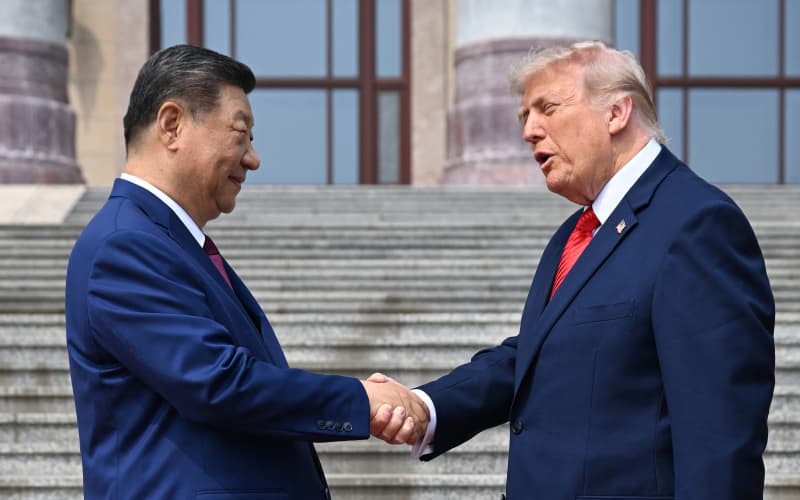
Following a Trump-Xi meeting in late October 2025, China officially suspended its latest round of rare earth export controls for one year, as part of a broader agreement to roll back a range of tariffs and trade barriers.
Washington and Beijing had previously reached a new trade framework in June 2025 following talks in London, with China agreeing to gradually restart rare earth export licenses.
For Agilian and thousands of similar manufacturers, the October deal was a turning point. Orders unfroze. The second half of 2025 became the company's busiest ever, with production hours rising 29% compared to the first half of the year.
The Offshoring Experiment — and Its Limits
Throughout the chaos, Agilian tried to hedge its bets. It set up an entity in India and partnered with a factory in Malaysia — both seen as safer, tariff-free alternatives. The reality proved humbling.
"India takes time," Gaussorgues said. "It took us one year to have the official company." Meanwhile, a 50% tariff hike on India announced in August 2025 — Trump's pressure on New Delhi to stop buying Russian oil — made that backup option even less attractive.
The Malaysia venture revealed a different problem: "everything takes way, way longer" than in China, the team found. U.S.-based production looked even worse, with incomplete supply chains and high labor costs making it uncompetitive.
By early 2026, Agilian's factory was operating at nearly full capacity. "It's back to the situation where it's like tariffs don't exist," said Renaud Anjoran, the company's vice-president. "American customers are not thinking of buying from other places."
The Bigger Picture: Did Trump's Tariffs Work?
Trump's tariffs were designed to reduce America's trade deficit with China and revive domestic manufacturing. The results are mixed — but not without strategic wins.
The U.S. goods and services deficit came in at $901.5 billion for 2025, barely changed from $903.5 billion in 2024. The deficit with China did narrow — to its smallest level in over two decades — but much of it simply migrated to Vietnam and Taiwan.
A Bloomberg analysis found that Vietnam's manufacturing surge, while real, was largely a pass-through: Foxconn, for example, imported billions in Chinese components and generated only a fraction of final product value locally.
Yet the tariffs achieved something arguably more important: they forced Beijing to reveal — and then partially retreat from — its rare earth leverage, exposing a strategic vulnerability that Washington is now actively working to address. The U.S. Department of Defense committed $400 million to domestic rare earth production. Deals with Australia and other allies are in progress.
Experts caution that breaking China's dominance over rare earths is likely to take at least a decade, even with sustained investment and political will. But the process has started — and Trump's pressure accelerated it.
What Comes Next
Trump is expected to visit China in May 2026. Expectations are modest. Analysts suggest the most likely outcome is a pledge to keep talking and a framework to prevent tariff wars from boiling over again.
Gaussorgues, back in Dongguan, is cautiously optimistic. He hopes to grow Agilian's revenue 30% over the next three years. But he's keeping his Malaysia and India operations running — "as an insurance policy," he says.
The trade war didn't collapse Chinese manufacturing. But it forced a reckoning that neither side can fully ignore. Supply chains are shifting, dependencies are being exposed, and the rules of global trade are being rewritten — one tariff at a time.
.
Sources
- CNBC — A year into Trump tariffs, Chinese factories and ports are buzzing with activity (February 12, 2026): https://www.cnbc.com/2026/02/12/trump-tariffs-cny-chinese-factories-and-ports-are-buzzing-with-activity.html
- Bloomberg — How Trump's Tariffs Altered Global Supply Chains in Unintended Ways (March 31, 2026): https://www.bloomberg.com/graphics/2026-vietnam-trump-tariffs-supply-chain/
- Center for Strategic and International Studies (CSIS) — China's New Rare Earth and Magnet Restrictions Threaten U.S. Defense Supply Chains (October 14, 2025): https://www.csis.org/analysis/chinas-new-rare-earth-and-magnet-restrictions-threaten-us-defense-supply-chains
- International Energy Agency (IEA) — With new export controls on critical minerals, supply concentration risks become reality (2025): https://www.iea.org/commentaries/with-new-export-controls-on-critical-minerals-supply-concentration-risks-become-reality
- Al Jazeera — Despite US push, China poised to dominate rare earths for years (October 21, 2025): https://www.aljazeera.com/economy/2025/10/21/despite-us-push-china-poised-to-dominate-rare-earths-for-years
- China Briefing — China's Rare Earth Export Controls — Impact on Businesses and Industries (November 2025): https://www.china-briefing.com/news/chinas-rare-earth-export-controls-impacts-on-businesses/
- Euronews — The biggest winners and losers of the tariff war (March 26, 2026): https://www.euronews.com/business/2026/03/26/the-biggest-winners-and-losers-of-the-tariff-war-as-ai-related-trade-skyrockets
- Council on Foreign Relations — Leapfrogging China's Critical Minerals Dominance (February 4, 2026): https://www.cfr.org/reports/leapfrogging-chinas-critical-minerals-dominance
.
What's Your Reaction?
 Like
0
Like
0
 Dislike
0
Dislike
0
 Love
0
Love
0
 Funny
0
Funny
0
 Wow
0
Wow
0
 Sad
0
Sad
0
 Angry
0
Angry
0











Comments (0)