

Flag Wars at Sea: China and the Philippines Clash Again Over Disputed Sandbar
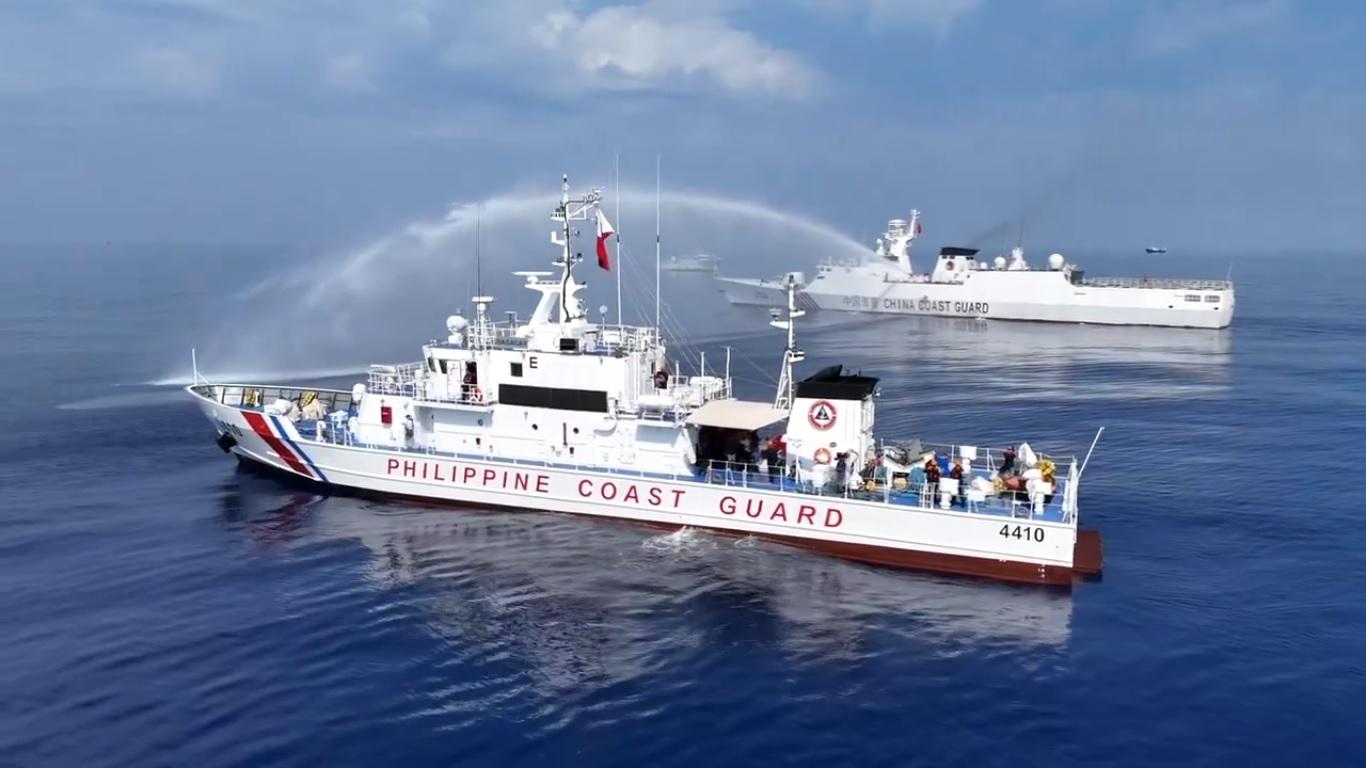
A tiny, uninhabited sandbar in the South China Sea has once again become the center of a tense standoff between China and the Philippines. On Sunday, both sides accused each other of illegal incursions near Sandy Cay — a dispute that reflects a much larger and increasingly dangerous territorial conflict.

.
A Remote Sandbar, A Powder Keg
Sandy Cay is not much to look at. A cluster of three small sandbars in the Spratly Islands, it sits near a Philippine military outpost on Thitu Island — known in the Philippines as Pag-asa Island. No one permanently lives there. But on Sunday, May 3, 2026, it became the latest flashpoint in one of Asia's most volatile territorial disputes.
China's coast guard announced it had identified five Philippine nationals who had landed on the reef, calling the move "illegal" in a report carried by state-run media. Beijing did not specify what action, if any, its forces had taken in response.
Manila told a different story. A Philippine civil society group called Atin Ito, led by Akbayan Representative Dadah Kiram Ismula, landed on Sandy Cay at dawn as part of what it described as its fourth civilian mission to the area. The group planted the Philippine flag on the sandbar, calling it "a peaceful act of resistance" against Chinese aggression. The Armed Forces of the Philippines publicly backed the mission.
Both Sides Claim the Other Has No Right to Be There
The competing flag-plantings are only part of Sunday's confrontation. A Philippine coast guard spokesman also announced that Manila had identified four Chinese vessels allegedly conducting unauthorized research inside Philippine waters. Manila threatened to deploy both aircraft and ships to intercept them.
The Atin Ito mission departed from Pag-asa Island at 5:40 a.m., with Representative Ismula declaring: "The West Philippine Sea is ours. No amount of intimidation can erase that fact."
China's foreign ministry and the Philippine embassy in Beijing did not respond to requests for comment on the day's events.
Why Sandy Cay Matters
Sandy Cay carries strategic weight far beyond its size. Its 12-nautical-mile territorial zone under international law overlaps with the area around Thitu Island, a key site for Manila to monitor Chinese activity in the Philippines' exclusive economic zone.
China relies on expansive historical claims — known as the nine-dash and ten-dash lines — to assert sovereignty over nearly the entire South China Sea, a stance that conflicts with the United Nations Convention on the Law of the Sea (UNCLOS), which the Philippines and Vietnam both adhere to.
In 2016, an international arbitration court at The Hague ruled decisively in favor of the Philippines, declaring China's sweeping claims legally invalid. Beijing refused to recognize the ruling and has since continued — and intensified — its maritime operations in the region.
A Pattern of Escalation
Sunday's confrontation is not an isolated incident. It follows weeks of mounting tension specifically over Sandy Cay.
Chinese coast guard officials had previously landed on Sandy Cay, conducting what Beijing described as "maritime control" and "sovereign jurisdiction" — a move Philippine officials swiftly rejected as a provocation.
Throughout 2025, China expanded its coast guard deployments and island-building activities across the South China Sea, while the United States deepened its military engagement with the Philippines — prompting Beijing to send additional naval assets, including aircraft carriers, to the region.
The United States holds a mutual defense treaty with the Philippines dating back to 1951, and in 2026 is conducting over 500 military exercises with its Philippine counterparts — a number that underscores Washington's commitment to deterring further Chinese encroachment.
The U.S. Factor
The standoff poses a direct question to the Trump administration: how far will Washington go to back its treaty ally? U.S. Defense Secretary Pete Hegseth visited Manila in March and vowed to enhance America's military alliance with the Philippines to "reestablish deterrence" and counter what he called "China's aggression" in the Indo-Pacific.
Analysts warn that in a worst-case scenario, China's increasingly confrontational approach risks an accident or miscalculation that could cost lives — and potentially trigger the Philippines to invoke its mutual defense treaty with the United States.
No End in Sight for the Dispute
At a diplomatic level, the Philippines — as 2026 chair of ASEAN (the Association of Southeast Asian Nations) — has been pushing for a binding Code of Conduct in the South China Sea. But analysts at Chatham House assess that given the frequency of confrontations at sea and the depth of mistrust, a successful conclusion to negotiations under Philippine leadership is unlikely.
China's "nine-dash line" claims overlap with those of five ASEAN member states, but Beijing's conduct weighs most heavily on Manila, and talks on a code of conduct have dragged on for decades.
For now, the flags planted on a tiny sandbar tell the story clearly enough: neither Beijing nor Manila intends to back down.
Sources
- Reuters – China, Philippines trade accusations over South China Sea (May 3, 2026): https://www.reuters.com/world/china/china-philippines-trade-accusations-over-south-china-sea-2026-05-03/
- GMA News – PH civilian mission plants flag on Pagasa Cay 2 (May 3, 2026): https://www.gmanetwork.com/news/topstories/nation/986206/ph-civilian-mission-plants-ph-flag-on-pagasa-cay-2-amid-chinese-vessels-presence/story/
- Radio Free Asia – China, Philippines raise rival flags on disputed sandbank: https://www.rfa.org/english/southchinasea/2025/04/28/china-philippines-south-china-sea-flag/
- East Asia Forum – Drifting through dispute in the South China Sea (Feb. 2026): https://eastasiaforum.org/2026/02/27/drifting-through-dispute-in-the-south-china-sea/
- Chatham House – South China Sea agreement unlikely in 2026 (Dec. 2025): https://www.chathamhouse.org/2025/12/philippines-asean-chair-south-china-sea-agreement-unlikely-be-concluded-2026
- SAIS Review – A Calm Before the Storm: South China Sea Powder Keg (Mar. 2026): https://saisreview.sais.jhu.edu/a-calm-before-the-storm-south-china-sea-powder-keg/
- CNN – Sandy Cay: China and Philippines unfurl competing flags (Apr. 2025): https://www.cnn.com/2025/04/28/asia/china-philippines-sandy-cave-dispute-intl-hnk
.
What's Your Reaction?
 Like
2
Like
2
 Dislike
0
Dislike
0
 Love
0
Love
0
 Funny
0
Funny
0
 Wow
2
Wow
2
 Sad
0
Sad
0
 Angry
0
Angry
0











Comments (0)