

Beijing's Double Pressure Play: How China Is Loading the Gun Before the Trump-Xi Summit
With President Trump set to visit Beijing on May 14–15, China is simultaneously tightening its economic grip on foreign companies and pushing its Taiwan agenda to the top of the summit table. Washington has so far responded with unusual silence — a posture analysts warn Beijing could read as weakness.


.
Two Fronts, One Strategy
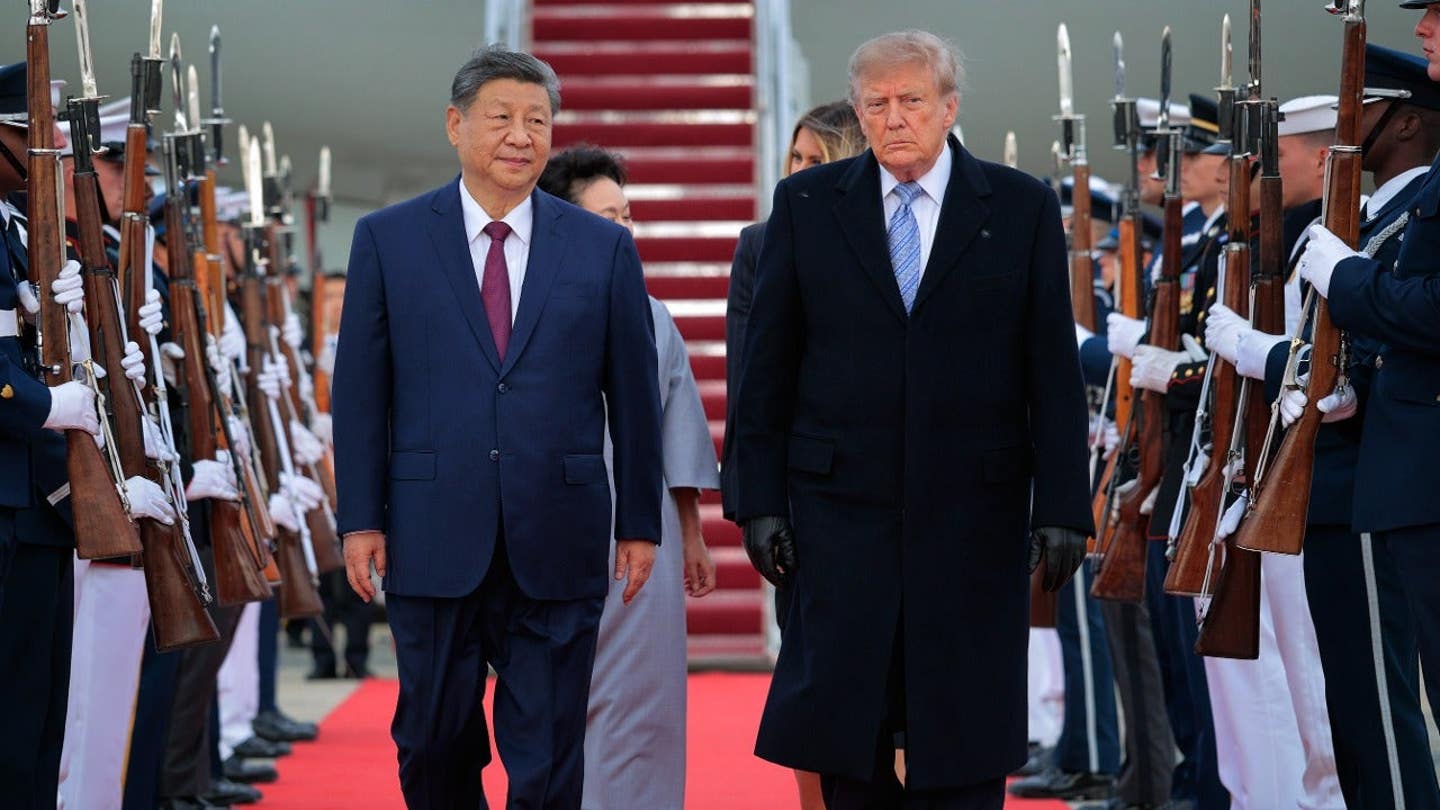
When Donald Trump lands in Beijing next month for his first visit to China as a sitting president in nearly a decade, he will walk into a carefully constructed environment. The Chinese Communist Party (CCP) has spent the weeks ahead of the summit quietly building pressure on two fronts — economic and geopolitical — while Washington has kept conspicuously quiet.
The pattern is deliberate, analysts say. Beijing is testing how much it can extract from a U.S. administration that, for now, appears more interested in preserving a fragile trade truce than in pushing back.
China's New Economic Weapon
On April 7, 2026, China's State Council published what legal experts are calling the country's most sweeping supply chain legislation to date. The new regulations — formally titled the Provisions on the Security of Industrial Chains and Supply Chains — grant Beijing broad authority to investigate and punish foreign companies that are seen as undermining China's role in global supply networks.
The rules took effect immediately, with no transition period.
In plain terms: any foreign business that tries to reduce its dependence on Chinese suppliers — what the Trump administration calls "derisking" — could now face investigation, investment bans, import and export restrictions, and even travel bans on individual employees.
Legal analysts at Morgan Lewis describe the regulations as a "national security–driven regulatory framework" that elevates existing trade tools into a unified and far more powerful instrument. Squire Patton Boggs, in an assessment of the rules, notes that the legislation is best understood not as a reactive measure but as the culmination of a strategy Beijing has been building since at least 2020 — steadily tightening its grip as U.S. export controls and tariffs intensified.
A second set of Chinese rules published shortly after targets foreign firms that comply with U.S. sanctions or export controls — which Beijing labels "unjustified extraterritorial jurisdiction." Together, the two regulatory packages give Beijing new leverage to punish companies that follow Washington's own trade policies.
Washington's Uncomfortable Silence
The Trump administration has built its economic strategy around reducing reliance on Chinese goods and reclaiming "sovereignty" in critical industries — semiconductors, critical minerals, pharmaceuticals. Beijing's new rules directly undercut that goal.
Yet the White House has said almost nothing.
When Reuters asked the White House for comment, a spokesman offered only a general statement that the administration would continue to use "every bit of America's economic might" to protect national and economic security. The Treasury Department and the Office of the U.S. Trade Representative did not respond at all.
Industry groups have been less restrained. The American Chamber of Commerce in China has warned that the rules give Beijing a powerful tool: China can quietly reduce purchases from foreign firms with little accountability, while foreign companies face regulatory risk for doing the same.
"Washington's response so far has been silence. That risks signaling weakness," said Craig Singleton of the Foundation for Defense of Democracies, a Washington think tank. He added that leaving the rules unaddressed could normalize supply chain coercion and accelerate Beijing's ability to lock foreign companies into long-term dependence.
U.S. industry sources told Reuters the administration had been briefed on the regulations — but offered no clear stance in response, staying in what one source described as "listening mode." Another compared the Chinese measures to "loading the gun without firing it," suggesting the Trump team is reluctant to provoke a confrontation ahead of the Beijing summit.
Taiwan: The Real Prize
While the economic pressure has largely flown under the radar, Beijing's Taiwan agenda is more openly declared — and potentially more consequential.
Xi Jinping has made clear that Taiwan will be the centerpiece of his agenda when Trump arrives. This is a significant shift from their last meeting in Busan, South Korea, where Xi deliberately set Taiwan aside to focus on reaching a trade truce.
Not this time.
China's Foreign Ministry has described Taiwan as the "core of core interests" in the bilateral relationship. Beijing's key demand is procedural but symbolically enormous: it wants Washington to change a single phrase in its official language on Taiwan — from "the U.S. does not support Taiwan independence" to the stronger "the U.S. opposes Taiwan independence." The distinction matters enormously in diplomatic terms, and Beijing has been pressing this point at working-level meetings throughout the summit preparations.
The U.S. has so far declined to make the change. But analysts at The Diplomat warn that even ambiguous language from Trump during the summit could shift Beijing's strategic calculations — and rattle Taiwan, Japan, and other U.S. allies in the region.
Taiwan's own officials are watching with alarm. "We will be watching whether the U.S. makes any changes to its position on Taiwan Strait issues as a result of that meeting," said Shen Yu-chung, a deputy minister at Taiwan's Mainland Affairs Council. Taiwan's foreign ministry has noted that the Trump administration has repeatedly reaffirmed its support for the island since taking office.
What Beijing Is Really Playing For
The Trump administration has, in fact, significantly increased arms sales to Taiwan in its second term — reportedly more than the entire Biden presidency combined. Former Trump adviser Robert O'Brien has stated flatly that Trump will not become "the first American president to lose Taiwan."
But Beijing is not necessarily expecting a dramatic reversal. Analysts at The Diplomat and Foreign Policy suggest China's goals are more incremental: delay arms sales, soften U.S. rhetoric, and frame Taiwan as an internal Chinese matter — not one for Washington to weigh in on.
Xi also met with the chairman of Taiwan's main opposition party, the KMT, on April 10 — the 47th anniversary of the U.S. signing of the Taiwan Relations Act. The timing was not accidental. The message: cross-strait peace can be managed between Chinese parties, without U.S. involvement.
The strategic stakes extend beyond diplomacy. Taiwan is home to advanced radar stations and intelligence-gathering posts that the U.S. quietly relies on to monitor Chinese military activity. Losing influence over Taiwan, one Western security official noted, would mean losing one of Washington's best windows into what Beijing is doing militarily.
The Stakes for Trump — and Everyone Else
Trump's visit will be the first by a U.S. president to Beijing since Trump himself went in 2017. The relationship has been through a great deal since then: a trade war, a pandemic, a spy balloon, and multiple crises in the Taiwan Strait.
Foreign Policy, citing a database of U.S.-China presidential interactions, notes that leader-level contact between Washington and Beijing has dropped sharply this decade — averaging 2.5 exchanges per year, compared to 4.6 in the 2010s. The summit is a chance to re-establish some basic operating rules for a relationship defined by strategic competition.
But the lead-up suggests Beijing is entering the room with considerable confidence. New economic rules designed to trap foreign companies. A Taiwan demand that tests American resolve. And a White House that, at least publicly, is holding its fire.
"China is clearly in a much more emboldened position," said Reva Goujon, geopolitical strategist at Rhodium Group.
Whether Trump chooses to push back — or offer concessions in exchange for trade wins — will define not just the summit, but the broader trajectory of U.S. policy in Asia for years to come.
.
Sources:
- Reuters – "White House quiet as China ramps up trade leverage before Trump-Xi summit" (April 30, 2026): https://www.reuters.com/world/china/white-house-quiet-china-ramps-up-trade-leverage-before-trump-xi-summit-2026-04-30/
- Reuters – "Taiwan tops Beijing's agenda for Trump-Xi summit" (April 29, 2026): https://www.reuters.com/world/china/taiwan-tops-beijings-agenda-trump-xi-summit-2026-04-29/
- Morgan Lewis – "China Enacts First Comprehensive Regulations on Industrial and Supply Chain Security" (April 2026): https://www.morganlewis.com/pubs/2026/04/china-enacts-first-comprehensive-regulations-on-industrial-and-supply-chain-security
- Squire Patton Boggs – "China's New Supply Chain Security Regime" (April 2026): https://www.squirepattonboggs.com/insights/publications/china-s-new-supply-chain-security-regime/
- The Diplomat – "China's Taiwan Calculus Ahead of the Trump-Xi Summit" (April 2026): https://thediplomat.com/2026/04/chinas-taiwan-calculus-ahead-of-the-trump-xi-summit/
- Foreign Policy – "Lessons for the Trump-Xi Meeting From 5 Decades of U.S.-China Summits" (April 27, 2026): https://foreignpolicy.com/2026/04/27/trump-xi-summit-us-china-trade-deal-taiwan-geopolitics/
- Taipei Times – "Taiwan fears it will be 'on menu' of Trump-Xi meet" (April 26, 2026): https://www.taipeitimes.com/News/taiwan/archives/2026/04/26/2003856264
.
What's Your Reaction?
 Like
0
Like
0
 Dislike
0
Dislike
0
 Love
0
Love
0
 Funny
0
Funny
0
 Wow
0
Wow
0
 Sad
0
Sad
0
 Angry
0
Angry
0













Comments (0)