

Taiwan's President Defies Beijing — and Makes It to Eswatini Anyway
Taiwan's President Lai Ching-te completed a surprise visit to Eswatini after China had previously blocked his aircraft from flying there. Beijing responded with unusually sharp language, calling Lai a "rat." The episode highlights a growing Chinese strategy to isolate Taiwan diplomatically — and Taiwan's determination to push back.

.
A Trip No One Announced — Until It Was Done
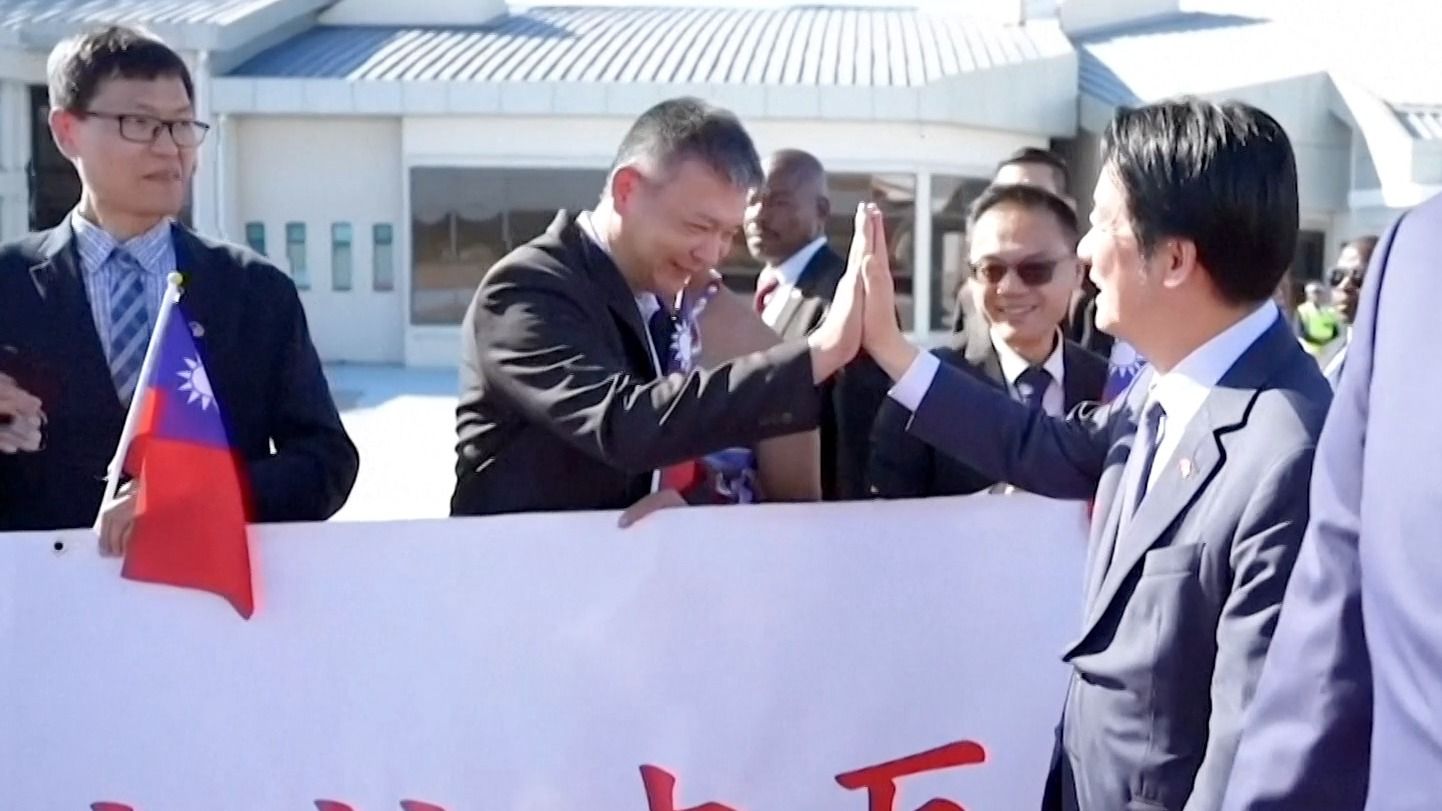
Taiwan's President Lai Ching-te arrived in the small southern African kingdom of Eswatini on Saturday, May 3, 2026 — quietly, without prior announcement, and aboard an Eswatini government aircraft. Only after landing did Lai post about the visit on his Facebook and X accounts, sharing a photo of himself stepping off the plane.
The low-key arrival was no accident. A senior Taiwan security official explained that the "arrive then announce" model is now standard practice in sensitive diplomatic missions, designed to minimize what he called "uncertain risks of potential interference from external forces."
Those risks are very real. Just two weeks earlier, Lai had been forced to cancel the exact same trip.
How China Blocked the First Attempt
In late April, Taiwan announced that the Seychelles, Mauritius, and Madagascar had revoked overflight permits for Lai's presidential aircraft — permits that had already been granted. Taiwan's government placed the blame squarely on Beijing, accusing China of pressuring the three Indian Ocean nations to shut their airspace.
It was a historic first: no Taiwan president had ever had an entire foreign trip cancelled due to denied airspace access. The incident drew sharp criticism from the United States and expressions of concern from the European Union, the United Kingdom, France, and Germany.
Analysts noted it appeared to represent a new and more aggressive Chinese strategy — not just blocking diplomatic ties, but physically impeding Taiwan's head of state from traveling to allied nations.
Eswatini: A Rare and Loyal Ally
Eswatini, the small landlocked monarchy formerly known as Swaziland with a population of around 1.3 million, is one of only 12 states worldwide that maintain formal diplomatic relations with Taiwan. The group consists mostly of small nations in Latin America, the Caribbean, and the Pacific.
For Taiwan's government, keeping these relationships alive is a top diplomatic priority. Each ally represents a foothold in international legitimacy — and China has spent years pressuring countries to switch recognition from Taipei to Beijing.
The visit to Eswatini was timed around the 40th anniversary celebrations of King Mswati III's reign. In his address to the king, Lai was unambiguous about what the trip represented.
"The Republic of China, Taiwan, is a sovereign nation," Lai said, using Taiwan's official name. "The 23 million people of Taiwan have the right to engage with the world, and no country has the right — nor should any country attempt — to prevent Taiwan from contributing to the world."
Beijing Fires Back — With Unusual Venom
China's response was swift and strikingly personal. The Taiwan Affairs Office in Beijing accused Lai of having "skulked" his way to Eswatini, with a spokesperson stating that his "despicable conduct — like a rat scurrying across the street — will inevitably be met with ridicule by the international community."
China's Foreign Ministry added that Lai had "secretly slipped aboard a foreign aircraft and sneaked out of Taiwan, lavishly squandering public funds." It reiterated Beijing's standard position that Taiwan is part of Chinese territory and that any diplomatic engagement by Taipei is illegitimate.
Taiwan's Mainland Affairs Council — the body responsible for China policy — was not impressed. It dismissed Beijing's statement as "fishwife's gutter talk" and made clear that Lai did not require Beijing's permission to travel anywhere.
A Broader Pattern of Pressure
The confrontation over Eswatini fits into a wider picture of intensifying Chinese pressure on Taiwan's international space. Beijing has long sought to shrink Taiwan's diplomatic circle, successfully convincing several countries in recent years to switch recognition. The number of Taiwan's formal allies has dropped significantly over the past decade.
The airspace denial tactic, if repeated, could set a troubling precedent — effectively giving Beijing veto power over where Taiwan's president can travel, by leaning on third countries to close their skies.
Lai, for his part, showed no sign of backing down. "Taiwan will never be deterred by external pressures," he wrote on X after arriving. "Our resolve and commitment are underpinned by the understanding that Taiwan will continue to engage with the world — no matter the challenges faced."
.
Sources
- Reuters – "Taiwan president arrives in Eswatini after blaming China for cancellation of prior trip" (May 2, 2026): https://www.reuters.com/world/china/taiwan-president-arrives-eswatini-after-blaming-china-cancellation-prior-trip-2026-05-02/
- Reuters – "Taiwan president defiant as begins Eswatini trip; China calls him a 'rat'" (May 3, 2026): https://www.reuters.com/world/china/taiwan-president-defiant-begins-eswatini-trip-china-calls-him-rat-2026-05-03/
- Reuters – "China praises countries that blocked Taiwan overflight in Africa" (April 22, 2026): https://www.reuters.com/world/china/china-praises-countries-that-blocked-taiwan-overflight-africa-2026-04-22/
- Reuters – "Taiwan president cancels Eswatini trip, blames Chinese pressure on African countries" (April 21, 2026): https://www.reuters.com/world/china/taiwan-president-cancels-eswatini-trip-blames-chinese-pressure-african-countries-2026-04-21/
- Reuters – "Taiwan's 12 remaining diplomatic allies" (May 2, 2026): https://www.reuters.com/world/china/taiwans-12-remaining-diplomatic-allies-2026-05-02/
.
What's Your Reaction?
 Like
0
Like
0
 Dislike
0
Dislike
0
 Love
0
Love
0
 Funny
0
Funny
0
 Wow
0
Wow
0
 Sad
0
Sad
0
 Angry
0
Angry
0












Comments (0)