.
Commentary
Slovenia, a European Union member, is drawing closer to the regime in China. On Nov. 11, the president of the National Council of Slovenia, Marko Lotric, gave an
interview to China’s state-controlled media, according to which he supported “Slovenia’s economic cooperation with China.”
I visited Slovenia’s beautiful and friendly capital city, Ljubljana, last year. So I was saddened to read that it is apparently being lured by not only China’s media but by easy money from Beijing. About two weeks before Lotric’s interview, the Financial Times reported that Slovenia plans to become one of the few countries to borrow in Chinese yuan, or renminbi, on international markets. Most national debt issuances are in hard currencies such as the dollar, euro, pound, or yen, all of which originate in democracies.
But Slovenia’s plan is undermining this hard-won advantage of democracies. Slovenian Finance Minister Klemen Bostjancic wants Slovenia to borrow
$700 million worth of what is known as “panda bonds.” Beijing welcomes the issuance of such bonds, as anything borrowed in yuan is a bet on China’s economy.
“We increased bilateral meetings with Chinese officials because we cannot wait,” Bostjancic told the Financial Times. “We have to protect our own interests.”
What about the rest of the world that Slovenia claims to care so much about?
Slovenian President Natasa Pirc Musar met with Chinese Foreign Minister Wang Yi on Sept. 13. Much of what she says about international politics fits with Chinese Communist Party (CCP) talking points. According to Chinese state media, Musar
said that “Slovenia highly commends China, as a responsible major country, for adhering to multilateralism and setting an example for the international community.”
Really?
.
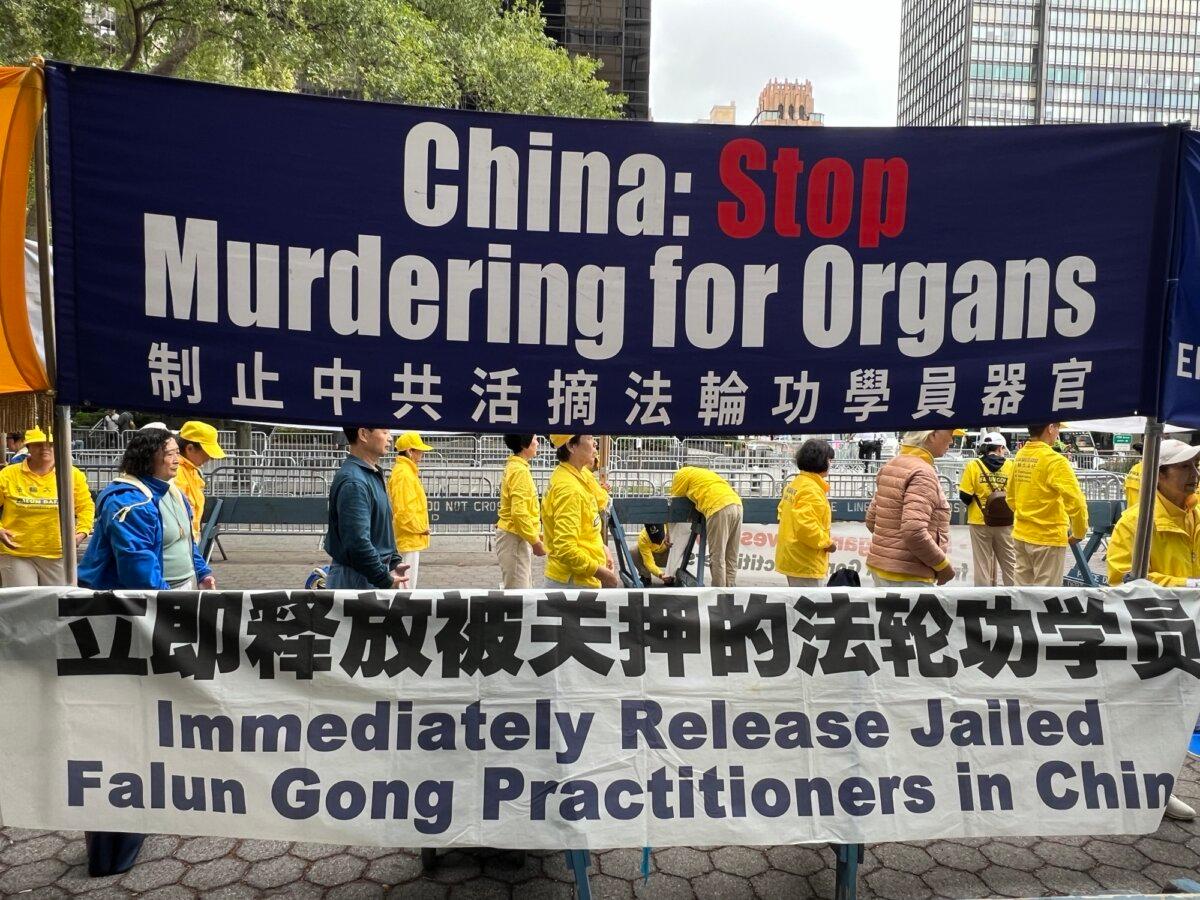
Falun Gong practitioners gather in front of the U.N. headquarters during the annual general assembly meeting, protesting the Chinese Communist Party's ongoing persecution of Falun Gong and the regime's human rights abuses, in New York City on Sept. 25, 2024. Sunny Zhao/The Epoch Times
.
Ten days after meeting with Yi, Musar gave a speech at the United Nations. She took a strong stand against genocide, but did not mention the ongoing genocide of the Uyghurs in China, not to mention Beijing’s repression of Tibetans, Christians, and Falun Gong. The CCP’s anti-religious campaigns are all arguably genocide by the U.N. definition.
Neither did Musar mention the
nearly 55,000 Americans who died in 2024 of synthetic opioids such as
fentanyl. Most of these deaths could have been avoided, but Beijing refuses to fully cooperate with U.S. counternarcotics authorities. This is arguably another genocide. Instead of taking an even-handed approach to this issue and that of the Israel–Palestinian conflict, the current administration in Slovenia chose to focus its criticism on the United States and Israel, both of which are fellow democracies. Her criticism played into
Chinese and
Iranian propaganda and was repeated at length by their state media.
The $700 million that Slovenia is borrowing in panda bonds will most likely be used to purchase Chinese imports. But Beijing would probably also like to see it used as a foreign reserve in Slovenia’s central bank. Both will improve China’s economy and chip away at the democratic advantage in international foreign exchange and debt markets.
When Slovenia borrows in yuan, it puts a European seal of approval on the CCP’s currency. This strengthens the regime, puts Slovenia’s sovereignty into a state of precarity, and hurts the U.S. dollar. Given that the CCP is a world ringleader of
dictators and
terrorists, whatever Slovenia borrows or imports in yuan is a boon for authoritarianism and violence, and a loss for the democracies.
Slovenia’s finance minister reportedly expects the issuance of more panda bonds in the coming years. While a small percentage of the global bond market, panda bonds have also been issued by
Egypt, which, since its coup in 2013, has been authoritarian. Hungary, which is veering in that direction, also issued a panda bond. Portugal did the same.
Slovenia and Portugal are considered fully free democracies, but they tread on dangerous ground when they support the regime in Beijing by borrowing in its currency. They do this from a weak individual bargaining position. The Slovenian president has met with the leaders of both Egypt and Portugal. Egypt is known to be particularly soft on the CCP, and Beijing would like to have a naval base in Portugal’s
Azores islands, a quarter of the way across the Atlantic towards the U.S. East Coast. Since around 2016, this possibility has concerned U.S. national security experts. The links of European countries such as Portugal, Slovenia, and Hungary to China should be of increasing concern, given that Beijing can use them as launchpads for its malign activities.
Slovenia should negotiate from a position of strength with Beijing, via stronger democracy-supportive networks such as NATO and the European Union. The regimes in China and Russia seek to fracture these democratic groups as a divide-and-conquer tactic. They would rather exploit the democracies singly than be forced to negotiate with them jointly through a single EU or NATO representative.
The United States is a strong democracy because we largely have a single point of negotiation when it comes to adversarial countries. The European Union, by contrast, remains relatively weak because it allows national leaders from countries such as Slovenia and Portugal to negotiate directly with Beijing. Some U.S. localities, such as Los Angeles, California, similarly degrade the strength of U.S. foreign policy by trying to negotiate separately with entities in China. To do so, like Slovenia, they typically have to keep quiet about Beijing’s various forms of aggression.
Slovenia has also issued debt in Japanese yen, blockchain, and sustainability-linked bonds. The country’s debt-to-GDP ratio is moderate at about
67 percent, so there should be no Slovenian desperation for new loans. Reasons for the new issuance were given as U.S. tariffs and China’s export controls on rare-earth elements. Neither of these reasons makes sense. The latter rewards Beijing for its own attempts at what amounts to critical resource blackmail. The former would be a bluff to try and pressure the Trump administration to remove tariffs. That won’t work as Slovenia’s approach to China makes it appear as part of the problem. If Slovenia continues down that path, it would eventually be ostracized by the other democracies.
So why is Slovenia being overly friendly to China?
Musar also visited the heads of state of Qatar, Kazakhstan, Algeria, Kenya, and Ethiopia, none of which are fully free democracies. And Slovenia now has tensions with the United States because Slovenia does not pay its fair share of defense. In 2014, Slovenia promised to spend at least 2 percent of GDP on defense. But in March, the U.S. presidential envoy for special missions, Richard Grenell, noted that Slovenia pays only 1.29 percent. That is far less than the 5 percent agreed to by NATO members in June.
In other words, Slovenia is an unreliable ally to NATO, to the United States, and to democracy. If the current administration in Slovenia really wants to stand for human rights and freedom—and speak truth to power—it ought to include in its critique the authoritarian influence exerted by the CCP. Instead, like so many, Ljubljana apparently prefers the easy money from China.
Views expressed in this article are opinions of the author and do not necessarily reflect the views of The Epoch Times.
.