

Trump Arrives in Beijing: The Summit That Will Test Who Really Holds the Cards
U.S. President Donald Trump touched down in Beijing on Wednesday for his first visit to China since 2017 — and arguably the most consequential American diplomatic trip in years. On Thursday, he sits down with President Xi Jinping at the Great Hall of the People. The agenda spans trade, Iran, Taiwan, nuclear weapons, and the fate of imprisoned dissidents. But the central question hanging over every meeting is simpler than any agenda item: who needs this summit more?

A comprehensive analysis of the overall situation surrounding Trump’s visit to China, exclusively from Udumbara.net on May 14, 2026
.
A Changed Equation
When Trump last visited Beijing in 2017, China went out of its way to flatter its guest — lavish ceremonies, exclusive tours of the Forbidden City, billions in promised purchases. Washington held the economic upper hand.
Eight years later, the equation has flipped.
Trump arrives with his approval ratings battered by an unpopular war with Iran, domestic inflation at its highest rate in three years, and his tariff strategy repeatedly blocked by U.S. courts. China, meanwhile, has spent months quietly sharpening its economic leverage — tightening rare earth export controls, enacting laws to punish companies shifting supply chains away from China, and building new financial tools aimed squarely at Washington.
"The power dynamic has shifted since Trump's last visit," said Ali Wyne, senior adviser for U.S.-China relations at International Crisis Group. Back in 2017, "China was trying to persuade the United States of its growing status. This time around, it's the United States — unprompted, of its own volition — that is acknowledging that status."
Trump himself revived the term "G2" — a superpower duo — when he met Xi on the sidelines of an APEC summit in South Korea last October, pausing the trade war. The language alone signals how dramatically Washington's posture has shifted.
The Schedule: Ceremony First, Substance to Follow
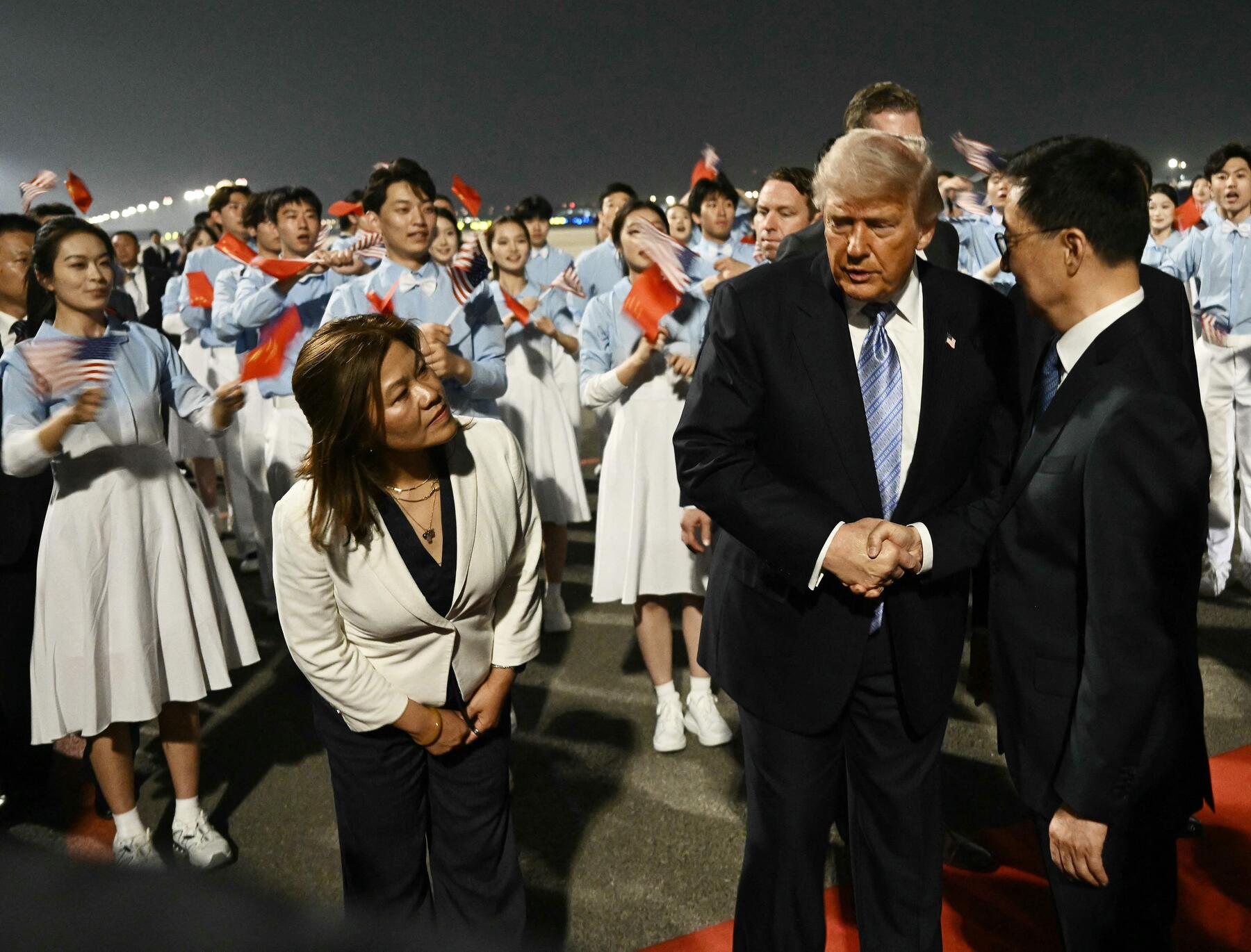
Trump was greeted Wednesday by Chinese Vice President Han Zheng and a military honor guard, as children waved Chinese and American flags on the tarmac. It was a choreographed welcome that set the tone for what is shaping up to be a summit heavy on symbolism.
Thursday's formal program begins at 10 a.m. Beijing time with an official greeting, followed by a full bilateral meeting at the Great Hall of the People. In the afternoon, the two leaders will tour the Temple of Heaven — the 15th-century Ming dynasty complex where emperors once prayed for good harvests — before a state banquet in the evening. On Friday, the two will share tea and lunch before Trump departs for Washington.
One notable late addition to the U.S. delegation: Nvidia CEO Jensen Huang, who boarded Air Force One during a refueling stop in Alaska after Trump personally requested his presence. Huang joins Tesla's Elon Musk, Apple's Tim Cook, Boeing CEO Kelly Ortberg, BlackRock's Larry Fink, and a total of 16 top American executives — all eager to resolve their own specific tensions with China.
Iran: The Hardest Ask
The issue Trump needs China's help on most is the one where Beijing is least likely to deliver.
The U.S.-Israeli war with Iran, which began on February 28, has sent oil prices surging past $104 a barrel and largely shut the Strait of Hormuz — the narrow waterway that once carried one-fifth of the world's oil and gas shipments. More than 60 percent of Americans oppose the conflict. Trump needs a diplomatic exit.
Trump's aides see Beijing — Iran's largest oil customer and a key supplier of dual-use goods to its military — as one of the few players capable of nudging Tehran back to the negotiating table. The message Washington is bringing to Beijing: it is in China's own interest that this war ends.
That argument has real logic behind it. Much of the oil flowing through the Strait of Hormuz is bound for China. A prolonged energy crisis hits Chinese exporters hard. And a protracted conflict in the Middle East is economically painful for Beijing.
But it is not the whole picture.
Iran is China's most important strategic partner in the Middle East — a counterweight to American influence, a major oil supplier, and a test case for how far Beijing will go to protect allies under U.S. pressure. Cutting that relationship, or forcing major Iranian concessions, would cost China far more than the economic pain of high oil prices.
"It will be difficult to get the Chinese deeply involved under any circumstances," said former Deputy Secretary of State Kurt Campbell. "They will want to be careful — they can see political quicksand as well as the next guy."
Washington's leverage here is theoretically significant but practically constrained. The U.S. could sanction Chinese banks facilitating Iranian oil purchases — and Treasury Secretary Scott Bessent has already sent warning letters to two unnamed Chinese financial institutions. But experts note those warnings have produced no action, and targeting a major Chinese state-owned bank could trigger an escalatory chain reaction — reviving the trade war, reigniting triple-digit tariffs, and prompting Beijing to again threaten rare earth supply cuts.
"Dropping bombs on a strategically important place like Iran has a huge impact on the global economy," said Jim Mullinax, a former State Department sanctions director. "But the impact of sanctioning a major Chinese state-owned bank could be even greater."
Even Trump's own signals are contradictory. On Tuesday, he told reporters he did not need China's help on Iran. Hours later, Secretary of State Marco Rubio told Fox News that Washington very much hopes Beijing will push Tehran to reopen the Strait of Hormuz. "It's in their interest to resolve this," Rubio said.
Trade: The "$30 Billion for $30 Billion" Gambit
On the economic front, both sides are moving toward a practical — if modest — new framework called the "Board of Trade," first proposed by U.S. Trade Representative Jamieson Greer in March.
The concept: each side would identify roughly $30 billion worth of non-sensitive goods on which tariffs could be reduced without crossing national security red lines. The approach is notable for what it deliberately avoids — Washington is no longer demanding that Beijing restructure its state-directed economic model. Instead, the focus is on numerical trade targets in specific sectors.
Greer described the idea as a plug "adapter" connecting two incompatible economic systems. It is not a transformation — it is a workaround.
Total U.S.-China goods trade shrank by 29 percent in 2025 to $415 billion, down from $582 billion the year before. The U.S. trade deficit with China fell to its lowest level in two decades. Both sides have an interest in stabilizing the relationship.
On energy, China maintains retaliatory tariffs on U.S. imports including 10 percent on crude oil, 15 percent on liquefied natural gas, and up to 55 percent on beef — all candidates for reduction in any deal. Boeing is hoping for what could be the largest aircraft order in history: potentially 500 Boeing 737 MAX jets plus dozens of widebody planes. Any such deal, if announced, would be a major headline win for both leaders.
A secondary "Board of Investment" framework is also being discussed, though U.S. Trade Representative Greer himself acknowledged: "I don't think we're at the point in our relationship with the Chinese where we want to talk about big investment programs either way."
Taiwan: Xi's Non-Negotiable
For Xi, no item on the agenda carries more weight than Taiwan.
China claims the self-governing island as part of its territory — a claim Taiwan firmly rejects. The United States follows a formal "one China policy" but is legally obligated to help Taiwan defend itself.
In December, the Trump administration approved more than $11 billion in arms sales to Taiwan — the largest such package in history. China responded with its most extensive military exercises around the island to date. Now a further $14 billion package is awaiting Trump's approval, with Beijing watching closely.
"We firmly oppose the United States engaging in any form of military ties with China's Taiwan region," said Zhang Han, spokesperson for China's Taiwan Affairs Office, just one day before the summit. Taiwan, she added, is "the core of China's core interests."
Trump has said he will raise the arms sales question directly with Xi — while also saying he does not believe a military conflict over Taiwan will happen on his watch. "I have a very good relationship with President Xi. He knows I don't want that to happen," Trump said.
Analysts in Taipei and Washington are watching carefully for any shift — however subtle — in Washington's language on Taiwan. Even a nuanced change in wording could send shockwaves through U.S. alliances across Asia.
Markets Are Watching
Financial markets have already priced in cautious optimism about the summit. The offshore Chinese yuan held at a more than three-year high against the dollar, with traders anticipating deal announcements. The U.S. dollar itself has been buoyed by something less encouraging: U.S. producer prices posted their biggest monthly increase in four years in April, adding to an inflation picture that is already at a three-year high.
Markets are now pricing in a roughly 32 percent chance that the Federal Reserve will raise interest rates in December — up from just 16 percent a week ago. The U.S. Senate confirmed Kevin Warsh as the new Fed Chair on Wednesday, handing him an immediate inflation challenge.
The combination of Iran-driven energy costs, trade war uncertainty, and rising domestic prices is precisely the economic backdrop that makes Trump's Beijing visit so urgent — and so difficult.
The Weight of What Comes Next
Trump and Xi are meeting at a moment when both the global economy and the global order are under simultaneous strain. Oil above $100 a barrel. A Middle East war with no clear end. Taiwan on a knife's edge. And two economies that the rest of the world depends on — locked in a rivalry that touches every supply chain, every technology sector, and every alliance.
The summit will produce announcements. Whether those announcements represent genuine progress or, as one analyst put it, merely "a superficial ceasefire largely to China's advantage," will only become clear in the weeks and months ahead.
What is already clear is this: the man who arrived in Beijing on Wednesday needing wins is the American president. The man greeting him at the Great Hall of the People knows it.
.
Sources:
- Reuters – "Trump, Xi set for Beijing talks with trade truce, Iran war at stake" (May 14, 2026): https://www.reuters.com/world/china/trump-xi-set-beijing-talks-with-trade-truce-iran-war-stake-2026-05-13/
- Reuters – "Trump wants China's help on Iran. Beijing may have other ideas" (May 13, 2026): https://www.reuters.com/world/china/trump-wants-chinas-help-iran-beijing-may-have-other-ideas-2026-05-13/
- Reuters – "Trump, Xi to weigh tariff cuts on $30 billion of imports in managed trade push" (May 13, 2026): https://www.reuters.com/business/autos-transportation/trump-xi-weigh-tariff-cuts-30-billion-imports-managed-trade-push-2026-05-13/
- Reuters – "Trump-Xi summit live: Talks in Beijing to include Iran, trade and Taiwan" (May 14, 2026): https://www.reuters.com/world/trump-xi-summit-live-talks-beijing-include-iran-trade-taiwan-2026-05-14/
- Reuters – "Dollar boosted by rate expectations, safe-haven flows as Trump, Xi meet" (May 14, 2026): https://www.reuters.com/world/china/dollar-boosted-by-rate-expectations-safe-haven-flows-trump-xi-meet-2026-05-14/
.
What's Your Reaction?
 Like
0
Like
0
 Dislike
0
Dislike
0
 Love
0
Love
0
 Funny
0
Funny
0
 Wow
0
Wow
0
 Sad
0
Sad
0
 Angry
0
Angry
0











Comments (0)