

Beijing's Back Channel: How China Is Using Taiwan's Opposition to Reshape the Cross-Strait Agenda
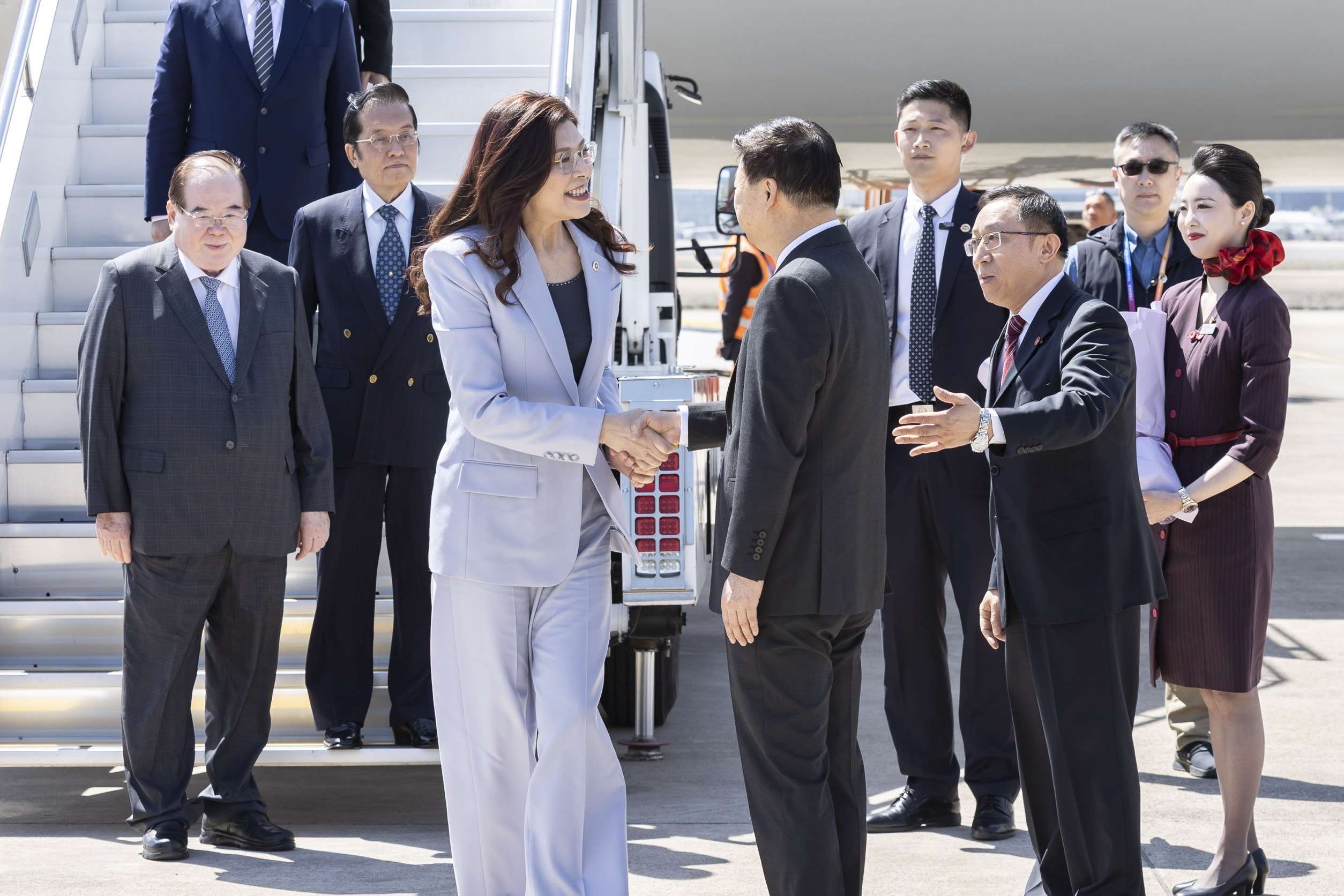
On Tuesday, April 7, 2026, Taiwan opposition leader Cheng Li-wun traveled to China at the invitation of President Xi Jinping, describing the trip as a "journey for peace." But behind the diplomatic language lies a carefully calculated political move — one that goes well beyond a simple party visit.

.
An Analysis of the Current Situation by Udumbara.net
.
A Rare Visit With Far-Reaching Implications
On Tuesday, April 7, 2026, Taiwan opposition leader Cheng Li-wun traveled to China at the invitation of President Xi Jinping, describing the trip as a "journey for peace." But behind the diplomatic language lies a carefully calculated political move — one that goes well beyond a simple party visit.
The trip is the first by a Taiwanese opposition leader in a decade and comes directly ahead of a planned meeting between Xi and U.S. President Donald Trump scheduled for May. That timing is not coincidental.
Cheng, the recently elected chairperson of the Kuomintang (KMT), leads a 14-member delegation on a six-day trip that takes her from Shanghai to Nanjing and finally to Beijing, where a meeting with Xi Jinping is widely expected.
.
The "Peace Mission" and What It Really Means
Cheng has been unambiguous about her stated goals. "The world views the Taiwan Strait as the most severe and dangerous powder keg," she told reporters. "Both sides of the Taiwan Strait should do their best to use peaceful means to stabilize the situation."
But political analysts are reading the visit very differently. Beijing refuses political engagement with Taiwan's ruling Democratic Progressive Party (DPP), which it labels pro-independence, while keeping channels open to forces like the KMT — and the timing and framing of this visit suggest a broader message beyond cross-strait relations alone.
In short: Beijing is not just talking to Taipei. It is talking past Washington.
.
Beijing's Three-Audience Strategy
According to analysts at The Diplomat, China is simultaneously sending signals to three very different audiences with this visit.
To Taiwan's voters, Beijing is saying that dialogue and stability remain available — but only through actors willing to work within China's preferred political framework. To the United States, the message is that American military and diplomatic power does not give Washington control over the Taiwan agenda. And to the wider world, China is demonstrating that it has its own instruments of influence and is not merely reacting to U.S. moves.
This is a strategic communication exercise dressed up as a peace trip.
.
The Party-to-Party Channel: Beijing's Real Prize
The KMT holds no governmental power in Taipei — Taiwan's elected president, Lai Ching-te of the DPP, runs the executive branch. So what can Cheng actually deliver?
While the KMT is not in a position to strike agreements with Beijing that would affect the entire island, Cheng might sign party-to-party cooperation agreements with the Communist Party to reinstitute regular dialogue or boost ties at a municipal level between KMT-controlled localities and Chinese cities, according to Atlantic Council fellow Wen-Ti Sung.
This is the core of Beijing's play. By reviving formal party-to-party channels, the Chinese Communist Party (CCP) gains a structured line of influence into Taiwan's political landscape — one that bypasses the elected government entirely.
.
A Divided Taiwan Watches Closely
The DPP opposes Cheng's trip, viewing it as a public relations win for Beijing. Their concerns are shared by more centrist members of the KMT itself, who worry she will alienate Taiwan's mainstream voters.
Taiwan's ruling party lawmakers raised concerns over what would be discussed and warned that the KMT's exchanges with Beijing could not be monitored. Premier Cho Jung-tai called for greater scrutiny of politically influential figures dealing with the Communist Party.
The visit is also dividing ordinary Taiwanese. One Taiwanese businessman waiting at the airport said he didn't think the visit was "a very good thing," while another based in eastern China described it as "definitely a good thing because the two sides of the Strait have always had very close ties."
Public opinion data tells a clear story, however: a survey by the Taiwan Public Opinion Foundation in October 2025 found that only 13.9 percent of respondents supported unification with China, compared to 44.3 percent who supported independence and 24.6 percent who preferred maintaining the current status quo.
.
The Defense Budget: An Inconvenient Backdrop
Cheng's visit unfolds against a fierce domestic battle in Taipei. Taiwan's opposition-controlled parliament has stalled attempts by the government to pass a $40 billion special defense budget, expected to fund arms deals with the United States and the development of Taiwan's indigenous defense capabilities.
The KMT has framed its resistance as fiscal responsibility. The party has proposed a smaller defense budget and criticized the DPP's larger request as a "blank check" for arms purchases.
By elevating party-to-party dialogue with the opposition at this moment, China can reinforce a narrative already present in Taiwan's politics: that peace can be preserved through cross-strait engagement, rather than rapid military expansion.
.
The Xi-Trump Summit Shadow
Looming over everything is the planned meeting between Xi Jinping and Donald Trump in Beijing in May. Arms sales to Taiwan are expected to top the agenda, and Trump has suggested he would be open to discussing future American weapons deliveries to Taiwan with Xi.
Cheng's visit "may sideline the Taiwan Strait tension issue from the Xi-Trump summit, thus enabling the U.S.-China summit to focus on business areas of common interest rather than geostrategic points of contention," according to Wen-Ti Sung of the Atlantic Council.
In other words: if Beijing can present itself as already managing Taiwan through dialogue, it reduces the pressure on Washington to push the issue in May.
.
What Comes Next: Three Scenarios
Scenario 1 — Symbolic Success, Limited Substance: Cheng secures a photo opportunity with Xi, returns to Taipei with warm words, and the KMT uses the images to argue that dialogue works. No binding agreements are signed, but Beijing has achieved its narrative goal.
Scenario 2 — Institutionalized Back Channel: Party-to-party agreements are formalized, creating a permanent structure for CCP-KMT exchanges at the municipal level. Beijing gains a durable influence mechanism that operates independently of Taipei's elected government.
Scenario 3 — Political Backlash in Taiwan: If Cheng makes concessions seen as undermining Taiwan's sovereignty or dignity, moderates within the KMT fear she will alienate the mainstream vote ahead of the 2026 local elections. The visit could then become a liability rather than an asset.
.
The Bigger Picture
A political scientist at Soochow University in Taipei warned that Cheng risks playing into Beijing's "United Front" strategy — a long-term effort to use Taiwanese politicians to reinforce the narrative that Taiwan is an internal matter for China.
Beijing's approach here is not new, but it is more refined than military pressure alone. Rather than threatening Taiwan into submission, the CCP is offering the KMT a seat at the table — and using that seat to shape the political conversation on the island, in Washington, and on the world stage.
Whether Cheng Li-wun returns home as a peacemaker or as a useful prop in Beijing's political theater will depend on what she agrees to — and what she refuses.
.
Sources
- Associated Press / Washington Times – Cheng Li-wun arrives in China: https://www.washingtontimes.com/news/2026/apr/7/cheng-li-wun-taiwan-opposition-leader-arrives-china-calls-journey/
- Al Jazeera – Taiwanese opposition leader to meet China's Xi: https://www.aljazeera.com/news/2026/4/7/taiwanese-opposition-leader-to-meet-chinas-xi-in-a-test-of-diplomatic-skill
- ABC News / AP – Taiwan opposition leader heads to China: https://abcnews.com/International/wireStory/taiwan-opposition-leader-heads-china-calls-journey-peace-131789103
- The Diplomat – Why Cheng Li-wun's Visit to China Matters: https://thediplomat.com/2026/04/why-cheng-li-wuns-visit-to-china-matters/
- NPR – Taiwan's opposition leader arrives in China: https://www.npr.org/2026/04/07/nx-s1-5776401/taiwan-opposition-arrives-china
- South China Morning Post – KMT leader begins journey of peace in Shanghai: https://www.scmp.com/news/china/politics/article/3349225/taiwanese-opposition-leader-cheng-li-wun-begins-journey-peace-shanghai
- NBC News – Taiwan's opposition leader seeks to win friends in China: https://www.nbcnews.com/world/asia/taiwans-opposition-leader-seeks-win-friends-china-high-stakes-visit-rcna266349
.
What's Your Reaction?
 Like
1
Like
1
 Dislike
0
Dislike
0
 Love
0
Love
0
 Funny
0
Funny
0
 Wow
1
Wow
1
 Sad
0
Sad
0
 Angry
0
Angry
0














Comments (0)