

China's Robot Revolution Lands in Tokyo — And Japan Is Playing Catch-Up
The Humanoids Summit Tokyo, which opened on May 28, 2026, highlighted a striking shift in the global robotics industry: Chinese companies now dominate a market that Japan once pioneered. From affordable dancing robots to AI-powered warehouse helpers, Beijing's manufacturers are setting the pace — while Tokyo scrambles to find its place.

.
Tokyo's Robot Show Has a Chinese Problem
The Takanawa Convention Center in Tokyo was buzzing with mechanical life on Thursday. Dancing robots, robotic hands fine enough to thread a needle, and full-sized humanoids designed for airport logistics were all on display at the Humanoids Summit Tokyo — the first Asian edition of one of the world's leading robotics conferences.
The exhibitor list read like a who's-who of the global industry: Boston Dynamics, Toyota, Honda. But the real attention-grabbers were the newcomers from China. Companies like Booster Robotics, LimX Dynamics, and Unitree brought hardware that combined performance with affordability — a combination that established players have struggled to match.
One miniature robot, the High Torque Mini Pi Plus, stole hearts with its playful dance routines. The price tag was equally eye-catching: starting at just $5,500. It cannot run a factory line or stack shelves — yet — but it signals where the market is heading.
A Pattern Japan Has Seen Before
Experts at the event were blunt in their assessment. Tim Hornyuk, author of a widely read book on Japan's robotics culture, invoked a term that will be familiar to Japanese industry observers: "Galapagos syndrome." The phrase describes a recurring pattern in which Japanese innovators develop world-class technology that thrives domestically but fails to break out globally — often because it was never designed with international mass-market realities in mind.
Japan led the world in humanoid robotics for decades. Its engineers built the foundational systems. But when it came to scaling up, reducing costs, and deploying robots in real commercial settings, the country fell behind. Chinese manufacturers stepped in, took the underlying technology, refined it for cheaper mass production, and captured the market.
It is a story Japan has lived through before — in televisions, in mobile phones, and most recently in electric vehicles.
Chinese Robots Now Power Japanese Operations
Perhaps the most telling example at the summit came not from a Chinese booth, but a Japanese one. GMO, a Tokyo-based AI and robotics company, is developing a humanoid robot with camera-equipped eyes to assist Japan Airlines with cargo handling and airport logistics.
The goal is for the robot to perform tasks exactly as a human worker would, making the two effectively interchangeable. This is no niche project — Japan faces a severe labor shortage that is only expected to worsen. Demographic forecasts suggest the country could be short more than 11 million workers by 2040, driven by a rapidly aging population.
The critical detail: the robotic technology powering GMO's airport helper was supplied entirely by Unitree — a Chinese company. Unitree is currently the world's second-largest humanoid robot seller by market share, trailing only Shanghai-based AgiBot.
According to research from the South China Morning Post and market analysts at Counterpoint, Chinese firms collectively controlled more than 80 percent of global humanoid robot installations in 2025. AgiBot held a 30 percent share of worldwide units, with Unitree close behind.
Japan's Counter: Quality, Culture, and Craft
Not everyone at the summit was ready to cede the future to China. Honda's robotics team showed off a motorized four-fingered robotic hand capable of handling tiny bolts and threading needles with precise, controlled movements — a demonstration of engineering finesse that even competitors had to acknowledge.
Keisuke Tsuta, assistant chief engineer at Honda, argued that durability and production quality would ultimately distinguish Japanese robotics. Japan's manufacturing tradition, he said, remains a competitive advantage that brute-force scaling cannot simply erase.
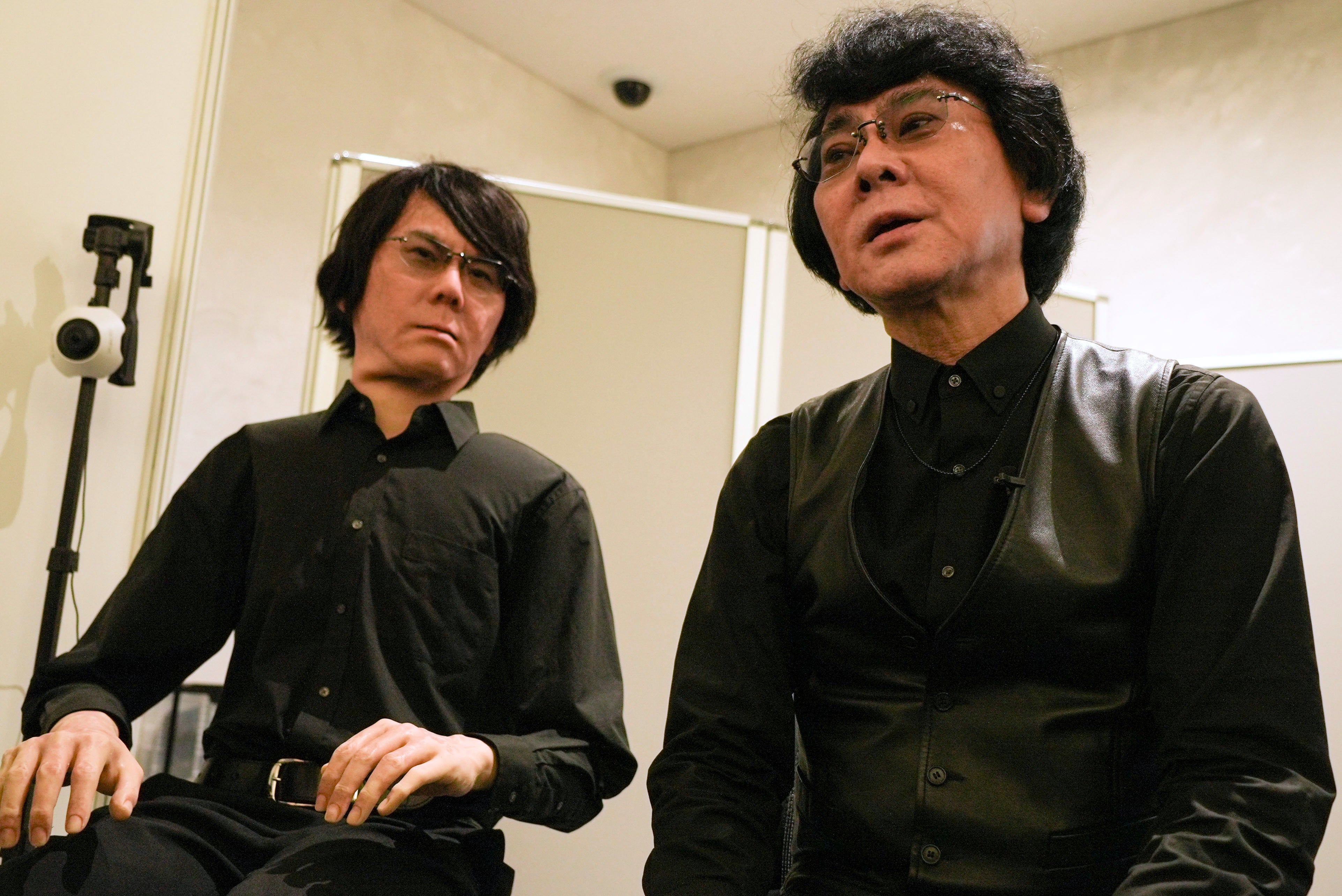
Osaka University Professor Hiroshi Ishiguro — who has worked on humanoid robots for decades and built a near-identical robotic replica of himself — offered a different kind of confidence. Japan's advantage, in his view, is cultural rather than technical. Japanese society accepts robots in a way few others do. They are not feared as job-stealers or surveillance tools. They are welcomed.
A recent Pew Research survey supports this: roughly 28 percent of Japanese respondents said they feel anxious about artificial intelligence — compared to 50 percent in the United States.
Ishiguro's robot clone, dressed in matching black attire and seated beside its human counterpart, fielded a question about the meaning of robots in a calm, slightly monotone voice: "I think robots will coexist with people. Robots are the mirror of human beings."
Beijing's Strategy: More Than a Business Model
China's robotics surge is not purely a private-sector story. The country's latest Five-Year Plan places robotics at the center of its industrial modernization agenda. Government subsidies, coordinated investment, and national production targets have turbo-charged an industry that in 2025 alone released more than 330 distinct humanoid robot models.
Critics note that China's national robotics standardization committee has explicitly tied civilian robotics development to People's Liberation Army priorities — a reminder that the technology race in this sector is not only economic. Research published by the Jamestown Foundation has raised concerns about interoperability restrictions and potential state access embedded into Chinese robotics platforms.
For Japan, the European Union, and the United States, this adds a geopolitical dimension to what might otherwise appear to be a straightforward market competition.
What Comes Next
Japan is not without a path forward. The country's Ministry of Economy, Trade and Industry has set an ambitious target: a 30 percent share of the global physical AI market by 2040. Japanese firms are betting that their manufacturing precision, their cultural head start in human-robot integration, and their acute domestic need — hospitals, warehouses, airlines all desperately short of workers — will drive a robotics boom on home soil.
The question is whether that boom can be turned into global competitiveness, or whether Japan will once again find itself building excellent technology for an audience of one.
As Hornyuk put it in Tokyo: "I really hope Japan can come up with its own Model T moment for humanoid robots. But I think China has already stolen their lunch."
.
Sources
-
Associated Press — "Humanoids dance and thread needles as Japanese robotics developers look to outdo Chinese," May 28, 2026: https://apnews.com/article/humanoids-japan-technology-robotics-machines-honda-50e66b5d7eeea63d0a1a60357e679228
-
South China Morning Post — "China dominates global humanoid robot market with over 80% of installations," January 16, 2026: https://www.scmp.com/tech/big-tech/article/3340142/china-dominates-global-humanoid-robot-market-over-80-installations
-
Rest of World — "China is winning the humanoid robot race while Tesla's Optimus lags," February 25, 2026: https://restofworld.org/2026/china-humanoid-robots-unitree-agibot-tesla-optimus/
-
Fortune — "Japan's labor crisis is making the case for robots taking the jobs you don't want," April 6, 2026: https://fortune.com/2026/04/06/japan-labor-shortage-robots-ai-robotics-humanoid/
-
IMF Working Paper — "The Impact of Aging and AI on Japan's Labor Market," September 2025: https://www.imf.org/en/publications/wp/issues/2025/09/19/the-impact-of-aging-and-ai-on-japan-s-labor-market-challenges-and-opportunities-570528
-
Humanoids Summit Tokyo — Official event page: https://humanoidssummit.com/
.
What's Your Reaction?
 Like
0
Like
0
 Dislike
0
Dislike
0
 Love
0
Love
0
 Funny
0
Funny
0
 Wow
0
Wow
0
 Sad
0
Sad
0
 Angry
0
Angry
0















Comments (0)