

Chinese Regime Pushes for Loyalty After Major Military Shake-Up: Insiders


.
The Epoch Times spoke to several sources in China, who requested anonymity for safety reasons, about follow-ups after the purge of Central Military Commission (CMC) Vice Chairman Zhang Youxia and CMC member Liu Zhenli, who also heads the Joint Staff Department.
One Beijing-based source told The Epoch Times that the two men have been secretly detained and placed in complete isolation at a heavily guarded site in Beijing’s Changping district. Multiple sources said the preliminary political assessment of the two men does not center on routine disciplinary or legal violations, but on allegations that they sought to “split the CMC”—a charge that directly challenges the CMC chairman and the military’s ultimate command authority. The current CMC chairman is Chinese leader Xi Jinping.
Purge Signals
Within the CCP, accusations such as “splitting the Party” or “splitting the central leadership” are extremely rare and reserved for figures deemed to pose a substantive threat to the core power structure. These labels are typically not spelled out in public documents, but they carry decisive weight internally. The true political meaning often becomes clear only from how the regime subsequently handles the case.The CCP’s post-1989 treatment of former General Secretary Zhao Ziyang was a historical precedent for this kind of opaque but consequential political judgment. Zhao was viewed as a pro-reform leader within the CCP before the Tiananmen Square Massacre in 1989, but he was removed from power and placed under house arrest that same year until his death in 2005.
.

Military Put on High Alert
A China-based insider familiar with the situation told The Epoch Times that the handling of Zhang and Liu has sent shockwaves throughout the PLA. Mid- and senior-level officers across multiple units have been ordered to cancel leave, halt planned travel, and remain on standby, according to the insider, and at the same time, the military’s command and propaganda systems have been tightened, creating an atmosphere of heightened tension.Some insiders from within the military told The Epoch Times that this approach—using an authoritative editorial to set the political tone at the earliest stage of a case—is uncommon even by the standards of recent PLA purges.
Focus on Power, Not Money
From the official narrative and its accompanying propaganda, analysts say Zhang’s case appears less focused on financial corruption than on a reordering of military power itself.The early intervention by the PLA’s official newspaper, the highly politicized language of internal notices, and the rapid dissemination of documents form what one observer described as a classic “conclusion first, disposal later” process. This is designed to quickly draw political boundaries and suppress internal debate.
Long-Running Rift With Xi Jinping
In October 2025, The Epoch Times cited multiple military insiders as saying Zhang had clashed sharply with Xi over whether China should use force against Taiwan.According to those accounts, Zhang repeatedly opposed launching an immediate military campaign, arguing that this would risk intervention from the United States and its allies.
Sources said Zhang favored stabilizing the situation and avoiding a major conflict amid economic slowdown and diplomatic isolation. Xi interpreted this stance as “undermining military morale,” making it a trigger for subsequent purges of senior officers.
Under pressure, Zhang allegedly countered by reshuffling personnel and pushing for investigations into figures aligned with Xi’s camp, including political work chief Miao Hua and former vice chairman He Weidong. “It became a life-and-death struggle within the military,” the source said. Zhang ultimately managed to retain his post and factional base—until now.
.
Timing and Symbolism
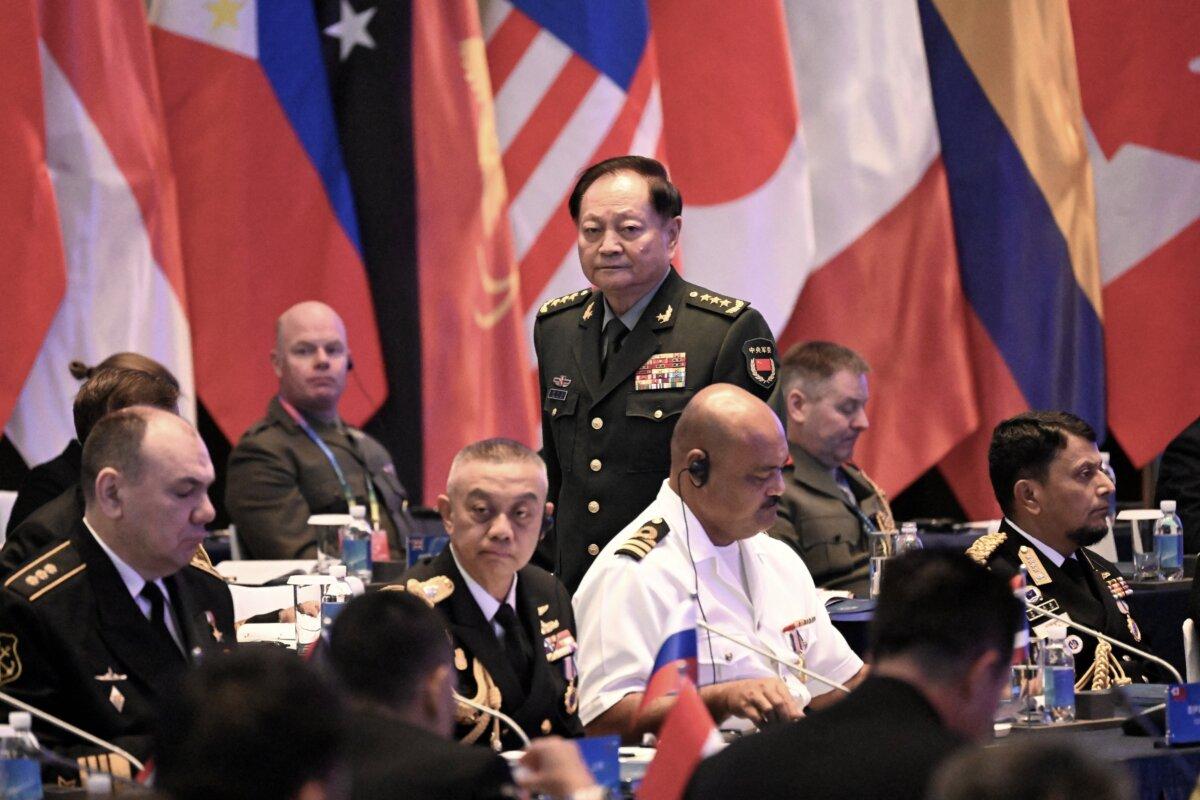
Pan, an analyst who follows PLA politics closely and is only identified by his surname for safety reasons, told The Epoch Times that the decision to move against Zhang as China approaches the PLA’s 100th anniversary sends a strong signal that the leadership is seeking to eliminate uncertainty at a critical juncture.“The core objective isn’t anti-corruption,” Pan said. “It’s to force a clear alignment within the military over who ultimately controls command authority.”
Reading Between the Lines
The Jan. 24 PLA Daily editorial itself offers clues to the scale of the purge. Pan noted that the headline’s framing of anti-corruption as a “tough battle,” a “protracted battle,” and an “overall battle” is not rhetorical excess, but a deliberate classification.The “tough battle,” he said, reflects the seniority of the targets since Zhang and Liu sit at the very core of the military power structure. The “protracted battle” signals that the campaign is not a short-term cleanup, but a systematic effort to dismantle entrenched networks and factions within the military. Most striking, he said, is the term “overall battle.”
Corruption as a Constant—and a Tool
Chen, a “red second generation” who grew up in military compounds, told The Epoch Times, on condition of revealing only his surname, that the PLA’s long-standing opacity has made it one of the most corruption-prone sectors of the CCP system. Civilian law enforcement has no jurisdiction over the military, creating structural impunity.He said large-scale smuggling by military units began as early as the late 1970s, with military vehicles effectively off-limits to local law enforcement. Corruption in weapons procurement, he added, has persisted for decades.
“Before Zhang was promoted, the military disciplinary bodies already had evidence of his corruption,” Chen said. “When you need someone, corruption isn’t the problem. Disloyalty, or suspected disloyalty, is the real problem.”
What's Your Reaction?
 Like
0
Like
0
 Dislike
0
Dislike
0
 Love
0
Love
0
 Funny
0
Funny
0
 Wow
0
Wow
0
 Sad
0
Sad
0
 Angry
0
Angry
0













Comments (0)