

China’s Fuel Price Cap Sparks Accusations of Hidden Price Gouging
China’s Fuel Price Cap Sparks Accusations of Hidden Price Gouging - China’s government has imposed temporary controls on gasoline and diesel prices, limiting a planned record‑high increase to roughly half of what the country’s pricing formula would normally require. Analysts say the move is less consumer protection and more a way for state‑owned oil giants to profit from global turmoil while presenting the policy as relief for drivers.

.
Lede
China’s government has imposed temporary controls on gasoline and diesel prices, limiting a planned record‑high increase to roughly half of what the country’s pricing formula would normally require. Analysts say the move is less consumer protection and more a way for state‑owned oil giants to profit from global turmoil while presenting the policy as relief for drivers.
What the Government Announced
China’s National Development and Reform Commission (NDRC) introduced temporary control measures to cap the latest fuel price hike.
- Under the pricing mechanism, gasoline should have risen by 2,205 yuan per ton and diesel by 2,120 yuan per ton.
- With the cap, the actual increases were limited to 1,160 yuan (gasoline) and 1,115 yuan (diesel).
- Officials said the controls were needed to “mitigate abnormal international oil price surges” and protect downstream users.
This marks the first use of such controls since 2013, despite China’s pricing system being designed to track global crude benchmarks.
Why Analysts Call It “Price Gouging in Disguise”
Independent analysts argue that the cap is not genuine relief — instead, it allows state‑owned refiners to:
- Raise prices sharply while claiming they “reduced” the increase
- Blame global conflicts (especially the Iran war and Middle East instability) for domestic hikes
- Maintain high margins by restricting exports and prioritizing domestic sales
Some analysts told media outlets that China’s oil supply is not significantly disrupted, yet state firms are using geopolitical tensions as a pretext for aggressive price increases.
What Drivers Are Experiencing
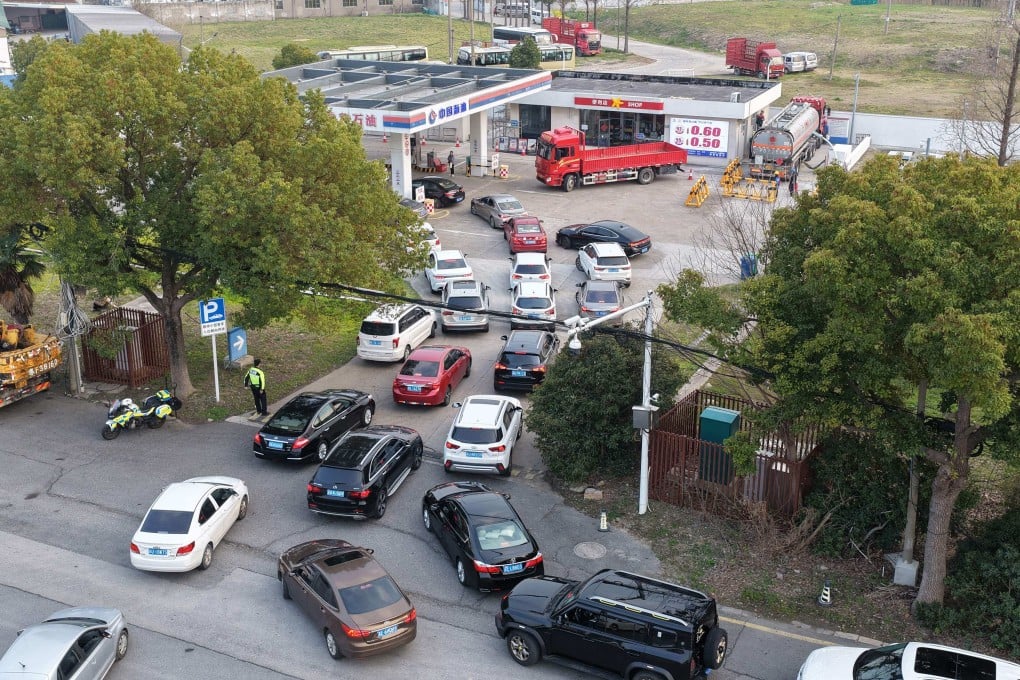
Nationwide panic buying
- Long lines formed at gas stations in Beijing, Shenzhen, Jiangsu and other regions after Sinopec warned of a pending hike.
- Some stations temporarily ran out of 92‑ and 95‑octane gasoline.
Higher costs at the pump
- A typical 50‑liter tank of 92‑octane gasoline now costs about 86.5 yuan more.
- Drivers rushed to fill up before midnight deadlines, creating scenes resembling mini‑panics across major cities.
Impact on logistics and trucking
- Diesel users — especially trucking companies — face the biggest strain.
- Some operators paused routes or raised freight rates to offset rising fuel bills.
- Monthly fuel costs for haulers increased by thousands of yuan per vehicle.
.

.
Why Prices Are Rising So Fast
1. Middle East conflict and oil volatility
Global crude prices surged due to the U.S.–Israeli war on Iran and threats to shipping routes near the Strait of Hormuz.
- Brent crude jumped more than 27% in a single week.
2. China’s heavy import dependence
China imports roughly 70% of its crude, making it highly exposed to global shocks.
Iran alone supplies an estimated 13–20% of China’s imported oil.
3. Government‑ordered export cuts
Refiners were instructed to halt fuel exports to stabilize domestic supply, tightening the market further.
How China’s Fuel Pricing Mechanism Works (Simple Explanation)
For non‑experts, here’s the basic system:
- Every 10 working days, China adjusts domestic fuel prices based on a basket of global crude benchmarks.
- Prices can move only within a floor‑and‑ceiling range.
- When crude exceeds $130 per barrel, China typically does not raise retail prices further.
- When crude falls below $40, China pretends crude is still $40 to maintain margins.
This system gives the government — and state oil firms — wide discretion to manage prices.
Why Critics Say the Cap Is Misleading
Analysts argue the government is presenting the cap as relief, but:
- The final increase is still the largest in years.
- The cap allows state firms to lock in high profits while appearing to “protect consumers.”
- The narrative shifts blame to global events, even though China’s supply remains relatively stable.
In short:
The cap softens the headline number but still results in a major price jump — and state oil giants benefit the most.
.
Sources
- CTN News — China’s fourth 2026 fuel price hike and consumer impact.
- CNBC — Panic buying and Sinopec’s advance warning of a “meaningful” price hike.
- The Epoch Times — Analysts accuse state firms of using war as pretext for price gouging.
- Reuters via U.S. News — Largest fuel cap increase in four years; crude price surge data.
- Xinhua / SCIO — NDRC’s official explanation of temporary control measures.
- ZAWYA / Reuters — Details on the capped increase and government rationale.
What's Your Reaction?
 Like
0
Like
0
 Dislike
0
Dislike
0
 Love
0
Love
0
 Funny
0
Funny
0
 Wow
0
Wow
0
 Sad
0
Sad
0
 Angry
0
Angry
0













Comments (0)