China Tightens Rare Earth Management With New Regulations

China Tightens Rare Earth Management With New Regulations

.

China has rolled out new interim measures to regulate the rare earth sector in the latest effort to tighten its grip over the metals critical to global semiconductor, defense, and other sectors.

Rare earth producers are now required to set up an internal tracking system to record production flows and submit the information to a national database on a monthly basis, according to the text of the regulation released by the country’s Ministry of Industry and Information Technology on Aug. 22.

China, the world’s largest rare earth miner and exporter, has spent more than a decade consolidating control over the supply chain of these strategically important metals. Efforts include implementing a quota system to dictate domestic mining, smelting, and separation activities.

The new regulation expanded the quota system to cover imported raw materials and a specific type of rare earth ore called monazite. With these requirements, China effectively controlled about 92 percent of the rare earth supply, Wong Xin of China’s rating agency CSCI Pengyuan said in a February report, after Beijing released a draft of the interim measures for public consultation.

The finalized regulation removed the language that only major state-owned rare earth conglomerates can engage in rare earth production. However, it still limited such activities to companies designated as qualified by Beijing.

Rare earth elements are a group of 17 metals used in products ranging from electric cars to fighter jets and submarines.

In early April, China imposed export controls on seven of these metals, along with magnets composed of three of them. The decision was widely viewed as a retaliation against an earlier tariff hike by Washington, while it targeted all of Beijing’s trading partners.

Under the export control rules, exporters are required to apply for special licenses and submit documents to prove that their overseas clients were not intended to use materials for military purposes. The application process, according to the commerce ministry, could take up to 45 days.
The restriction has dramatically delayed the supply of rare earth, with May exports hitting a five-year low, according to China’s customs data. Some automakers outside the country had to halt production temporarily.
.
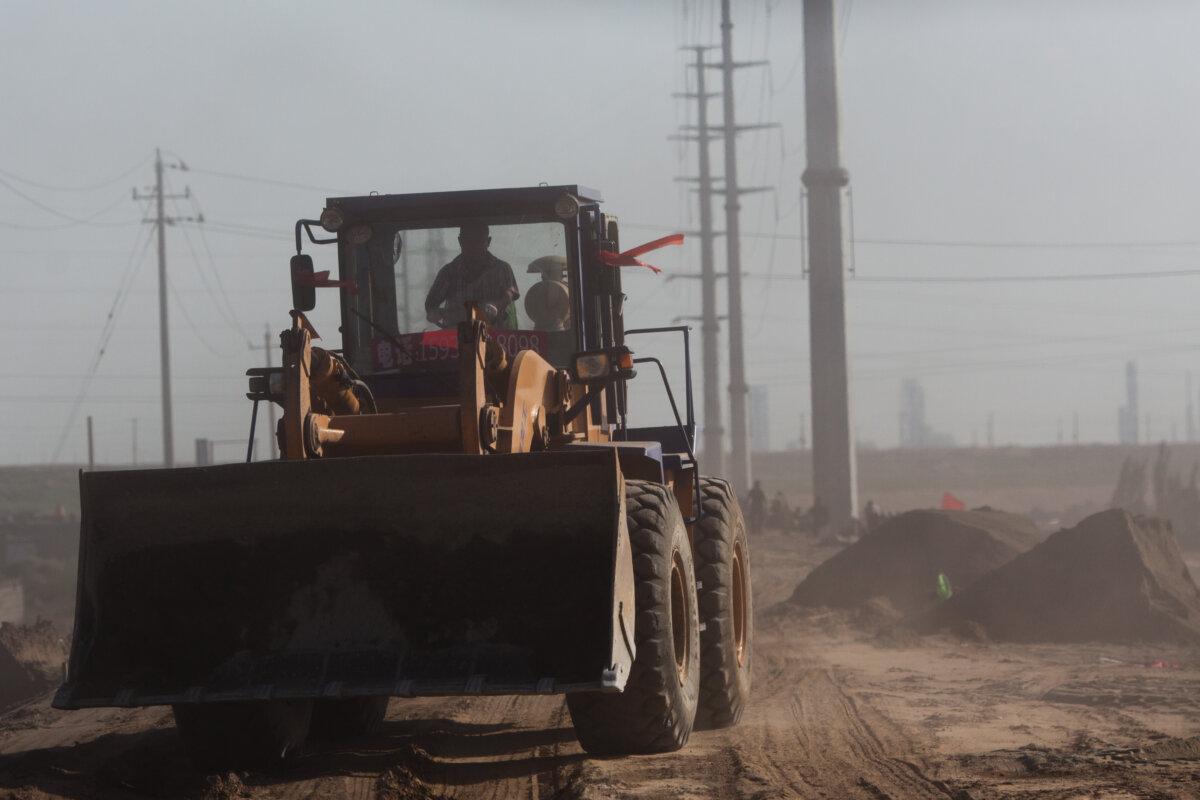
A wheel loader on a road near a 'toxic lake' surrounded by rare earth refineries near the city of Baotou in China's Inner Mongolia region on Aug. 19, 2012. On the edge of the city is a roughly 4-square-mile lake blackened by pollution from factories processing rare earths. Ed Jones/AFP via Getty Images
.
China is nearly a monopoly supplier of rare earths, accounting for 61 percent of global extraction and 92 percent of refining production, according to the International Energy Agency.
The United States imported most rare earths from China, though that dependence has eased in recent years. From 2018 to 2021, China was responsible for 74 percent of rare earths imported to the United States, down from 80 percent between 2014 and 2017, according to the United States Geological Survey.
It’s not the first time that communist China has leveraged its dominance in the critical industry to exert political pressure on other nations. In 2009, amid heightened tensions in a territorial row between Beijing and Tokyo, the regime temporarily blocked the rare earth exports to Japan, but the ban was undermined by rampant smuggling, Chinese media reported.
.
In its latest trade fight with the United States, the Chinese regime has stepped up efforts to crack down on rare earth smuggling. On May 12, officials from 10 state agencies, alongside local regulators from seven provinces rich in strategic mineral deposits, convened to formulate a strategy to strengthen control over strategic minerals. It followed closely after another high-level meeting in Shenzhen, a city bordering Hong Kong, in which officials launched a special operation to combat the illegal flows of strategic minerals.
.
While the rare earth shipment from China saw a sharp rebound in July after three rounds of trade talks with the United States, concern has been mounting in the West over the reliance on China for these vital metals.
.
A view of the MP Materials rare earth open-pit mine in Mountain Pass, Calif., on Jan. 30, 2020. MP Materials acquired the site in July 2017 after its former owner went bankrupt. Steve Marcus/Reuters
.
In the United States, MP Materials announced a multibillion-dollar agreement with the Department of Defense in mid-July aimed at boosting the United States’ production of rare earth metals while reducing reliance on China and other nations.
.
“China’s move to restrict critical minerals supplies on April 4 was a sucker punch to U.S. industries and a wake-up call to Washington,” Rep. Young Kim (R-Calif.), chair of the House Foreign Affairs East Asia and Pacific subcommittee, said in an Aug. 21 statement following a site visit to MP Materials’ Mountain Pass Rare Earth Mine this week.

“We cannot rely on the Chinese Communist Party to power our most critical technologies and defense systems.”

.