

China, Russia Practice Destroying ‘Enemy Submarine’ in Naval Drill After Trump Moves US Nuclear Subs Near Russia


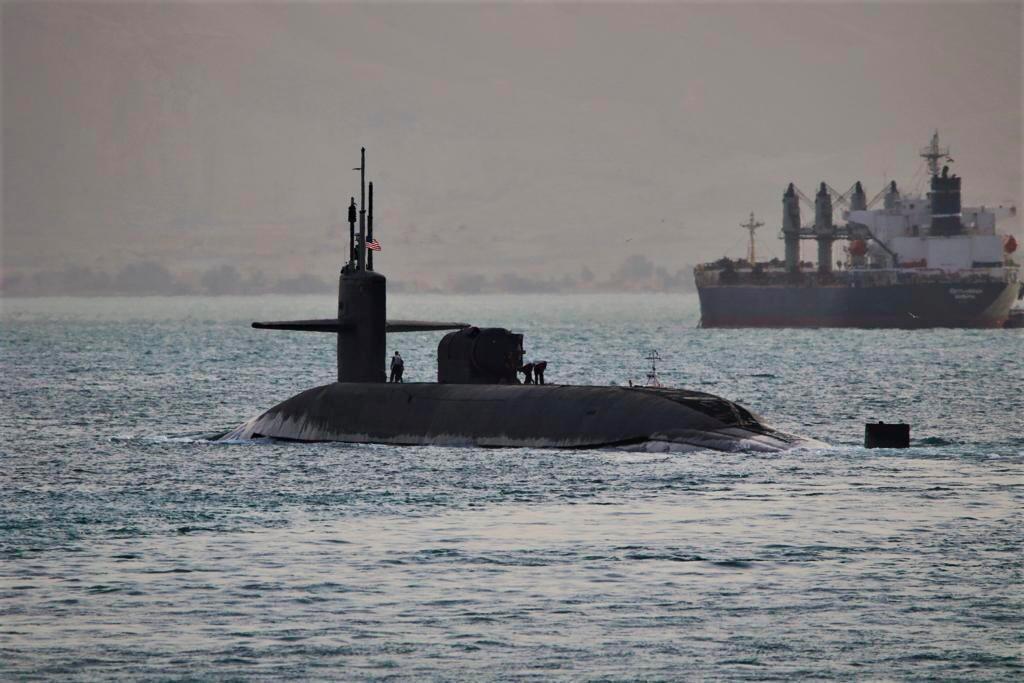
The Chinese and Russian navies have practiced destroying an “enemy submarine” in the Sea of Japan on Aug. 6 during joint military drills, days after President Donald Trump ordered two nuclear submarines to be deployed near Russia.
The navy of the Chinese communist regime and the Russian navy held their annual joint exercises from Aug. 1 to Aug. 5, which included artillery fire, anti-submarine and air defense mission training, and improving the ability of joint maritime search-and-rescue operations, according to Chinese state media.
In the final phase of the exercises, Russian destroyer Admiral Tributs and corvette Gromkiy conducted live-fire training alongside Chinese destroyers Urumqi and Shaoxing, according to Russian state media.
A Russian Navy IL-38 and a Chinese Y-8 maritime patrol aircraft located and destroyed a simulated enemy submarine in the joint drills, the Russian Ministry of Defense said on Aug. 6.
“As a result of effective joint actions, the ‘enemy’ submarine was promptly detected and mock-destroyed,” the ministry said.
The simulated submarine takedown followed President Donald Trump’s announcement on Aug. 1 that two U.S. nuclear submarines were moved to “the appropriate regions.”
Trump’s announcement was in response to statements from Dmitry Medvedev, deputy head of the Russian Security Council and former Russian president, about the risk of nuclear war between the United States and Russia.
The heated exchange came as Trump wanted Putin to end his more than three-year invasion of Ukraine, while Putin failed to negotiate.
.
China has been the main supporter of Russia in its war with Ukraine. Russia and China signed a “no limit” strategic partnership agreement shortly before Russia launched its invasion of Ukraine in 2022.
A spokesman for China’s Ministry of Defense said on July 30 that the joint naval drills with Russia are not targeted at any third party and have nothing to do with the current international and regional situation.
Chinese and Russian navies will conduct joint patrols in the Pacific region after the joint exercises in the Sea of Japan.
China and Russia have conducted annual joint naval exercises since 2012.
“Unlike previous exercises, this year it included a Chinese submarine for the first time, docking at the Russian Pacific Fleet’s base in Vladivostok, symbolizing closer military collaboration between the two countries,” Hung Tzu-Chieh, director of Division of Chinese Politics, Military, and Warfighting Concepts at Taiwan’s Institute for National Defense and Security Research (INDSR), told The Epoch Times on Aug. 7.
It was originally an annual routine military exercise, but this year, “it became more targeted because they expanded the anti-submarine practices and claimed to have sunk a simulated enemy submarine,” Su Tzu-yun, researcher and director of the Division of Defense Strategy and Resources at INDSR, told The Epoch Times on Aug. 7.
“This was, of course, in response to U.S. President Trump’s announcement that two nuclear submarines were deployed in waters near Russia.”
.

Not a Signal of Full-Scale Confrontation
Hung said he believed that the drill of destroying an “enemy submarine” was in response to the specific situation, and “shouldn’t be read as a signal for a full-scale confrontation between China, Russia, and the United States.”“Although the scope and level of cooperation of the Sino-Russian military exercises have been expanded from their routine joint drills and both sides [the United States, Russia, and China] have responded in strategic deployment, the overall military confrontation has not yet escalated significantly,” he said.
On the related political aspect, Su said that “the United States now focuses its efforts on combating the CCP, and its overriding principle is to improve U.S.–Russia relations. If Russia and Ukraine can reach a ceasefire, the United States will agree to lift sanctions and help Russia rebuild its economy.”
“It ultimately depends on Russia’s decision: will it side with the United States or side with the CCP?” Su said.
What's Your Reaction?
 Like
0
Like
0
 Dislike
0
Dislike
0
 Love
0
Love
0
 Funny
0
Funny
0
 Wow
0
Wow
0
 Sad
0
Sad
0
 Angry
0
Angry
0













Comments (0)