

China Quietly Raises Internal Alert Over Iran: Internal Source Reveals


.
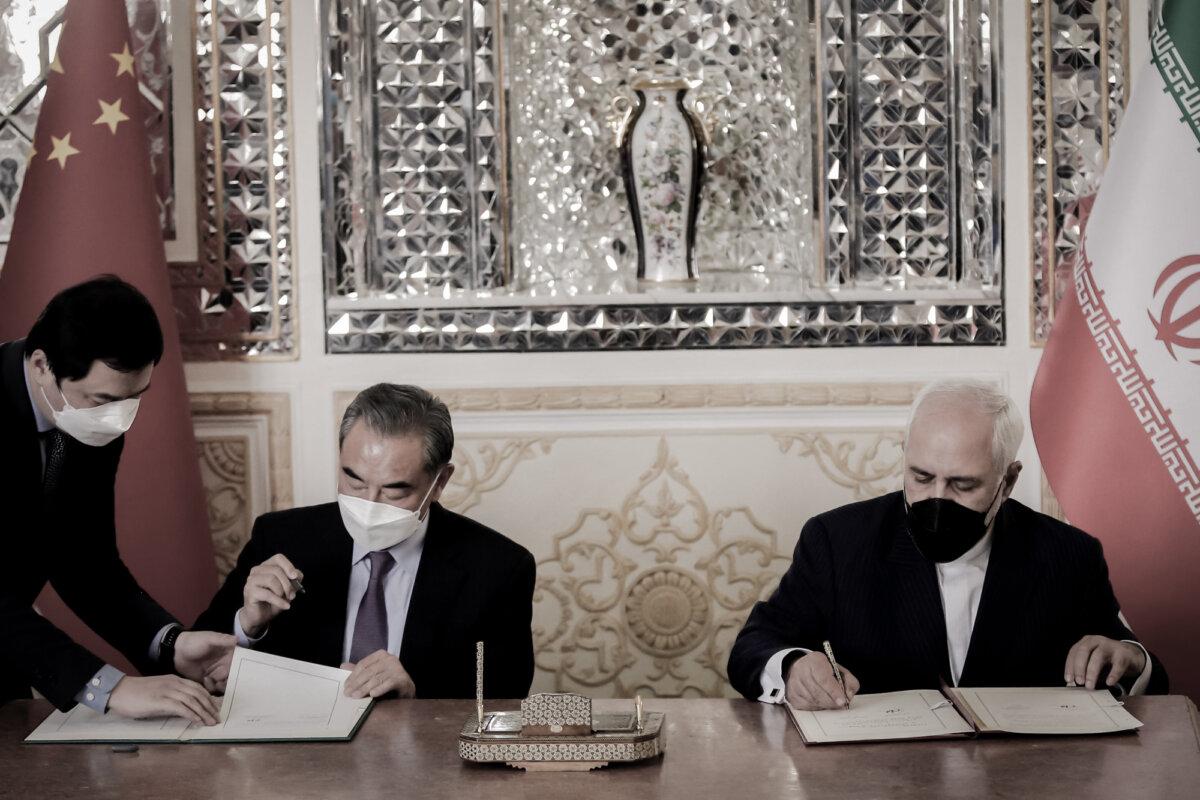
As tensions around Iran mount, the Chinese Communist Party (CCP) has quietly elevated its internal assessments of Middle East security, even as Beijing avoids public warnings that could disrupt its regional diplomacy, according to sources in China who spoke to The Epoch Times on condition of anonymity.
A source in China’s Ministry of Foreign Affairs told The Epoch Times that senior officials have recently conducted closed-door reviews of the security situation involving Iran and neighboring areas. China’s diplomatic and security agencies have been closely monitoring developments, particularly the risk that instability could spill beyond Iran’s borders. Those assessments have not been made public.
Reassessing China’s Presence in Iran
For Beijing, the stakes are significant. China has personnel stationed in Iran and nearby countries, long-term energy cooperation projects, and critical shipping routes that could be disrupted by a wider conflict. According to the source in the Chinese Foreign Ministry, these factors have now entered high-level contingency planning.“The internal review has focused on several key questions—whether China should continue purchasing Iranian oil under current conditions, whether Chinese-funded projects inside Iran can remain operational, and how evacuation or shutdown plans would be executed if the situation deteriorates rapidly,” said the source.
The source added that Chinese embassies and consulates across the Middle East have been instructed to increase the frequency of security reporting and maintain continuous monitoring of local developments. At the same time, officials are said to be studying detailed evacuation plans for Chinese diplomats and managers of state-owned enterprises operating in Iran.
According to another source in China’s diplomatic service, some Chinese institutions with exposure to Iran and neighboring countries have already been asked to reassess risks to overseas staff. Some diplomats and government-dispatched personnel in Iran have reportedly been told by the foreign ministry and Chinese embassies to “prepare for possible evacuation,” while certain Chinese-backed projects have been put on hold.
Companies involved in Iran-related operations have also quietly adjusted staff rotation schedules and living arrangements and stepped up internal safety briefings. None of these measures, the sources said, have been announced publicly.
.
High Alert Internally, Caution Externally
Yang Yongming, a pseudonym used by a person familiar with the inner workings of China’s diplomatic service, told The Epoch Times that Beijing’s current internal assessment views the Iran situation as one of “rising risk, but not one suitable for public classification.”“On one hand, relevant departments have moved into a heightened alert posture, advancing contingency planning and resource coordination,” Yang said. “On the other hand, there is a deliberate effort externally to avoid explicit risk warnings that could affect China’s diplomatic positioning, energy cooperation, or existing political relationships in the Middle East.”
Yang said official messaging has consistently downplayed the severity of the situation and avoided highlighting U.S. and Israeli military pressure on Iran. The CCP, he added, rarely comments publicly on U.S. military deployments in the region—changes that many international observers interpret as preparations for a potential conflict.
Political Calculation Over Public Warning
Kuan, a scholar in U.S.-China relations who spoke to The Epoch Times by only revealing his surname due to safety reasons, said the approach reflects a familiar pattern in Beijing’s handling of overseas security risks.“Whether authorities issue a public travel warning is not determined by the level of danger itself,” Kuan said. “It depends on how leaders assess the diplomatic and political consequences. Under this logic, ordinary citizens are not the primary audience for risk information.”
In his view, the existence of internal emergency preparations is itself an implicit acknowledgment that the situation carries real uncertainty.
“When contingency plans are activated internally but avoided in public discussion, it often means the risk assessment is already underway and information is being deliberately delayed or selectively withheld,” he said.
Kuan argued that the CCP prefers internal control and post-crisis remediation rather than early transparency that allows citizens to make their own judgments and avoid danger.
“In that framework, Party interests always come first, while ordinary people passively bear the risks,” he said.
He contrasted the current restraint over Iran with China’s swift issuance of travel warnings targeting Japan in November last year, after Japanese Prime Minister Sanae Takaichi made remarks related to Taiwan that sharply strained bilateral ties.
“The speed and clarity of that response had nothing to do with a sudden deterioration in public safety in Japan,” Kuan said. “It was political. When Beijing wants to send a signal, it does so without hesitation. When it doesn’t—no matter how dangerous the situation—it stays silent.”
According to Kuan, the selective release of travel warnings reveals a broader truth about how citizens’ safety is weighed in Beijing’s foreign policy calculations—warnings are issued not when risk peaks, but when doing so aligns with political interests and external messaging priorities.
What's Your Reaction?
 Like
0
Like
0
 Dislike
0
Dislike
0
 Love
0
Love
0
 Funny
0
Funny
0
 Wow
0
Wow
0
 Sad
0
Sad
0
 Angry
0
Angry
0













Comments (0)