

China, Japan Clash at UN in Ongoing Feud Over Taiwan


.
China’s ambassador to the United Nations used a Security Council meeting on Dec. 15 to try to pressure Japan into retracting Prime Minister Sanae Takaichi’s recent remarks regarding Taiwan, stirring up already existing tensions between the two countries.
In response to lawmakers’ questions on Nov. 7 about Japan’s defense posture in a hypothetical Chinese attack on Taiwan, Takaichi said naval conflicts would constitute a “survival-threatening situation” for Japan. Under a 2015 law enacted by late Prime Minister Shinzo Abe, a survival-threatening situation would trigger Japanese military actions.
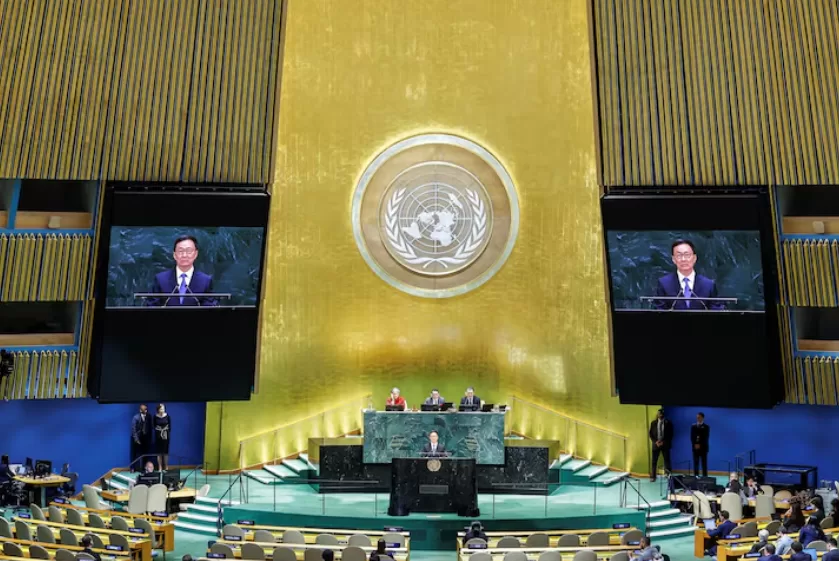
During a Dec. 15 U.N. Security Council meeting about maintaining international peace and security, Fu Cong, China’s permanent representative to the United Nations, repeated Beijing’s demand for Takaichi to retract what Fu described as “erroneous remarks,” and for the Japanese government to “repent for the past and refrain from continuing down the wrong path.”
Drawing parallels to World War II, Fu accused Japan of using Taiwan as a “pretext” to lift post-war military constraints, and described Japan’s strengthening of its defense posture as a “resurgence of militarism and fascism.”
He reiterated the CCP’s stance that Taiwan is “an inalienable part of the territory of China,” and that finding a way to resolve the Taiwan issue is “China’s internal affair.”
Japan’s permanent representative to the U.N., Yamazaki Kazuyuki, said Fu’s claims are “groundless,” and that his remarks “merely seek to sow division among member states, undermine a venue for the constructive discussions for the future of the U.N., and thus are inappropriate and irrelevant.”
“China’s assertion that Japan would exercise the right of self-defense even in the absence of an armed attack is completely erroneous,” he said.
Kazuyuki pointed to Japan’s post-war record, saying the country has been peace-seeking and “made innumerable contributions to peace and prosperity of the world.”
He said Japan’s defense posture is “exclusively defense oriented,” and that peace and stability in the Taiwan Strait are of global importance.
“We reiterate our consistent position of expecting that the issues concerning Taiwan will be resolved peacefully through dialog, and emphasize that the approach is [in] the interest of the entire world,” Kazuyuki said.
Taiwan was under Japanese rule for 50 years before Japan’s defeat in World War II. In 1945, Japan returned Taiwan to the Kuomintang (KMT)—the then-nationalist ruling party of China. KMT soon retreated from the mainland to the island of Taiwan, and is now the opposition party.
The CCP has never ruled Taiwan, but it has said it aims to absorb the island and has not ruled out doing so by force. The regime claims its treaties with diplomatic partners underpinned its “One China Principle,” which claims that the communist regime is the only legitimate government on both sides of the Taiwan Strait, while countries including the United States and Japan only acknowledge the CCP’s stance without endorsing it.
What's Your Reaction?
 Like
0
Like
0
 Dislike
0
Dislike
0
 Love
0
Love
0
 Funny
0
Funny
0
 Wow
0
Wow
0
 Sad
0
Sad
0
 Angry
0
Angry
0















Comments (0)