

China Is Now in Suspended Animation


.
China weeps and writhes, but the world slumbers.
Or, at least, much of the world slumbers, dreaming that the fruits of the China trade will continue to stimulate the global economy. That dream, in fact, has already ended.
The currency of the People’s Republic of China (PRC) has been weakening alongside the economy, and the factions of communist power stand, at daggers drawn, facing each other in the shadowed corridors of Zhongnanhai, the headquarters of the Chinese Communist Party (CCP).
“See,” the dreamers abroad say, “Xi Jinping still lives; he has his titles, power, and honors intact. We see no change; we see nothing beyond the Potemkin walls of the Great Hall of the People. The hope, and the threat, of the PRC remain as they were: the Fourth Plenary Session of the 20th Party Congress held between October 20 and 23, 2025, confirmed that business as usual prevailed.”
But that is not the case.
It might have been Xi Jinping, and not U.S. Founding Father Benjamin Franklin, who said (at the signing of the U.S. Declaration of Independence in 1776): “We must all hang together, or most assuredly we will all hang separately.”
And then there is the fourth major wellspring of power, opposed to all the Party contenders: the public, now bereft of economic hope or social pride. And it is the general public of mainland China that now sets the timeframe of change.
The reality behind this apparent stasis is far more dynamic than the tranquil scene that the outside world has been induced to believe. Xi, although retaining his paramount title and those of “chairman” of the Central Military Commission (CMC) and “president” of the PRC, has indeed effectively lost power. His attempts to safeguard his power have been thwarted, including the elimination of his so-called secret army, which had been created outside the command structure of the People’s Liberation Army (PLA), Xi’s ultimate defense.
This secret army—an independent military unit in Langfang, Hebei Province (close to Beijing), detached from China’s existing theater commands, regional forces, and the formal PLA hierarchy—had been created by two Xi loyalists, Gen. He Weidong and Adm. Miao Hua (both vice-chairmen of the CMC, thanks to Xi). But they had essentially been sequestered and removed from power early in 2025 by another CMC vice-chairman, Gen. Zhang Youxia. And, of course, Zhang—now the most senior CMC Vice-Chairman—had emerged as the default or de facto commander of the PLA by fairly early in 2025.
.

Along with Gen. He and Adm. Miao (director of the Political Work Department of the Central Military Commission) from October 2017 to June 2025, at least 3,000 more PLA officers were removed, with their fates unknown. No news of the manpower under the officers. These, presumably, were the troops of Xi’s secret army or division-sized “bodyguard.” Based on the PLA’s average officer-to-enlisted personnel ratio, that would imply the secret army’s strength was at least 12,000, if indeed those removed were all linked to Xi’s private force.
It must be assumed that the Xi team would also have identified regular PLA units that could have been co-opted to their cause if a showdown occurred.
However, as a result of Gen. Zhang Youxia’s actions, Xi Jinping has lost control of the PLA and his private military force, which answered solely to him outside the Party and PLA lines of authority.
Former CCP leader Mao Zedong had famously said that power grows from the barrel of a gun, and the new reality is that the gun is firmly in the hands of Zhang Youxia. Zhang is ostensibly partnered with the “reformists” and old guard of the CCP in removing Xi from power. Still, the pretense of the tenuous “legitimacy” of the CCP and its “right” to control all of mainland China keeps all parties fearful that any cracks in the facade would lead to the collapse of 76 years of the pretense of lawfulness or legitimacy.
So when will this frozen image suddenly shatter?
It could be assumed that the shattering has already begun.
The crowds are in the streets in many cities in a fashion that is being described as “pre-revolutionary.” That places the Party factions under great pressure. The last economic bargaining chip the Party had to leverage against the West (and particularly the United States) was its alleged control over the supply of rare-earth minerals, critical to the manufacture of electric vehicles, major defense systems (such as the F-35 fighter), and so on.
U.S. President Donald Trump, in the midst of the Fourth Plenum session, suddenly agreed to a summit with Australian Prime Minister Anthony Albanese—until then a favored client of the CCP—at which the United States and Australia agreed a supply deal for Australian rare earths to the United States. Then, at the ASEAN summit in Kuala Lumpur, Trump secured deals with rare-earth supplier and processor nations (Malaysia, Thailand, Cambodia) for rare-earth supplies.
Later, in Tokyo, Trump and Prime Minister Sanae Takaichi agreed to a deal to process rare earths, and after that, at the APEC summit in South Korea, the Republic of Korea also agreed with the United States to provide such capabilities. It was also the subject of an understanding that Trump reached with Tajikistan President Emomali Rahmon at the White House on Nov. 6. And Tajikistan is right in the backyard of Russia and China.
The CCP’s leverage was demolished, and rare earths are already being provided from processing states such as Malaysia. The rare earths are not rare.
The only strategic negotiating lever left to the CCP, then, was bluster: “wolf warrior” diplomacy. But who controlled the lever (or levers) to make this happen?
It seemed clear that some of Xi Jinping’s residual influence was with the media and perhaps even the foreign ministry. All CCP contestants seem to need to ensure that PRC military strength was seen to be intact and harmonized—which is patently no longer the case—so that would give weight to the bluster.
.
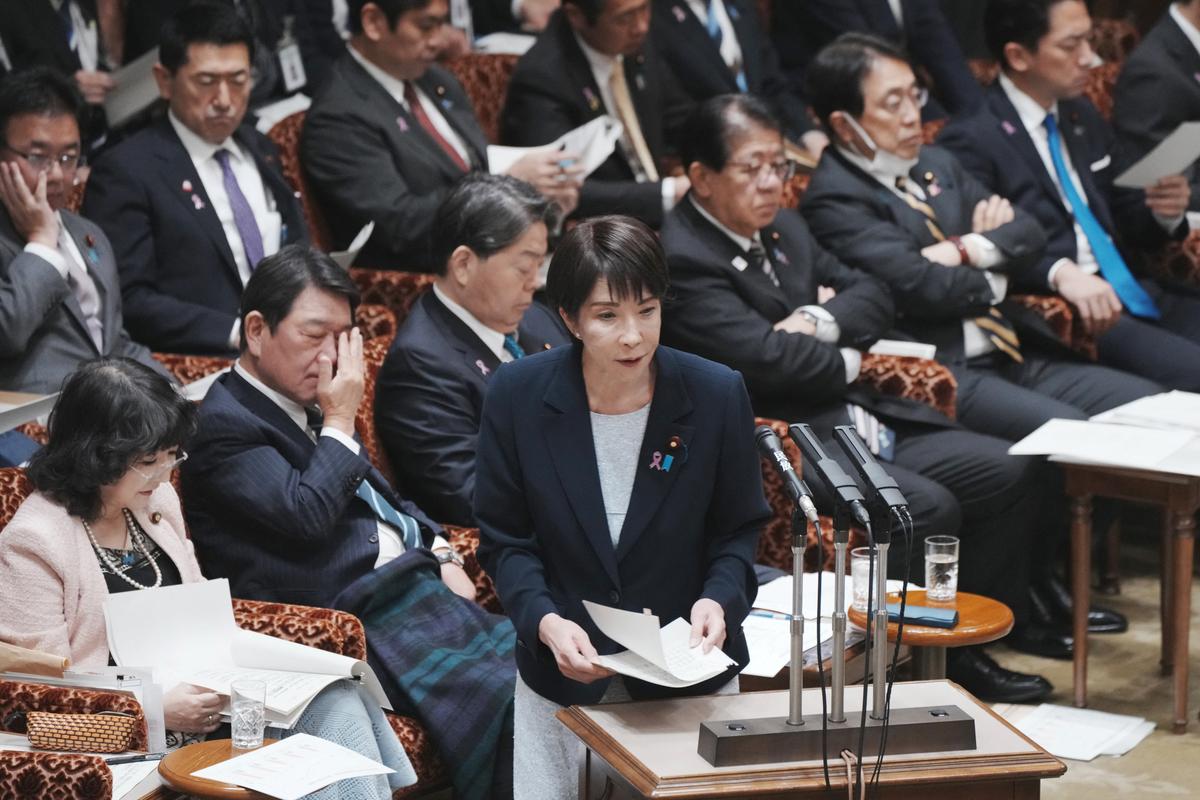
The most provocative distraction came from China’s consul-general in Osaka, Japan, Xue Jian, who said on Nov. 8 that Japanese Prime Minister Takaichi’s head should be cut off. Although the offensive remark posted on social media was quickly deleted, neither Xue nor the Chinese foreign ministry apologized; instead, they doubled down on their insults against Takaichi. This was largely a response to the prime minister’s statement that a crisis (caused by the Chinese regime) over Taiwan would pose a threat to Japanese security.
Essentially, the exchange sparked a flurry of comments that it could lead to a Sino–Japanese war, which, given the Chinese military’s lack of readiness, was unlikely. And if it did occur, it could precipitate a major humiliation for the CCP and Xi Jinping, but it could allow the CCP to instigate a major declaration of martial law to completely suppress the mainland population.
The anti-climactic commissioning of the PLA Navy’s newest aircraft carrier, the Fujian, on Nov. 5 at Sanya, the southernmost city of Hainan Island, was so played down by Chinese state media—as well as by the lackluster commissioning ceremony—that it confirmed reports that the Fujian was not thoroughly tested, was not as capable as had been portrayed, and was essentially a pro forma commissioning of a ship not even close to ready for combat.
Xi Jinping was at the ceremony to hand the commissioning flag to the ship, but on shore. He was flanked by his seemingly last loyalist, Cai Qi, who did not deliver a speech before the notably small crowd of spectators.
Every element of wealth and function seems now to have been stripped away or is slipping away from the Chinese regime, yet the perception of normalcy is the one thing the CCP has been able to sustain for the outside world.
If it were Japan, it would be seen as some opaque Kabuki theater, hiding a hollow world behind. As it is, the PRC’s massive disintegration is a direct mirror of the Soviet Union’s collapse in the early 1990s, only with greater consequences for the Chinese and global populations.
What's Your Reaction?
 Like
0
Like
0
 Dislike
0
Dislike
0
 Love
0
Love
0
 Funny
0
Funny
0
 Wow
0
Wow
0
 Sad
0
Sad
0
 Angry
0
Angry
0














Comments (0)