

Your Appendix May Be Protecting Your Brain — Removing It Could Raise Alzheimer's Risk
A major new study using artificial intelligence has found a surprising link between appendix removal and a higher risk of Alzheimer's disease. Researchers say the gut — not just the brain — may be where the disease actually begins, and that everyday habits like diet could be key to prevention.

.
The Brain Disease That May Start in Your Gut
For decades, Alzheimer's disease has been understood as a brain problem — a slow buildup of toxic proteins, a loss of neurons, a tragedy unfolding inside the skull. New research is now challenging that view in a fundamental way.
A major study conducted jointly by the University of Technology Sydney (UTS) and Massachusetts General Hospital, which is affiliated with Harvard Medical School, suggests that Alzheimer's may begin far earlier and much further down in the body — in the gut. Published in the peer-reviewed journal Alzheimer's & Dementia: Diagnosis, Assessment & Disease Monitoring, the findings are drawing attention from researchers worldwide.
AI Scans 10,000 People — and Finds a Shocking Result
The research team used artificial intelligence to analyze data from nearly 10,000 people. They looked at more than 120 different factors — diet, sleep, medical history, vitamin intake, lifestyle habits, and gut bacteria — to identify which combinations are most strongly associated with Alzheimer's risk.
The single strongest predictor was not a genetic marker or a brain scan result. It was something far more ordinary: whether a person had their appendix removed.
"People who had their appendix removed — one of the most routine surgical procedures in the world — showed substantially elevated Alzheimer's risk," said Associate Professor Kaveh Khalilpour, co-lead of the study and a researcher at the UTS Visualisation Institute.
Appendectomy (surgical removal of the appendix) is performed millions of times each year, most often as an emergency treatment for appendicitis. It is generally considered a low-risk procedure with no lasting consequences. This study suggests that assumption may need to be revisited.
What Does the Appendix Actually Do?
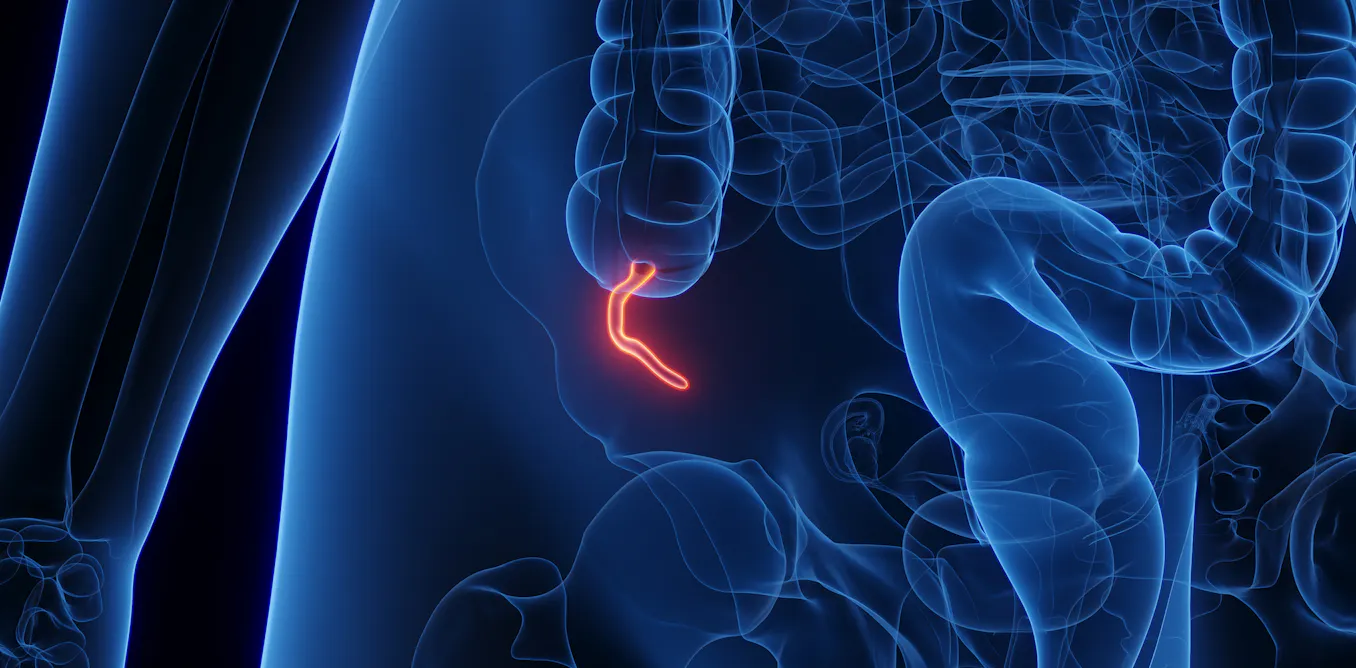
The appendix has long been dismissed as a leftover from evolution — a small pouch attached to the large intestine that seems to serve no purpose. Recent science has been revising that view.
Researchers now believe the appendix functions as a kind of biological reservoir, housing colonies of beneficial gut bacteria. When the digestive system is disrupted by illness, infection, or antibiotic treatment, the appendix may help the gut microbiome (the vast community of microorganisms living in your intestines) recover and rebuild.
"We speculate that it functions as a reservoir of beneficial gut bacteria," Khalilpour explained. "When it is removed, the microbiome loses a key recovery mechanism — its ability to replenish healthy microbial communities after illness, infection, or antibiotic use."
In other words: without an appendix, the gut may struggle to bounce back — and over a lifetime, that could matter for the brain.
Diet, Diabetes, and the Long Shadow of Chronic Disease
Beyond the appendix finding, the study identified several other strong risk factors — many of them modifiable through lifestyle choices.
Long-term eating habits played a central role. Dairy products and other foods containing lactose were linked to a lower risk. Diets rich in whole foods, plant-based protein, and omega-3 fatty acids (found in fish, flaxseed, and walnuts) were also protective. By contrast, processed foods, refined sugars, and saturated fats were associated with higher risk.
Chronic health conditions mattered too. Diabetes, high blood pressure, and depression each emerged as significant contributors to Alzheimer's risk in the model. This aligns with a growing body of research linking cardiovascular and metabolic health to brain health over time.
"Our study adds to growing evidence that taking care of gut health through healthy eating, managing chronic disease, and reducing inflammation may be one important part of lowering long-term risk," Khalilpour said.
The Gut-Brain Highway
The study also explored the so-called gut-brain axis — a two-way communication network connecting the digestive system and the immune system to the brain. Think of it as a biological highway, constantly sending signals in both directions.
When researchers examined gut microbiome data from around 2,000 samples, they found that people with Alzheimer's showed clear signs of dysbiosis — a harmful imbalance of gut bacteria. Microbial diversity was lower than normal. Beneficial bacterial species known as Roseburia and Faecalibacterium, which help control inflammation in the body, were significantly reduced.
"A more inflammatory microbial environment had taken hold — one that appears capable of sending damaging signals to the brain via the gut-brain axis," said Dr. Faezeh Karimi, a senior lecturer at UTS and co-author of the study.
This matters because a healthy gut does far more than digest food. It regulates the immune system, produces chemicals that affect brain function, and helps keep inflammation in check. When that system breaks down — quietly, over years — the consequences for the brain may be severe.
A New Tool for Early Detection?
The researchers were careful to note that their AI model is not a diagnostic tool. It cannot tell any individual whether they will develop Alzheimer's. But it points toward something significant: a future in which a simple health questionnaire, entered into an AI system, could flag elevated risk years before symptoms appear.
"Unlike genetic risk factors, these exist on a timeline that may be intervened upon," Karimi said. That distinction is crucial. Genetic risk cannot be changed. Diet can. Gut health can be supported. Chronic conditions can be better managed.
The practical implications could be significant. Imagine an older adult who had their appendix removed years ago, has eaten a high-sugar, low-fiber diet for most of their life, and currently shows no memory problems. An AI model incorporating these factors could identify elevated risk — early enough for meaningful lifestyle changes to make a difference.
What This Means for You
The study's authors are careful to say that more long-term research is needed before firm clinical recommendations can be made. Correlation is not causation, and this is a risk model, not a definitive diagnosis.
That said, the direction of the evidence is consistent with a growing scientific consensus: what you eat, how healthy your gut is, and how well you manage chronic conditions all appear to influence your long-term brain health in ways that were not fully appreciated until recently.
The takeaway is less alarming than it might seem. Appendix removal will remain a necessary medical procedure in cases of appendicitis. But the finding highlights just how interconnected our body systems are — and how decisions made over a lifetime, on what we eat and how we live, may shape our cognitive fate decades later.
"Alzheimer's may not begin in the brain at all," Khalilpour concluded. "It may begin quietly — and years earlier — in the gut, shaped by the food we eat, the bacteria we carry, and the medical history we accumulate across a lifetime."
.
Sources
-
University of Technology Sydney — Official press release: "Study shows links between Alzheimer's and gut health can lead to prevention" (April 2026) https://www.uts.edu.au/news/2026/04/study-shows-links-between-alzheimers-and-gut-health-can-lead-to-prevention
-
Neuroscience News — "AI Identifies Appendix Removal and Diet as Alzheimer's Risks" (April 21, 2026) https://neurosciencenews.com/gut-microbiome-alzheimers-appendix-30571/
-
Original peer-reviewed study — Jabeen, Karimi, Zomorrodi, Khalilpour: "Multi-modal machine learning and gut microbiome pathway analysis for Alzheimer's risk prediction." Alzheimer's & Dementia: Diagnosis, Assessment & Disease Monitoring. DOI: 10.1002/dad2.70340 https://alz-journals.onlinelibrary.wiley.com/journal/23528729
-
National Institutes of Health / PubMed — Jamerlan et al.: "Microbial diversity and fitness in the gut–brain axis: influences on developmental risk for Alzheimer's disease." Gut Microbes, April 2025. https://www.ncbi.nlm.nih.gov/pmc/articles/PMC11988266/
-
ScienceDirect — "The Risk of Alzheimer's Disease After Acute Appendicitis With or Without Appendectomy" (2021) https://www.sciencedirect.com/science/article/abs/pii/S1525861021005715
.
What's Your Reaction?
 Like
0
Like
0
 Dislike
0
Dislike
0
 Love
0
Love
0
 Funny
0
Funny
0
 Wow
0
Wow
0
 Sad
0
Sad
0
 Angry
0
Angry
0















Comments (0)