

Scientists Finally Map the Sense of Smell — A Discovery That Could Help Millions
For the first time, Harvard researchers have created a complete map of smell receptors in the nose and their connection to the brain. Published in Cell in April 2026, the findings overturn decades of scientific assumptions — and could open new paths for treating smell loss in millions of people worldwide.

.
A Missing Piece in Neuroscience — Now Found
Vision has a retinal map. Hearing has a cochlear one. For decades, the sense of smell stood alone as the one human sense without a comparable structure. Scientists assumed its roughly 1,100 receptor types were simply scattered across nasal tissue in no particular order. Now, two landmark studies published on April 28, 2026, in the journal Cell have overturned that assumption entirely.
Two independent research teams at Harvard University — one led by neuroscientist Dr. Sandeep Robert Datta at Harvard Medical School, the other by Professor Catherine Dulac at Harvard's Department of Molecular and Cellular Biology — have each produced the first detailed spatial map of smell receptors in the mouse nose. Crucially, both teams arrived at the same result.
"Our results bring order to a system that was previously thought to lack order," said Datta, senior author of the first study. "Which changes conceptually how we think this works."
The Nose Has Stripes
To build their map, Datta's team analyzed roughly five million nerve cells from hundreds of mice, using advanced genetic tools that reveal which type of smell receptor each neuron carries and exactly where in the nose it sits.
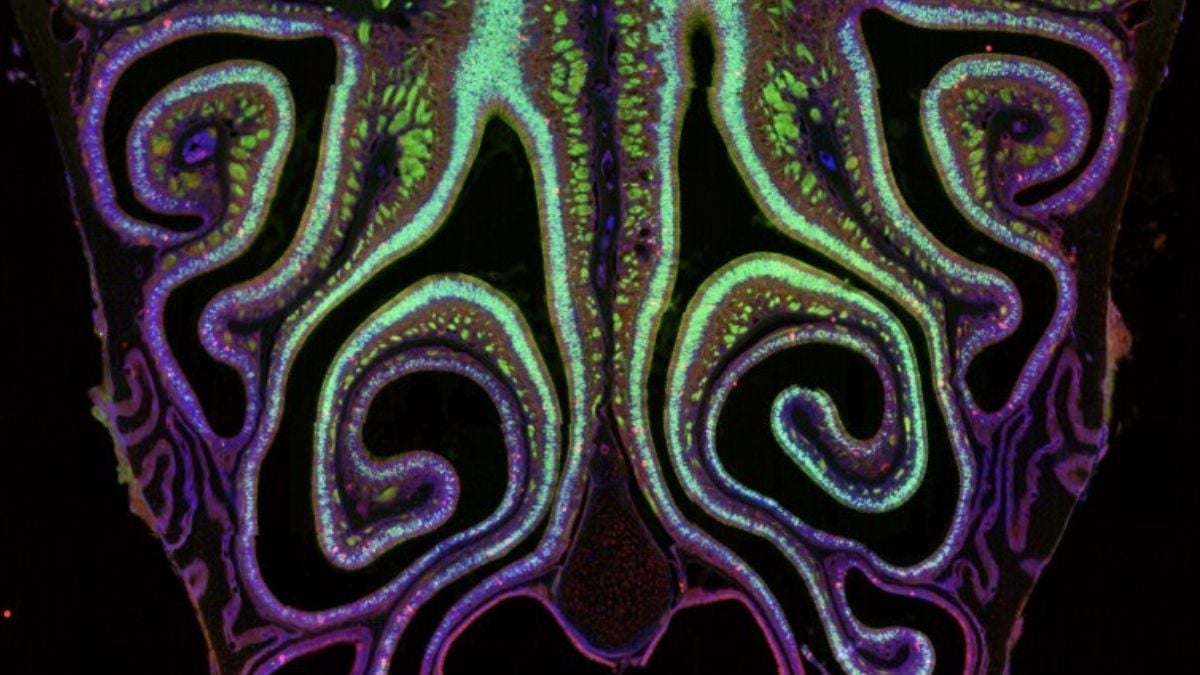
What they found was striking: rather than a random scatter, the smell receptor cells are arranged in precise horizontal stripes — running from the top to the bottom of the nasal tissue — grouped by receptor type. This pattern was consistent across every animal studied.
"We show that development can achieve this feat of organizing a thousand different smell receptors into an incredibly precise map that's consistent across animals," Datta said.
The Dulac lab's companion study went a step further. It traced how that organized pattern in the nose connects to the brain's olfactory bulb — the region where smell signals are first processed. The layout in the brain mirrors the one in the nose, suggesting a precisely coordinated system that links the two organs together.
How This Order Is Built
Datta's team also investigated how this striped organization forms in the first place. The answer appears to lie in a molecule called retinoic acid — a chemical already known for guiding the body's growth and development.
During development, smell-sensing neurons are exposed to varying concentrations of retinoic acid across the nasal tissue. These gradients appear to act as a kind of biological positioning signal, helping each neuron "decide" which receptor to produce and where to settle.
When researchers disrupted retinoic acid signaling in experiments, the entire receptor map shifted — regions moved up or down within the tissue. This confirmed that the chemical gradient plays a key role in establishing the nose's spatial organization.
Why It Matters: Millions Struggle with Smell Loss
The broader significance of this discovery becomes clear when you consider just how common smell loss is — and how poorly it is currently treated.
Studies estimate that between five and ten percent of people who lost their sense of smell due to COVID-19 never fully recovered. And COVID is just one cause: head injuries, aging, and infections can all damage the olfactory system. Research has consistently linked long-term smell loss to depression, anxiety, social isolation, and reduced quality of life.
Yet effective treatments remain extremely limited. Smell disorders are notoriously difficult to treat, in part because scientists did not understand how the system is organized to begin with.
"We cannot fix smell without understanding how it works on a basic level," Datta said.
The new findings suggest why restoration is so hard: it is not enough to simply replace damaged neurons. Any new cells would need to land in precisely the right positions within the nose's spatial map — and reconnect to the brain's corresponding regions. A stem-cell therapy, for example, would need to distribute new cells across the entire olfactory tissue, not just patch isolated areas.
What Comes Next
Both teams are now investigating why the receptor stripes appear in their specific order, and whether similar organizational patterns exist in human tissue. Researchers are beginning to study human nasal samples to see how closely the mouse findings apply.
The answer matters enormously. As Dr. Bradley Goldstein, a sinus specialist at Duke University School of Medicine, has noted: direct proof of this organization in humans has not yet been established — but similar organizing principles are likely at work.
Beyond smell restoration, the researchers are also exploring connections to social behavior. The Dulac lab's study found that distinct spatial regions of the olfactory map appear to be dedicated to processing social odors — signals that convey information about other individuals, including sex and age. This raises new questions about how smell shapes human behavior and emotion in ways science is only beginning to understand.
"Smell has a really profound and pervasive effect on human health," Datta said — not only for pleasure and safety, but for psychological well-being.
For the millions living without a fully functioning sense of smell, this first map of the olfactory system is more than a scientific milestone. It is the beginning of a roadmap toward repair.
.
Sources:
- NIH National Institute on Deafness and Other Communication Disorders – "Scientists Create Detailed Map of Odor Receptors" (April 2026): https://www.nih.gov/news-events/nih-research-matters/scientists-create-detailed-map-odor-receptors
- Cell Journal – Brann et al., "A spatial code governs olfactory receptor choice and aligns sensory maps in the nose and brain" (April 28, 2026): https://doi.org/10.1016/j.cell.2026.03.051
- Cell Journal – Bintu et al., "Spatial organization and detection of social odors in mouse primary olfactory system" (April 28, 2026): https://doi.org/10.1016/j.cell.2026.03.053
- ScienceDaily – "A hidden map in your nose could explain how smell works" (April 30, 2026): https://www.sciencedaily.com/releases/2026/04/260429102025.htm
- EurekAlert! – "Scientists create first-ever 'smell map'" (April 28, 2026): https://www.eurekalert.org/news-releases/1125595
- Oxford Academic / Chemical Senses – "Impact of olfactory loss on quality of life: a 2025 review": https://academic.oup.com/chemse/article/doi/10.1093/chemse/bjaf023/8214547
- UK House of Lords Library – "Living with Anosmia: The problem of long-term loss of sense of smell" (March 2026): https://lordslibrary.parliament.uk/living-with-anosmia-the-problem-of-long-term-loss-of-sense-of-smell/
.
What's Your Reaction?
 Like
0
Like
0
 Dislike
0
Dislike
0
 Love
0
Love
0
 Funny
0
Funny
0
 Wow
0
Wow
0
 Sad
0
Sad
0
 Angry
0
Angry
0













Comments (0)