

"Important Consensus" — But No Word on Nuclear Weapons: The Xi-Kim Summit and What It Really Decided
Xi Jinping has returned to Beijing after his two-day state visit to Pyongyang. Both governments are calling the summit a historic success. But the most revealing detail is what neither side chose to say: the word "denuclearization" was absent from every official statement. That silence may be the most consequential outcome of the entire visit.


.
Xi Departs, Sends a Thank-You — and a Signal
After two days of summits, banquets, artistic performances, and ceremonial tree-planting in Pyongyang, Chinese President Xi Jinping departed North Korea on Tuesday. Before leaving, he paid tribute alongside Kim Jong Un at the Sino-Korean Friendship Tower — a monument to Chinese soldiers who died fighting for North Korea in the 1950–1953 Korean War. The symbolism was deliberate: a reminder that this alliance is built not just on diplomacy, but on sacrifice and shared history.
In a message of thanks carried by North Korean state media KCNA on Wednesday, Xi declared that the visit had been "successfully concluded" and that China-North Korea relations had now entered "a new historical stage." He described reaching a series of what he called "important joint consensus" with Kim Jong Un, and said he hoped to meet the North Korean leader again.
"The mutual understanding between China and North Korea has become deeper and more comprehensive, and the direction of future development has become clearer and more defined," Xi told his hosts at a final lunch before his departure, according to China's Xinhua news agency.
What Was Agreed: Cooperation Across the Board
The official outcomes of the summit are broad in scope and carefully phrased. Both governments confirmed agreement to expand cooperation across politics, economics, trade, culture, and what they termed "strategic communication" — regular high-level consultations between their governments.
Kim told Xi he would fully support the "One China principle," Beijing's position that both sides of the Taiwan Strait belong to one country, regardless of changes in the international situation. It was a tangible diplomatic gift, delivered publicly and on the record — worth something to Beijing as it navigates its competition with Washington.
Xi, for his part, called for both sides to capitalize on the full reopening of border crossings and the resumption of direct flights and passenger train services — practical connectivity that had been frozen since the pandemic. Trade between the two countries last year recovered to pre-pandemic levels, and further economic packages — food aid, fertilizer, possibly the return of Chinese group tourism — are expected to follow.
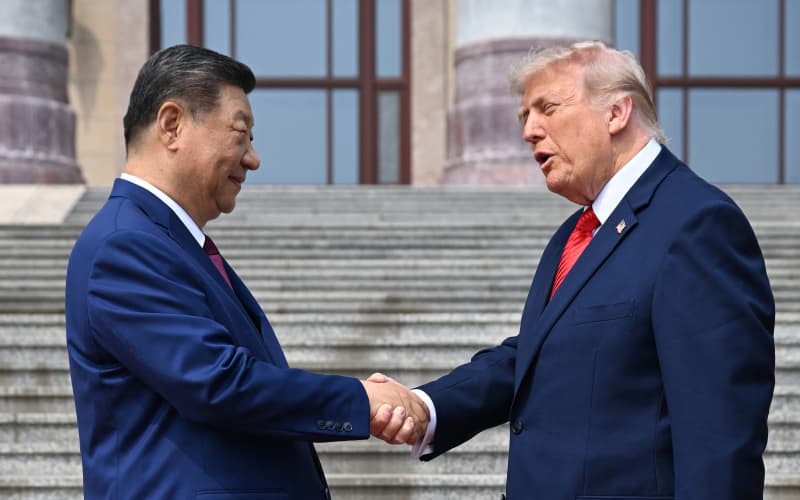
The timing of Xi's visit plays to Beijing's efforts to cast China as a versatile, global power broker at a moment of intense geopolitical flux. Xi's trip to Pyongyang came just weeks after he separately hosted both Russian President Vladimir Putin and U.S. President Donald Trump in Beijing. He is expected to travel to the United States for another meeting with Trump in September.
The Word Nobody Said
For all the ceremony and the communiqués, the single most important detail of this summit was its most conspicuous omission.
There was no public reference to denuclearization or anything to that effect in reports by either country's state media — raising serious questions about whether Beijing has quietly shifted its long-standing policy position on North Korea's weapons programme.
This was not always the case. During Xi's trip to Pyongyang in 2019, he explicitly pointed out China's support for efforts toward the denuclearization of the Korean Peninsula. That language is now gone.
As we flagged in our two earlier reports in this series — and as analysts have confirmed — this absence is not accidental. (See: Xi Jinping in Pyongyang: Kim Jong Un Negotiates From a Position of Strength and Xi Arrives: China and North Korea Vow to Fight "Hegemony" Together)
"Chinese officials have taken the position of not speaking publicly about denuclearization on the Korean Peninsula while still maintaining it as a long-term goal," said Leif-Eric Easley, a professor of international studies at Ewha Womans University in Seoul. "Kim appears to want Xi to accept North Korea as a nuclear neighbor."
China's policy ambiguity on the denuclearization issue started emerging in 2024, driven by several factors, indicating China's new priority on advancing its strategic competition with the United States — a competition in which North Korea serves as a useful buffer, regardless of its weapons status.
Beijing Shifts Its Priority: Countering Washington Over Curbing Pyongyang
The summit underlined a deepening strategic alignment between the two countries and their unity amid an intensifying Sino-U.S. rivalry over trade, security and other areas.
In practical terms, this means Beijing appears to have made a calculation: the value of a stable, aligned North Korea as a geopolitical buffer outweighs the benefit of pressing Kim on nuclear disarmament — a demand that was never going to succeed anyway, and which would only have pushed Pyongyang further toward Moscow.
"Russia is tangibly a more reckless actor in northeast Asia," said Adam Farrar of the Center for Strategic and International Studies. Xi's visit was, in part, about ensuring China — not Russia — remains North Korea's most critical partner.
Analysts note that the implications extend beyond the peninsula. China's silence on North Korea's denuclearization will inadvertently push South Korea to reassess China's strategic value as a partner. Seoul, which has long relied on Beijing as a channel of influence over Pyongyang, may now have to adjust its own calculations.
Kim Leaves the Table With Everything He Wanted
Kim Jong Un arrived at this summit from a position of strength — and he leaves it having conceded nothing of substance. He received a state visit from the leader of the world's second-largest economy, secured pledges of expanded trade and economic cooperation, won international recognition of his diplomatic relevance, and — most critically — faced no public pressure whatsoever on his nuclear programme.
In the days surrounding the summit, Kim unveiled a new weapons-grade nuclear material production facility, called for expanding his atomic arsenal at what he described as an "exponential rate," observed sea trials of a new naval destroyer, and had his sister publicly dismiss American calls for denuclearization as an "anachronistic dream." (See our full coverage here)
None of that prompted any recorded pushback from Beijing — at least not in public.
South Korean President Lee Jae Myung told reporters Monday that North Korea is currently producing enough nuclear material annually for approximately ten to twenty new weapons, and is close to perfecting intercontinental ballistic missile technology. The programme is not pausing for diplomacy. It is accelerating alongside it.
What Comes Next: Trump, Taiwan, and an Uncertain Peninsula
The question now is whether Xi's renewed leverage over Kim will translate into any movement toward the United States. President Trump has expressed repeated willingness to restart direct talks with Pyongyang. Kim has so far refused, insisting Washington first abandon its demand for denuclearization as a precondition.
While it is highly likely that the leaders of China and North Korea would confer before Kim might meet Trump again, it is doubtful that Xi will serve as a catalyst for U.S.-North Korea talks, Easley said.
The summit has nonetheless shifted the regional landscape in ways that will take time to fully assess. Beijing has reasserted itself as Pyongyang's primary patron. Kim has received that reassurance without having to offer anything meaningful in return. And the Korean Peninsula's security architecture — the question of who gets a seat at the table when its future is decided — remains, as always, deeply contested.
What this summit made clear is where the lines now run: China and North Korea are aligned, strategically and ideologically. Nuclear weapons are North Korea's business, not Beijing's. And the era in which international pressure could meaningfully constrain Kim Jong Un's ambitions may, quietly, be over.
.
Sources
- Reuters – "China's Xi says he reached important consensus with Kim in North Korea visit, KCNA reports" (June 10, 2026): https://www.reuters.com/world/china/chinas-xi-says-he-reached-important-consensus-with-kim-north-korea-visit-kcna-2026-06-09/
- Reuters – "North Korean and Chinese leaders agree to boost ties at Pyongyang summit" (June 8/9, 2026): https://www.reuters.com/world/china/north-korea-china-agree-expand-cooperation-various-sectors-north-koreas-state-2026-06-08/
- Korea Herald – "Summit shows China more focused on countering US influence than curbing N. Korean nukes: experts" (June 10, 2026): https://www.koreaherald.com/article/10767793
- CNN – "Xi Jinping calls for strengthened strategic cooperation with North Korea in rare summit with Kim Jong Un" (June 2026): https://www.cnn.com/2026/06/07/asia/china-xi-jinping-north-korea-kim-jong-un-intl-hnk
- Christian Science Monitor – "What Xi and Kim gained from their summit in North Korea" (June 9, 2026): https://www.csmonitor.com/World/Asia-Pacific/2026/0609/xi-jinping-pyongyang-kim-jong-un-summit
- Udumbara.net – "Xi Jinping in Pyongyang: Kim Jong Un Negotiates From a Position of Strength": https://udumbara.net (finale URL nachtragen)
- Udumbara.net – "Xi Arrives: China and North Korea Vow to Fight Hegemony Together": https://udumbara.net (finale URL nachtragen)
- Udumbara.net – "Kim's Sister Draws a Hard Line": https://udumbara.net/kims-sister-draws-a-hard-line-north-korea-will-never-give-up-its-nuclear-weapons
.
What's Your Reaction?
 Like
0
Like
0
 Dislike
0
Dislike
0
 Love
0
Love
0
 Funny
0
Funny
0
 Wow
0
Wow
0
 Sad
0
Sad
0
 Angry
0
Angry
0













Comments (0)