

Convergence of Events and Disastrous Policies Threaten the CCP


.
From the outside, the Chinese Communist Party (CCP) appears monolithic—an ironclad political machine controlling the world’s second-largest economy and ruling more than 1.4 billion people with an iron fist. Beijing goes to great lengths to project an image of stability, discipline, and long-term strategic planning to both its people and the outside world.
But history tells us that authoritarian systems often look strongest right before cracks from internal and external pressures begin to show. Beneath the CCP’s carefully managed image lie a series of structural challenges—aging leadership, demographic collapse, slowing economic growth, internal power struggles, and declining confidence in local governance—that threaten the integrity of the Party’s control over the country and its economy.
Aging Leadership and An Uncertain Future
One of the quiet but significant issues inside the CCP is its aging leadership and the growing uncertainty about succession.The Politburo Standing Committee, which is China’s top decision-making body, is dominated by men in their late 60s and 70s. CCP leader Xi Jinping himself is now in his early 70s. Traditionally, the Party has tried to manage leadership transitions through informal rules, including the so-called “seven up, eight down” convention that encouraged officials aged 68 or older to step aside.
Those norms have all but disappeared dramatically in recent years.
In 2018, China removed presidential term limits, allowing Xi to potentially remain in power indefinitely. That move consolidated Xi’s authority in the short term but created long-term uncertainty about what happens when Xi dies or is no longer able to rule.
This is an enormous problem for the Party.
When authoritarian systems lack clear succession mechanisms, elite competition often shifts behind closed doors—sometimes destabilizing the very system meant to maintain order. History offers plenty of examples—from the late Soviet Union to other one-party states—where leadership uncertainty eventually became a source of political instability.
China’s Demographic Time Bomb
Another challenge is demographic—and it may be even more consequential.
China’s population is aging rapidly. Decades of the one-child policy, rising living costs, and urbanization have sharply lowered birth rates. In fact, China’s population began declining in 2022 for the first time in more than six decades.
That’s not just a statistical milestone. It marks a profound turning point in the country’s economic trajectory.
A shrinking workforce means slower economic growth. Meanwhile, pension obligations and health care costs for the elderly are rising quickly. Fewer young workers will be supporting a rapidly expanding elderly population.
Slowing Growth and Economic Friction
The collapsing population is proving to pose insurmountable challenges, at least in the short- and medium-term. For more than 40 years, China’s economic growth averaged near double digits. That era is now over.China’s economy is slowing as it confronts multiple structural problems that are impossible to ignore, such as rising debt, billions in bad debt, a cratering property sector, declining productivity gains, and weakening export demand.
All of these distortions stem from CCP policies.
The results were predictable. Local governments are heavily indebted. The once-booming real estate sector—a long-time pillar of economic growth—is under severe stress. Labor costs are rising, making China less competitive as a low-cost manufacturing hub.
Internal Party Politics Never Disappeared—But Grow Worse
None of this necessarily means economic collapse today, but that’s from an outsider’s point of view. Internally, there are some indications that the Party is as unpopular as it has ever been. Slower growth undermines one of the CCP’s most important sources of political legitimacy, but so does the general discontent that seems to be rising.Although the CCP presents itself as a unified organization, the reality is that Chinese politics has always contained internal factions competing for influence.
These networks typically form around regional affiliations, career paths, or political alliances within the Party.
That in itself is a double-edged sword. Since coming to power, Xi has launched one of the largest anti-corruption campaigns in modern Chinese history. Millions of officials have been investigated or punished since 2012.
.
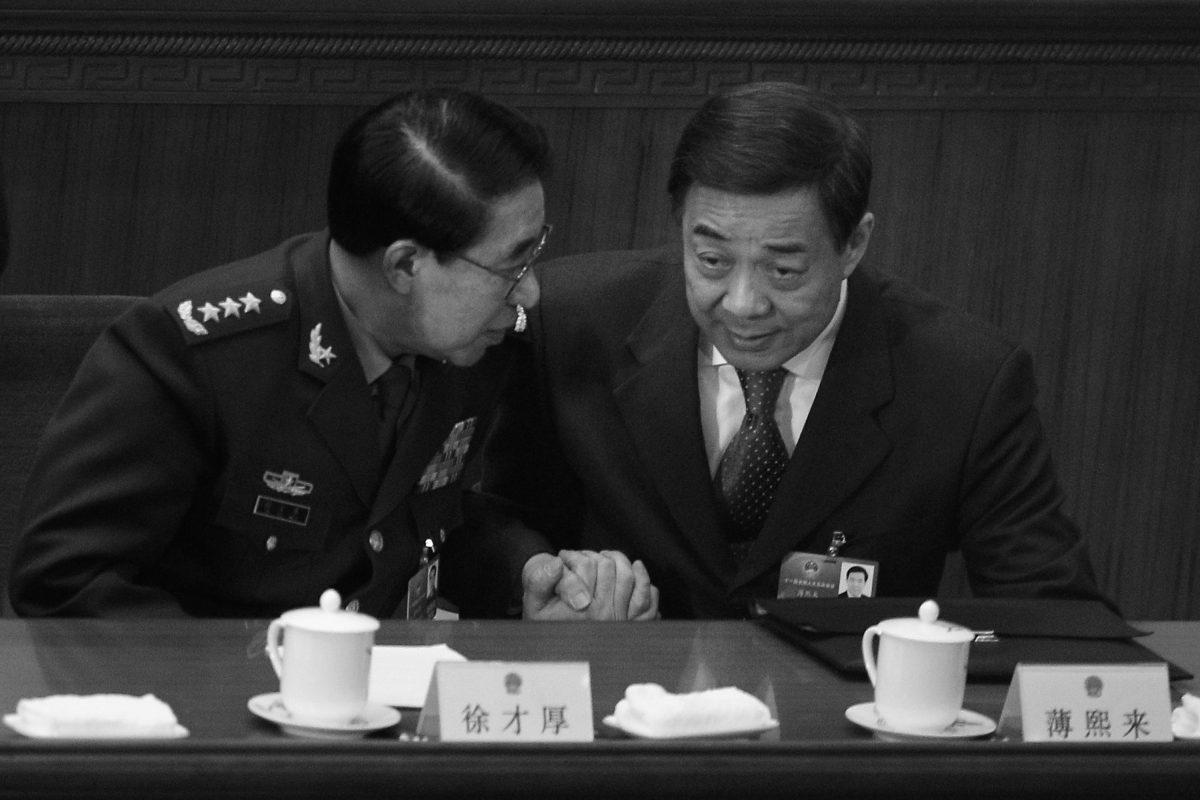
The then-vice chairman of the Central Military Commission Xu Caihou (L) appears to console former Politburo member Bo Xilai after the third plenary meeting of the rubber-stamp National People's Congress in Beijing on March 9, 2012. One month later, Bo would be removed from all of his Party posts, the first prominent member of Jiang Zemin's faction to be purged. Xu was also purged. Feng Li/Getty Images
.
The campaign has reshaped the Party’s internal balance of power, sidelining rival factions and consolidating authority around Xi. Plus, purges often create as many new enemies as quickly as they eliminate the perceived ones.
Local Governments Are Under Pressure
At the national level, Beijing appears firmly in control. But much of China’s day-to-day governance depends on provincial and local governments.And that’s where financial pressure is growing rapidly.
For years, local governments relied heavily on land sales tied to China’s property boom. When real estate developers bought land, local officials used the revenue to finance infrastructure projects and public services.
But as the property sector weakens, those revenues have fallen sharply. Today, many local governments face mounting debt, shrinking budgets, and delayed payments to contractors and workers.
The Authoritarian Dilemma
These pressures point to a deeper issue facing the CCP.Authoritarian systems often struggle during periods of structural economic change. In more open economies, businesses and citizens can adapt relatively quickly to shifting conditions. Innovation, entrepreneurship, and market competition help redirect economic activity.
But centralized political systems tend to restrict that kind of flexibility.
In China’s case, the problem is compounded by another factor: The ruling Party itself has become deeply intertwined with the country’s wealth. Political elites, state-owned enterprises, and Party networks often control major sectors of the economy.
That creates a dilemma.
Allowing greater economic freedom could help China adapt to new realities. But it could also weaken the Party’s political control and threaten the privileges of those at the top. History suggests that when ruling elites enrich themselves while limiting economic opportunity for the broader population, public confidence can erode surprisingly quickly.
How the CCP responds to these pressures could ultimately shape not only China’s economic future but also the stability of its political system.
What's Your Reaction?
 Like
0
Like
0
 Dislike
0
Dislike
0
 Love
0
Love
0
 Funny
0
Funny
0
 Wow
0
Wow
0
 Sad
0
Sad
0
 Angry
0
Angry
0














Comments (0)