

China Expands Orbital Surveillance and Military Space Power in 2026 to Counter the US


.
China is accelerating its space program in 2026 with record launch rates, massive megaconstellation deployments, and specialized surveillance satellites, signaling a deliberate push to expand military space capabilities and challenge U.S. dominance in orbit.
China opened its 2026 space mission schedule on Jan. 13 with two orbital missions, marking the start of an ambitious campaign that could set a new launch record. Relying on “military-civil” fusion, Beijing is projected to conduct more than 70 state launches and potentially exceed 100 total launches when commercial rockets are included, a sharp acceleration from the 92 launches carried out in 2025.
Megaconstellations are a central pillar of the 2026 plan. The Guowang constellation is expected to deploy roughly 310 satellites, while Qianfan is projected to launch approximately 324. Together, the two megaconstellations alone account for an estimated 634 satellites planned for launch in 2026, more than double the roughly 300 satellites China deployed in 2025.
The 142-degree retrograde orbit is significant because it reflects a deliberate operational choice that carries substantial costs. Launching against Earth’s rotation requires additional velocity and fuel, yet Beijing selected this orbit to gain enhanced surveillance advantages.
The inclination enables faster ground-track coverage and repeated access to mid-latitude regions between roughly 52 degrees north and south, including most of the continental United States, major U.S. military installations in Japan, South Korea, and Guam, as well as critical Pacific sea lanes. This frequent revisit capability enables sustained monitoring of bases, carrier strike group transit routes, and logistics hubs, allowing tracking of movements rather than merely observing fixed facilities.
Combined with the Yaogan series’ known dual-use nature, this orbital profile suggests the satellite is optimized for persistent surveillance of U.S. military activity in the Pacific and potentially over the continental United States. Although China publicly frames Yaogan satellites as civilian assets, many are believed to carry military-grade sensors supporting reconnaissance, targeting, and signals intelligence.
In a Taiwan contingency, frequent-revisit coverage would help China track and potentially disrupt U.S. force movements by supporting missile targeting, maritime domain awareness, and early warning through near-continuous updates rather than isolated snapshots.
.
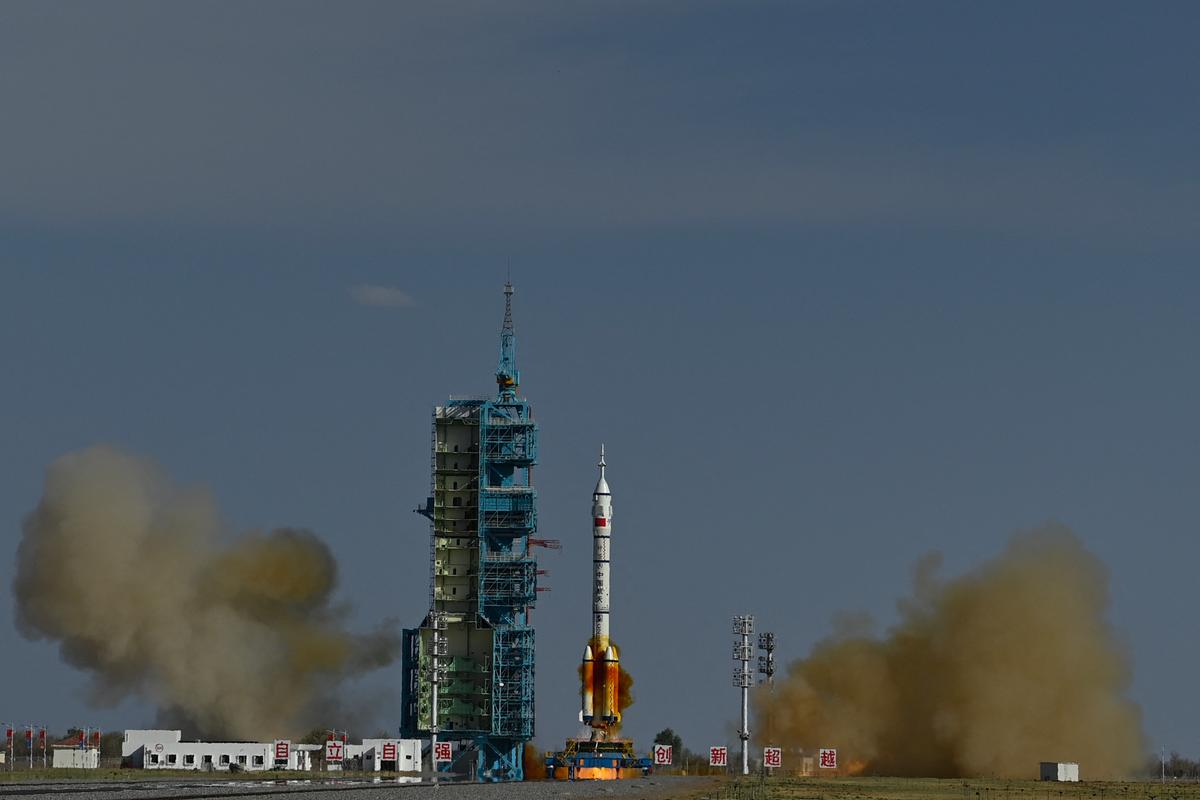
About an hour after the Long March 6A was launched on Jan. 13, a Long March 8A rocket launched from the Hainan Commercial Space Launch Site, deploying nine satellites for the Guowang low-Earth-orbit megaconstellation. Guowang is China’s state-led response to Starlink and is believed to support communications, navigation, remote sensing, and space situational awareness.
Launching from Hainan signals a shift from legacy military spaceports to commercial infrastructure built for frequent, high-density launches. Optimized for aggregated payloads, the Long March 8A provides the lift capacity needed for megaconstellation missions and supports China’s move toward reusable launch vehicles following the December 2025 debut of the Long March 12.
China’s civil-military integration strategy suggests Guowang could be routinely used for military purposes or rapidly mobilized to support People’s Liberation Army (PLA) operations in a crisis. As a state-run broadband megaconstellation, it provides a sovereign alternative to Starlink, enabling resilient PLA command and control while reducing the U.S. ability to disrupt Chinese military access to satellite services.
A viable low-Earth-orbit (LEO) satellite internet capability would strengthen PLA communications by improving speed, coverage, and redundancy, particularly for air and naval forces operating beyond the First Island Chain. Guowang’s multi-tier design also enables integration with terrestrial 5G and future 6G networks, reinforcing network resilience and centralized state control consistent with China’s informatized warfare doctrine.
Strategic control of a global LEO broadband constellation would enhance China’s ability to provide satellite services at home and abroad while expanding Beijing’s influence over data flows and partner nations. Reduced reliance on U.S.-controlled space infrastructure, including GPS, could erode U.S. leverage with key partners and complicate coalition military coordination.

Most of those launches used reusable Falcon 9 rockets, reducing costs, shortening turnaround times, and allowing higher launch frequency. By contrast, China still relies primarily on expendable Long March rockets and is only beginning to test reusability through its state-run system.
Beyond launch volume, the quality and responsiveness of U.S. capabilities provide an advantage. SpaceX launches larger, more capable satellites per mission and can respond within days if required, while China’s state-controlled launch architecture is slower and more bureaucratic. The upcoming Starship vehicle, now in testing, is expected to deliver payload capacity far beyond anything currently available to China, potentially replacing multiple launches with a single mission.
These advantages are reinforced by institutional support. In 2026, the Pentagon’s Commercial Augmentation Space Reserve will expand to provide wartime access to commercial satellite networks, and NASA’s Starling mission has already demonstrated autonomous satellite coordination using Starlink.
What's Your Reaction?
 Like
0
Like
0
 Dislike
0
Dislike
0
 Love
0
Love
0
 Funny
0
Funny
0
 Wow
0
Wow
0
 Sad
0
Sad
0
 Angry
0
Angry
0















Comments (0)