

Kim and Xi Seal a New Chapter — But Pyongyang's Nuclear Arsenal Stays Off the Table
The Pyongyang summit between Kim Jong Un and Xi Jinping has concluded with broad pledges of deeper cooperation in trade, politics and culture. North Korea's state media made no mention of nuclear weapons or relations with Washington. The silence speaks louder than the handshakes.

.
Flags, Fanfare, and a Strategic Embrace
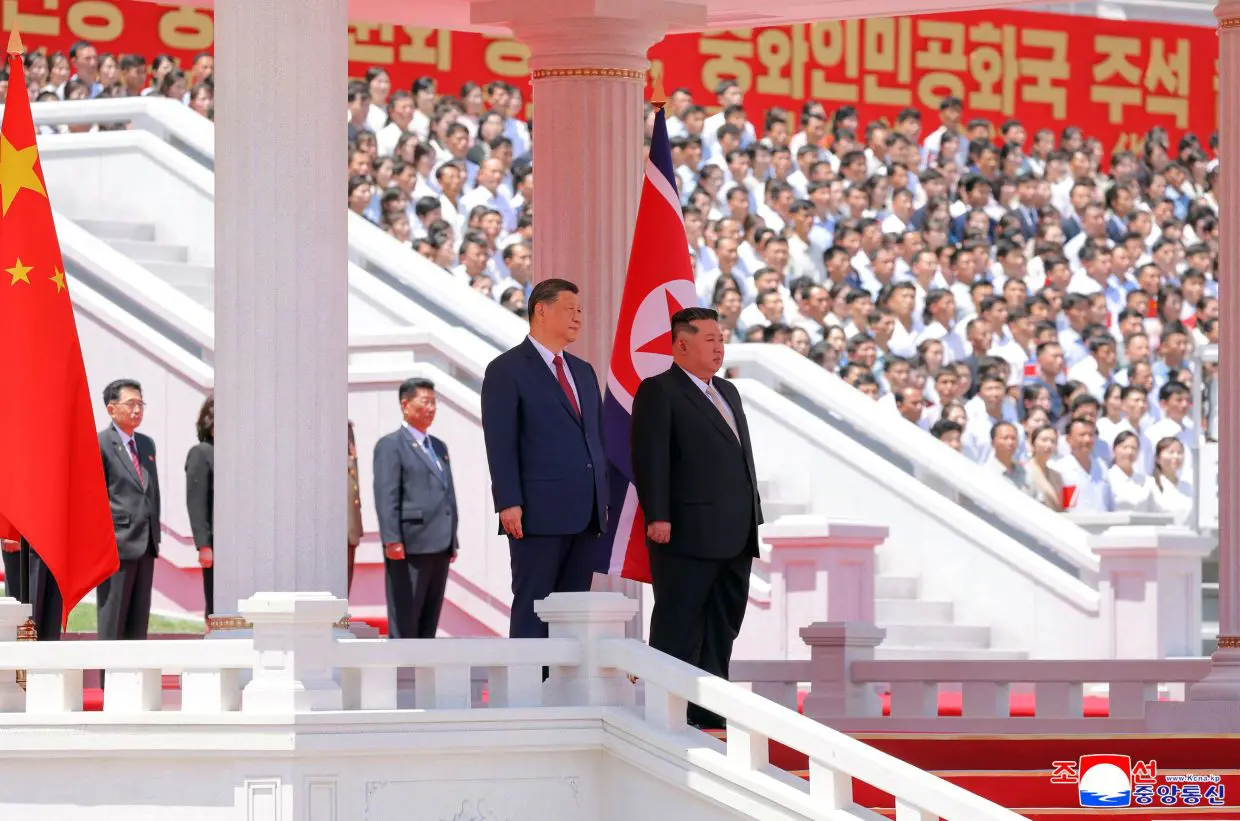
The optics were carefully choreographed from the moment Xi Jinping's plane touched down at Pyongyang's international airport on Monday. Kim Jong Un and his wife Ri Sol Ju were waiting on the tarmac, smiling and clapping. The Chinese first lady Peng Liyuan stood at Xi's side.
What followed was a full display of state ceremony: a military honor guard, thousands of citizens filling the main square, buildings draped in both countries' flags, giant portraits of the two leaders, and red-and-yellow banners celebrating "friendship and unity." Children carried balloons. A lavish banquet was held in the evening. An artistic performance featured Chinese and North Korean songs extolling the nations' closeness, described in state media as full of "patriotism, revolutionary spirit and national sentiments."
It was, by any measure, the reception of an honored guest — and a statement of political intent.
What Was Agreed: Broad, Binding, and Carefully Worded
In their summit, the two leaders agreed to expand bilateral cooperation across politics, economics, culture, and what their governments described as "strategic communication" — a term covering regular high-level consultations between the two governments. North Korea's state news agency KCNA reported that the leaders agreed to move their relationship into "a new historical starting point," coinciding with the 65th anniversary of the two countries' friendship and mutual assistance treaty.
Xi told Kim he intended to use the visit to achieve significant progress in bilateral relations. Kim responded by declaring that consolidating the new era of friendship between the two countries is the "unchanging strategic choice" of North Korea.
Kim also reaffirmed Pyongyang's support for Beijing's "One China principle" — the position that Taiwan is an inseparable part of Chinese territory — and pledged that support would hold regardless of how the international situation evolves. It was a tangible diplomatic gift to Xi, delivered publicly and on the record.
Xi, for his part, signaled that China would expand cooperation in trade, agriculture, construction, and technology, and called on both sides to use the recent reopening of direct flights and passenger train services as a springboard for broader people-to-people exchanges.
The Loudest Signal: What Was Not Said
For all the ceremony and the pledges, the most revealing element of the Pyongyang summit may be what North Korean state media chose not to report.
KCNA made no mention of North Korea's nuclear weapons programme. It made no mention of relations with the United States. The word "denuclearization" appeared nowhere in the official readout.
This was not an oversight. As we flagged in our preview of this summit, the absence of that single word carries enormous weight. (See: Xi Jinping in Pyongyang: Kim Jong Un Negotiates From a Position of Strength)
"Chinese officials have taken the position of not speaking publicly about denuclearization on the Korean Peninsula while still maintaining it as a long-term goal," said Leif-Eric Easley, a professor at Ewha Womans University in Seoul. "Kim appears to want Xi to accept North Korea as a nuclear neighbor."
Beijing, it seems, has quietly obliged.
Kim's Nuclear Programme: Expanding, Not Negotiating
The diplomatic warmth in Pyongyang unfolded against a backdrop of accelerating nuclear activity. South Korean President Lee Jae Myung told reporters Monday that North Korea is currently producing enough nuclear material each year for approximately ten to twenty new bombs, and is close to perfecting intercontinental ballistic missile technology capable of reaching the continental United States.
Earlier in the week, Kim personally unveiled a new facility for producing weapons-grade nuclear material and vowed to expand the country's arsenal at what he called an "exponential rate." He also inspected sea trials of a newly built naval destroyer and called for accelerating the development of a nuclear-armed navy.
Kim Yo Jong — the North Korean leader's sister and one of his most influential advisers — dismissed any American hope for denuclearization as an "anachronistic dream" just days before the summit began. The full details of her statement, and its direct challenge to both Washington and Beijing, are covered in our earlier report. (See: Kim's Sister Draws a Hard Line)
What Xi Takes Home
Xi is expected to depart Pyongyang on Tuesday afternoon after what South Korean media reported will be a large farewell ceremony with a full honor guard at the airport. Before leaving, he is expected to visit the Sino-Korean Friendship Tower — a monument honoring Chinese soldiers who died fighting alongside North Korea in the 1950–1953 Korean War. The symbolism is deliberate: a reminder of the blood cost of the alliance, and of its depth.
Beijing's tangible gains from the visit are likely to be gradual rather than immediate. Two-way trade between China and North Korea recovered to pre-pandemic levels last year, and the resumption of direct flights and train services earlier in 2026 has already improved the practical functioning of the relationship. Further economic packages — food shipments, fertilizer, the possible return of Chinese group tourism — are expected to follow.
On the larger strategic question — whether China has successfully pulled North Korea back from its close alignment with Russia — the answer is more ambiguous. Kim Jong Un has spent years carefully balancing Beijing and Moscow to his own advantage, and analysts say that calculation has not fundamentally changed.
"While it is highly likely that the leaders of China and North Korea would confer before Kim might meet Trump again, it is doubtful that Xi will serve as a catalyst for U.S.-North Korea talks," Easley said.
Trump, Taiwan, and the Architecture of a New Alignment
Xi's Pyongyang visit is the third leg of a remarkable diplomatic sprint. In May alone, he hosted both U.S. President Donald Trump and Russian President Vladimir Putin in Beijing. He is expected to travel to the United States for another meeting with Trump in September.
In this context, the North Korea summit is part of a broader positioning exercise. By demonstrating that China holds meaningful sway over Pyongyang — and by securing Kim's formal reaffirmation of the One China principle — Xi arrives at any future meeting with Trump holding additional diplomatic cards.
"Xi will try to demonstrate China's sway over the Korean Peninsula and a leadership role in the entire Northeast Asia," said Kwak Gil Sup of the One Korea Center. Restoring that influence gives Beijing leverage in its ongoing strategic competition with Washington.
Whether that leverage translates into any movement on the Korean Peninsula's deep-seated security questions remains to be seen. What Monday's summit confirmed is that Pyongyang and Beijing are aligned on the essentials: economic cooperation is welcome, ideological solidarity is affirmed — and North Korea's nuclear programme is nobody's business but Kim Jong Un's.
.
Sources
- Reuters – "North Korean and Chinese leaders agree to boost ties at Pyongyang summit" (June 8/9, 2026): https://www.reuters.com/world/china/north-korea-china-agree-expand-cooperation-various-sectors-north-koreas-state-2026-06-08/
- AP News – "Xi and Kim express hopes for greater ties between China and North Korea" (June 2026): https://apnews.com/article/china-north-korea-xi-kim-3aa60c2ed4f7a115c0c297df4dd04118
- Reuters – "China's Xi says he will work with North Korea to fight hegemony" (June 8, 2026): https://www.reuters.com/world/china/chinas-xi-says-he-will-work-with-north-korea-fight-hegemony-north-korean-media-2026-06-07/
- Udumbara.net – "Xi Jinping in Pyongyang: Kim Jong Un Negotiates From a Position of Strength": https://udumbara.net (finale URL bitte nachtragen)
- Udumbara.net – "Kim's Sister Draws a Hard Line: North Korea Will Never Give Up Its Nuclear Weapons": https://udumbara.net/kims-sister-draws-a-hard-line-north-korea-will-never-give-up-its-nuclear-weapons
.
What's Your Reaction?
 Like
0
Like
0
 Dislike
0
Dislike
0
 Love
0
Love
0
 Funny
0
Funny
0
 Wow
0
Wow
0
 Sad
0
Sad
0
 Angry
0
Angry
0













Comments (0)