

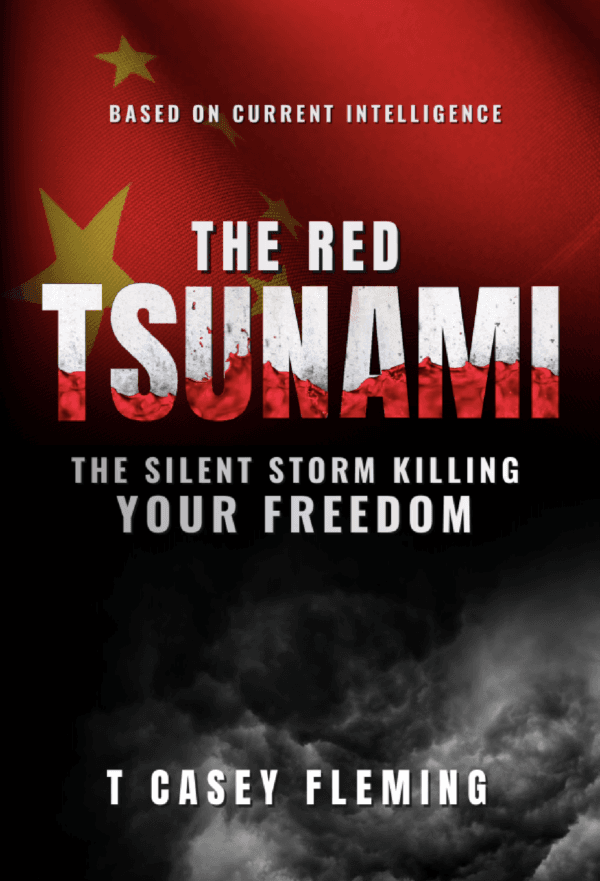
Why I Wrote ‘The Red Tsunami—The Silent Storm Killing Your Freedom’


.
I recently wrote “The Red Tsunami—The Silent Storm Killing Your Freedom” as a whistleblower exposé and survival guide because time is running out. Rhetoric and cover-up about global competition ignore the people most affected by it: citizens.
Strategy is debated in conference rooms and policy circles, but its consequences are lived daily in homes, social media, interpersonal dynamics, and schools through prices, jobs, privacy, access to information, and trust in institutions. When competition is framed only as a contest between states, the citizen becomes an afterthought. That is a mistake we can no longer afford.
The defining feature of today’s threat environment is not conventional war. War was redefined by the Chinese Communist Party (CCP) 27 years ago to be anything but the military. It is unrestricted war—a strategy in which no clear boundaries exist between peace and conflict, civilian and military, economic and political. Under this model, everything becomes a domain of attack: trade, technology, education, media, health care, infrastructure, and even social cohesion. Citizens are not collateral damage in this strategy; they are the primary target to be destroyed.
This is the reality behind “The Red Tsunami.” It is not a single event or dramatic confrontation. It is the steady accumulation of nefarious influence and leverage across the systems that citizens depend on every day. Supply chains shape affordability and availability. Digital platforms determine the information people see and trust. Labor markets influence security and opportunity. Data flows affect privacy and autonomy. When these systems are influenced or controlled externally, the impact is not abstract—it is personal.
Unrestricted war succeeds because it operates below the threshold that triggers public alarm. There are no tanks crossing borders, no formal declarations, no singular moment demanding action. Instead, pressure is applied gradually, persistently, and secretly. Economic dependencies are created. Technological standards are set. Data is harvested. Narratives are shaped. Illicit drugs murder 150,000 young adults every year. Minds are permanently damaged and controlled. Over time, citizens experience fewer choices, less resilience, and diminished agency—often without a clear understanding of why.
This is not a partisan observation. It is a structural one. Open societies are designed for transparency, efficiency, and growth. These qualities benefit citizens enormously, but they also are weaponized and create vulnerabilities when competitors do not operate under the same assumptions or constraints. When adversaries pursue long-term strategic objectives unconstrained by legal, ethical, or political limits, under “no rules,” the imbalance is not theoretical—it shows up cumulatively in citizens’ daily lives.
The greatest misconception is that unrestricted war targets governments first. In reality, it bypasses them by design. Citizens are reached directly through consumer dependence, digital influence, employment pressures, education, and information environments that blur the line between truth and manipulation. Trust erodes not because democracy fails overnight, but because people begin to feel that systems no longer work for them.
The risk is not engagement itself. The risk is engagement without protection for the citizen. When critical industries are optimized for cost rather than continuity, citizens pay during disruptions. When data security is treated as secondary to convenience, citizens lose privacy. When economic resilience is sacrificed for short-term efficiency, communities absorb the shock. These are not abstract trade-offs; they are cumulative consequences.
What concerns me most is not a lack of awareness among experts, but the distance between strategy and citizenship. Democracies are effective when citizens understand the stakes and see themselves reflected in the response. They falter when competition is framed as something happening “out there,” while its effects are felt “down here.”
This is not a call for isolation, ideological confrontation, or perpetual alarm. Nor is it an argument for mirroring unrestricted tactics. It is a call for realism grounded in open discussion, civic responsibility, and unity. If competitors treat every domain as a battlefield, then protecting citizens requires acknowledging that security, prosperity, and freedom are inseparable.
Resilience must be built on knowledge, with the citizen at the center. That means diversification instead of dependency, transparency instead of denial, and long-term durability instead of short-term convenience. It means aligning government, industry, and civil society around the shared goal of protecting citizen agency—not just national advantage.
There may never be a single moment when the threat becomes undeniable. No dramatic turning point. No universal agreement that “now” is the time to act. That is the strength of unrestricted war—and the danger of ignoring it. By the time consequences are obvious, the systems shaping citizens’ lives may already be too late to adapt.
.
.
I wrote “The Red Tsunami” to prove that outcomes are still shaped by choices—and that those choices must begin with the citizen. Awareness creates options. Preparation creates resilience. Denial leaves citizens exposed in a competition they never agreed to enter, but cannot escape.
The tsunami is not theoretical. It is already moving. Whether we respond with clarity, balance and unity will determine not just geopolitical outcomes, but also our future freedom, security, and opportunity for the people our systems exist to serve.
.
What's Your Reaction?
 Like
0
Like
0
 Dislike
0
Dislike
0
 Love
0
Love
0
 Funny
0
Funny
0
 Wow
0
Wow
0
 Sad
0
Sad
0
 Angry
0
Angry
0














Comments (0)