.
U.S. Ambassador to Japan George Glass has reaffirmed Washington’s support for Tokyo amid mounting threats from the Chinese regime to pressure Japanese Prime Minister Sanae Takaichi to retract her comments on Taiwan.
“Coercion is a hard habit to break for Beijing,” Glass
said on X on Nov. 20. “But just as the United States stood by Japan during China’s last unwarranted ban on Japanese seafood, we will be there for our ally again this time.”
Multiple Japanese media outlets, including public broadcaster
NHK, citing unnamed sources, reported on Nov. 18 that Beijing had notified Tokyo of the reimposition of the marine products ban. Beijing claimed that its decision was due to the need to assess the treated wastewater from the crippled Fukushima Daiichi Nuclear Power Plant, according to NHK.
When asked about the reports at a regular press conference hours later, Mao Ning, a spokesperson for the Chinese Foreign Ministry, said Japan had failed to submit the “technical materials” it had promised, a prerequisite for the entry of aquatic products into the Chinese market.
Mao noted that in light of Takaichi’s recent statements on Taiwan, there would be “no market” for Japanese seafood even if it entered China.
At a separate briefing in Tokyo on Nov. 19, the Japanese government’s top spokesperson, Minoru Kihara,
said there had been “no notifications” from Beijing regarding the seafood ban.
China, excluding Hong Kong, was the largest buyer of Japanese seafood, accounting for more than one-fifth of Japan’s total export value in 2022, according to
data from the Japanese Ministry of Finance.
The regime banned all aquatic products from Japan in August 2023, shortly after Japan began pumping more than 1 million metric tons of treated wastewater into the Pacific Ocean, a process expected to span a decade. China’s customs agency stated that the wastewater poses a risk of “radioactive contamination” to food safety, without providing scientific data to support this assertion.
The Japanese government has maintained that the treated wastewater is safe, and the International Atomic Energy Agency, the atomic watchdog of the United Nations, has
agreed.
After nearly a year of negotiations, the two countries finally
reached an agreement in September 2024 on the discharge of treated wastewater from Fukushima Daiichi, paving the way for the lifting of the ban. In late June, the regime’s customs agency announced a partial reopening of the Chinese market to Japanese seafood, allowing exports from all but 10 prefectures to resume.
Despite Beijing’s notice, Japanese Minister of Agriculture Norikazu Suzuki
said on Nov. 18 that only three out of nearly 700 Japanese facilities that had applied to re-register for seafood exports to China have been approved.
.
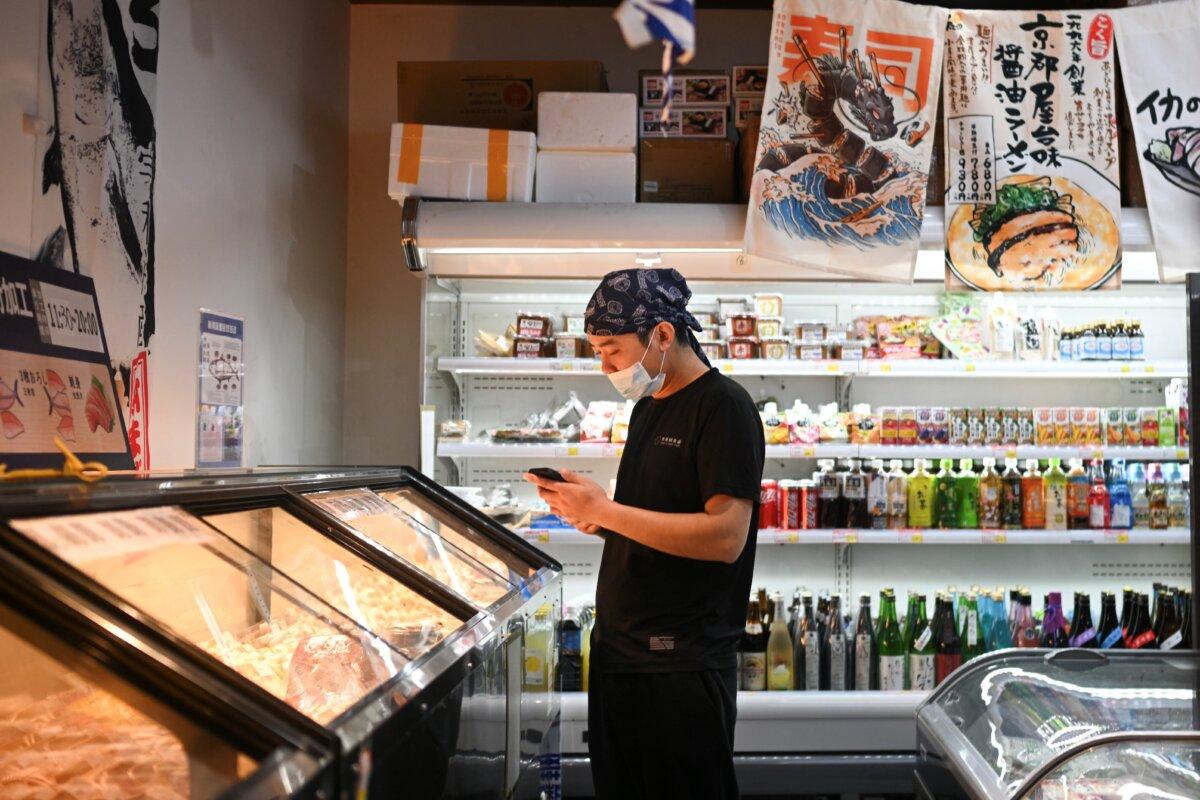
A worker is seen in a Japanese products supermarket in Beijing on Nov. 19, 2025. Pedro Pardo/AFP via Getty Images
.
Seafood shipments to mainland China have sunk sharply since the regime imposed restrictions, plummeting by 94 percent compared with 2022 levels, according to an analysis by Japan’s Fisheries Agency based on statistics from the
Ministry of Finance.
Amid the regime’s restrictions, the United States has emerged as a vital market for both Japanese
fishery products and food overall. Japan’s official
data show that in 2024, exports of agricultural, forestry, and fishery products to the United States soared by 18 percent to 242.9 billion yen (approximately $1.6 billion), making the United States Japan’s top destination for the first time in 20 years.
Japan: Economic Reliance on CCP ‘Dangerous’
The Japanese government has
said there is no need to retract its prime minister’s comment, as it did not deviate from Tokyo’s long-standing stance on Taiwan. Takaichi
told a parliamentary session earlier in November that a military attack on Taiwan could be viewed as a “survival-threatening situation” for Japan, a classification that could allow Japan to exercise the right to self-defense.
At a Nov. 18 meeting in Beijing, Masaaki Kanai, a senior Japanese foreign ministry official who oversees Asian and Oceanian affairs, reiterated to his Chinese counterpart that there has been no change in the government’s position, according to
his ministry.
Kanai also
pressed for immediate action from Beijing regarding the online comments made by Xue Jian, the Chinese consul general in Osaka, Japan.
In a now-deleted X post, Xue shared a news article about Takaichi’s comments and said, “The filthy head that recklessly sticks itself in must be cut off.”
The violent threat has sparked
calls among Japanese lawmakers to expel the Chinese diplomat. Hei Seki, a member of the upper house of Japan’s Parliament, reiterated the demand during a parliamentary session on Nov. 20,
urging the government to take a resolute stance by declaring Xue “persona non grata,” a designation that would enable his expulsion under international law.
.
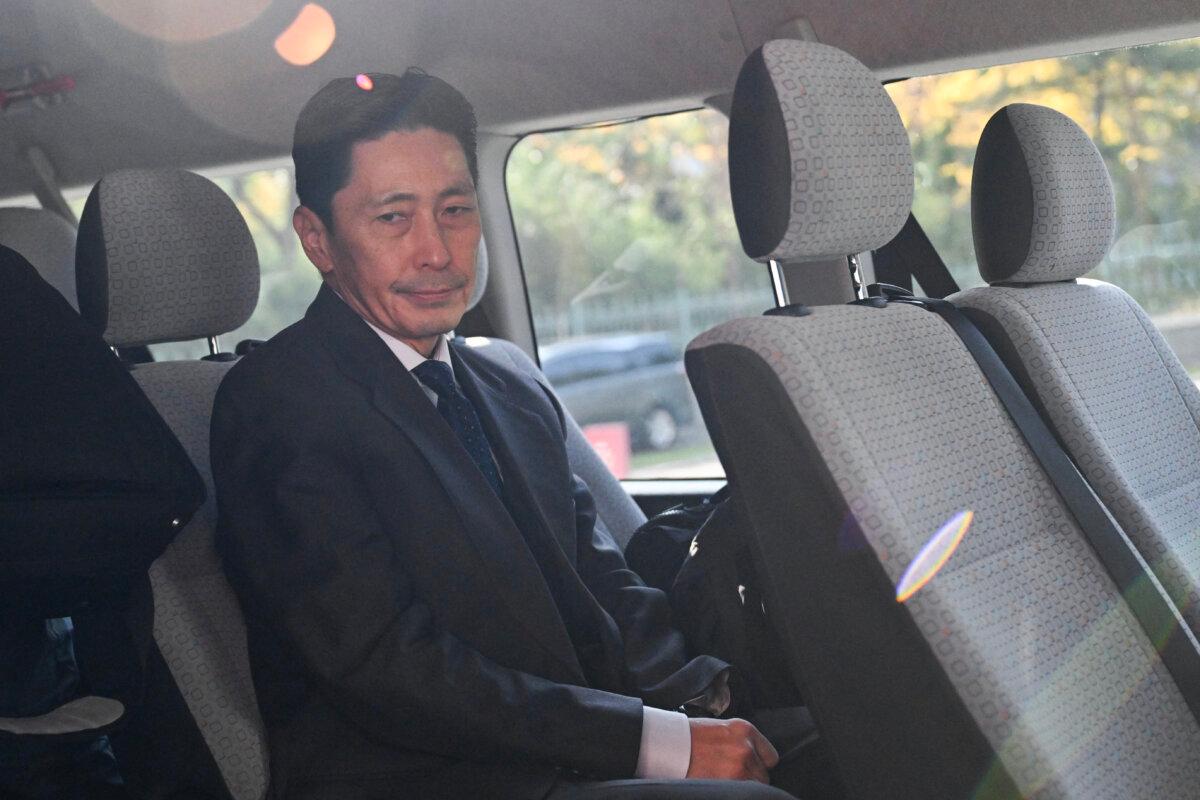
Director-General of the Japanese Foreign Ministry's Asian and Oceanian Affairs Bureau Masaaki Kanai departs after a meeting at the Chinese Foreign Ministry in Beijing on Nov. 18, 2025. Pedro Pardo/AFP via Getty Images
.
Adding to bilateral tensions, the regime’s foreign ministry issued a
warning to its citizens last week, advising them to reconsider travel plans to Japan because of heightened safety risks—a claim Japan has
pushed back on.
The advisory risks hurting Japan’s tourism industry, a key
driver of its economy, particularly as Chinese visitors are a major contributor to the sector. Japan’s official
statistics showed that in October, tourists from mainland China and Hong Kong made up more than 23 percent of all visitors to Japan.
Following the travel warning, the regime has
cautioned Chinese citizens to “plan studies in Japan with caution,” while seeking to exert pressure on the film industry.
Screenings of several upcoming Japanese movies—including the animated comedy “Crayon Shin-chan the Movie: Super Hot! The Spicy Kasukabe Dancers” and the live-action film “Cells at Work!”—have been postponed, China’s state broadcaster CCTV reported on Nov. 18, citing film distributors and importers. It claimed that this decision was based on an evaluation of the performance of Japanese films in China and the sentiments of Chinese audiences.
This is not the first time Japan has faced coercive tactics from the Chinese Communist Party. In 2010, the regime temporarily
blocked the export of rare earth elements to Japan after Japanese authorities detained a Chinese fishing captain whose vessel had collided with coast guard ships near the Senkaku Islands in the East China Sea, which the Chinese regime claims as the Diaoyu Islands.
The latest retaliatory measures have renewed concerns in Tokyo about Japan’s economic reliance on communist China.
“If we rely too heavily on a country that resorts to economic coercion the moment something displeases it, that creates risks not only for supply chains, but also for tourism,” Japanese Minister in Charge of Economic Security Kimi Onoda
said at a press conference on Nov. 18.
“We need to recognize that it’s dangerous to be economically dependent on somewhere that poses such risks,” she said, responding to a question about China’s calls for its citizens to avoid travel to Japan.
Reuters contributed to this report.
.




 Like
0
Like
0
 Dislike
0
Dislike
0
 Love
0
Love
0
 Funny
0
Funny
0
 Wow
0
Wow
0
 Sad
0
Sad
0
 Angry
0
Angry
0















Comments (0)