

The Illusion of Resilience: China’s Economic Recovery Masks Systemic Fragility


.
A Mirage in Metrics
China’s official narrative of economic recovery in 2025 is a masterclass in illusion. The government touts a 5 percent GDP growth rate for the first half of the year, and surface-level indicators suggest a rebound from pandemic-era stagnation.But behind the decorative veneer lies a brittle economic structure—defined by debt dependency, chronic deflation, and engineered opacity. For global markets and policymakers, the danger isn’t just the fragility itself—it’s the persistent misreading of China as a stable, predictable economic partner.
For example, in July, industrial output rose 6.1 percent year-on-year, and exports posted a surprising 7.2 percent increase. Yet these figures are curated with precision. Retail sales growth slowed to just 3.7 percent. Consumer price index (CPI) flatlined at 0.0 percent.
Deflation by Design
This “Xi-style deflation” isn’t a macroeconomic quirk—it’s the manifestation of entrenched pessimism. Households delay purchases and continue to hope for falling prices. Companies pull back investment, finding no traction for margin expansion amid weak demand. Growth stems less from productive output and more from policy-driven transfers and subsidies. Innovation, manufacturing efficiency, and competitive exports are overshadowed by the Chinese communist regime’s meddling.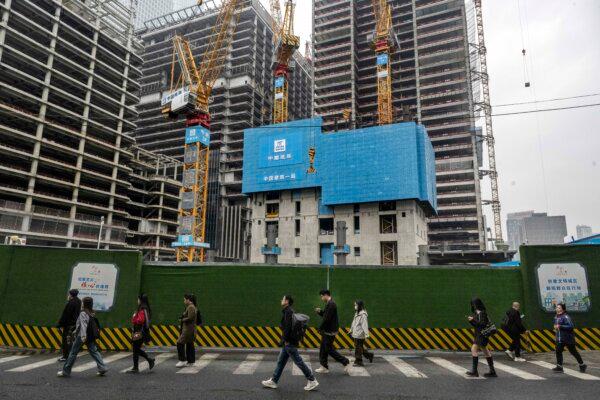
Debt as Lifeline
The structural risks embedded in this model are stark. Local authorities have turned to debt issuance at a scale that alarms even official creditors. Fitch Ratings warns that more than 8 trillion yuan in local government financing vehicle (LGFV) debt is vulnerable to funding shocks.Yuekai Securities and other analysts estimate that total local government debt has surpassed 51 trillion yuan, with much of it funneled into non-productive or politically directed projects. The stock has roughly doubled since 2020, driven by off-budget financing and stimulus-linked spending. This isn’t stimulus—it’s a liquidity IV drip keeping underperforming entities alive while postponing necessary restructurings.
Opacity as Policy
The opacity surrounding China’s economic data compounds these risks. A Wall Street Journal investigation documented the removal of hundreds of statistical series—from land sales and foreign investment inflows to soy sauce output. Rhodium Group estimates GDP may be overstated by at least 10 percent or $1.7 trillion.The difficulty in getting accurate information lies in data suppression, which is paired with political suppression: economists and analysts critical of Chinese leader Xi Jinping’s policies have disappeared or been silenced under “work secret” provisions in the revised State Secrets Law.
Global Reverberations
This is an internal governance choice that begets international consequences. Pushing out low-cost exports drives down prices worldwide, which can be tough on manufacturers elsewhere trying to stay profitable. These state-backed enterprises often sell below cost, making it hard for competitors in free-market economies to keep up. At the same time, China’s local governments, struggling with debt, are tweaking enforcement to attract foreign investors. While the adjustment brings in quick cash, it risks long-term damage to economic stability and trust in the system.Strategic Recalibration
The implications demand a shift in how the outside world engages with Beijing. Foreign investors can no longer treat Chinese markets as high-yield plays insulated from political calculus. Exposure must be recalibrated, with significant weight given to political risk, subsidy volatility, and the real possibility of sudden liquidity constraints in partner institutions.The Real Report Card
The portrayal of China’s economy as resilient obscures a structural fragility, not a cyclical one. The interplay of engineered statistics, politically driven credit allocation, and creeping fiscal exhaustion is neither sustainable nor benign. Treating the official narrative as fact creates financial risk and could foster strategic misalignment.The Chinese Communist Party may appear stable on the surface, thanks to carefully managed statistics and tightly controlled messaging. But when that stability is built on hidden debt and unclear financial practices, it’s fragile at its core. For leaders around the world, the takeaway is simple: don’t take China’s official story at face value. It’s not just a neutral snapshot of the economy; it’s a critical strategic narrative—lipstick on a pig.
What's Your Reaction?
 Like
0
Like
0
 Dislike
0
Dislike
0
 Love
0
Love
0
 Funny
0
Funny
0
 Wow
0
Wow
0
 Sad
0
Sad
0
 Angry
0
Angry
0

















Comments (0)