

The China Effect


.
For decades, drawn by low labor costs and huge consumer opportunities, Western companies moved their manufacturing bases to China. Many made fantastic profits for years from China’s sweatshop labor wages.
Earlier this month, Starbucks sold a majority of its Chinese operations–60 percent–to China’s Boyu Capital. With a business value of $4 billion, the deal is one of the largest selloffs by a global consumer company to China in recent years.
A Policy to Absorb Foreign Innovation
As Starbucks has learned, the costs of doing business in China can be high and far-reaching. Two local competitors, Luckin and Cotti, are undercutting Starbucks latte prices by more than two-thirds, grabbing big chunks of its market share.Grabbing coffee companies is just the tip of the iceberg.
Forced Technology Transfers Are Common
Foreign companies seeking access to China’s enormous market must often agree to joint ventures with Chinese partners. According to the National Defense University, China leverages “joint venture requirements, foreign investment restrictions … to force or pressure technology transfers from American companies.”This isn’t accidental; it’s deeply embedded in Beijing’s industrial policy and has worked exceptionally well. And it couldn’t be simpler. Why spend billions on research and development when you can force the transfer of, or steal, the very best technology the world has to offer without the budget expense?
IP Theft
Just ask Volkswagen.In November 2024, the German automaker finally relented and sold its Xinjiang operations to a state-owned Shanghai Motor Vehicle Inspection Certification (SMVIC). Sharing its technology was the price of entry into China, resulting in Volkswagen competing against its own designs there. It has been reported by various media outlets that China has been allegedly stealing the company’s secrets and manufacturing processes for more than two decades.
.
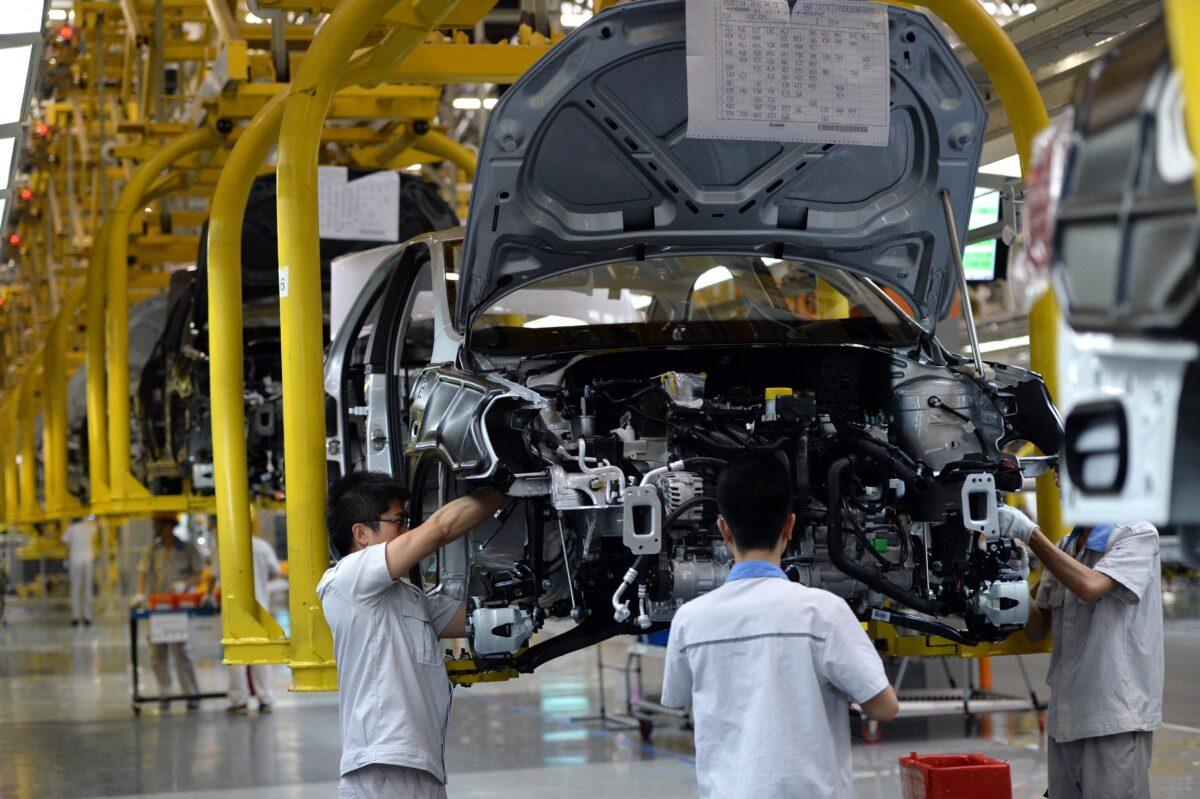
In a critical semiconductor case involving Micron Technology’s highly sensitive DRAM chip designs, Chinese state-owned Fujian Jinhua and employees from Taiwan’s UMC were indicted for conspiring to steal Micron’s trade secrets. The stolen designs were used by China to build its own DRAM chip factory. While UMC paid a $60 million fine in 2024, a U.S. court acquitted Fujian Jinhua because the U.S. Justice Department failed to prove that the company had stolen the trade secrets, but it remains on a U.S. Entity List.
The Chinese regime’s IP theft is conducted on an industrial scale across almost any industry imaginable, no matter the size of the company or the country involved. In 2004, Japan’s Kawasaki Heavy Industries, Germany’s Siemens, and Canada’s Bombardier were all required to share their high-speed rail technology if they wanted access to the Chinese rail market.
Over the years, Chinese engineers reverse-engineered, adapted, and rebranded that technology into their own “Harmony” high-speed trains. Today, Chinese high-speed train systems compete with those very same companies on the global market.
A ‘Reverse Starbucks Effect’
These examples are but a few of thousands of examples of Western companies willingly or unwillingly transferring their very lifeblood of business–their IP and industrial techniques–to China in exchange for a period of high profits and access to the country’s billion-plus consumer market. The truth is that foreign companies operating in China gain access to the consumer market long enough until Chinese competitors are able to replace them.Of course, this reverse Starbucks effect, where a company ultimately loses its IP and market share in China, isn’t new, but it is accelerating. The number of Western companies leaving China is growing and involves some of the biggest names in the world, including Microsoft, Dell, Stanley Black & Decker, Blizzard Entertainment, Airbnb, IBM, and, of course, Starbucks.
But is it too late? Have China-based supply chains made foreign companies vulnerable to Chinese disruption?
Certainly, with regard to rare-earth elements and other strategic materials, that’s the case, at least in the near term. It’s also the case with companies in multiple industries, to varying degrees.
If nothing else, when it comes to operating in China, the Starbucks effect amounts to Western companies finally waking up and smelling the coffee.
What's Your Reaction?
 Like
0
Like
0
 Dislike
0
Dislike
0
 Love
0
Love
0
 Funny
0
Funny
0
 Wow
0
Wow
0
 Sad
0
Sad
0
 Angry
0
Angry
0













Comments (0)