.
The United States is committed to Japan’s defense and opposes any attempts to alter Taiwan’s status through force or coercion, the Department of State said on Nov. 20.
The pledge marks the first statement from Washington since the Chinese Communist Party (CCP) dialed up economic and diplomatic pressure on Tokyo following Japanese Prime Minister Sanae Takaichi’s recent comments that
linked an armed conflict in the Taiwan Strait to a potential external threat to Japan.
Amid rising tensions, the CCP
continued to
sail its large, heavily armed coast guard vessels in waters near Japan-administered islands in the East China Sea, called Diaoyu by Beijing and Senkaku by Tokyo.
In a
statement on X, State Department Spokesperson Tommy Pigott said the U.S. commitment to the US–Japan alliance and Japan’s defense is “unwavering,” including with regards to Japan-administered Senkaku.
“The U.S.-Japan Alliance remains the cornerstone of peace and security in the Indo-Pacific,” Pigott said. “We firmly oppose any unilateral attempts to change the status quo, including through force or coercion, in the Taiwan Strait, East China Sea, or South China Sea.”
Japan PM Rejects CCP’s Demands
Facing escalating threats from the CCP, Takaichi was asked on Nov. 21 whether she plans to retract her earlier comments in parliament, where she
described a Taiwan contingency as a potential “survival-threatening situation” for Japan—a designation that might enable Japan to exercise its right to self-defense.
In response, Takaichi
told reporters that the government would make “a comprehensive assessment” of all available information regarding what situations qualify as an existential crisis, evaluating the specifics of actual circumstances as they occur.
“The government’s position is consistent,” the prime minister said. “I myself have repeated this answer.”
For Tokyo’s relations with Beijing, Takaichi said there is “no change” in the overall direction of fostering “constructive and stable” ties, a goal she and CCP leader Xi Jinping reaffirmed at their summit in South Korea last month.
At a later press conference in Beijing, Mao Ning, the regime’s foreign ministry spokesperson, said Japan should “retract the erroneous remarks” if it wishes to develop a mutually beneficial relationship and make the relationship constructive and stable.
Mao added that Beijing would take “resolute” actions should anyone cross the regime’s “red lines” on Taiwan.
The CCP views self-governed Taiwan as a breakaway province and refuses to rule out the use of force to bring it under communist rule. Japan, like most countries, doesn’t have formal ties with Taiwan, but it has
stressed the importance of peace and stability in the Taiwan Strait. Japan’s westernmost tip, Yonaguni, is only 68 miles from Taiwan’s coastline.
.
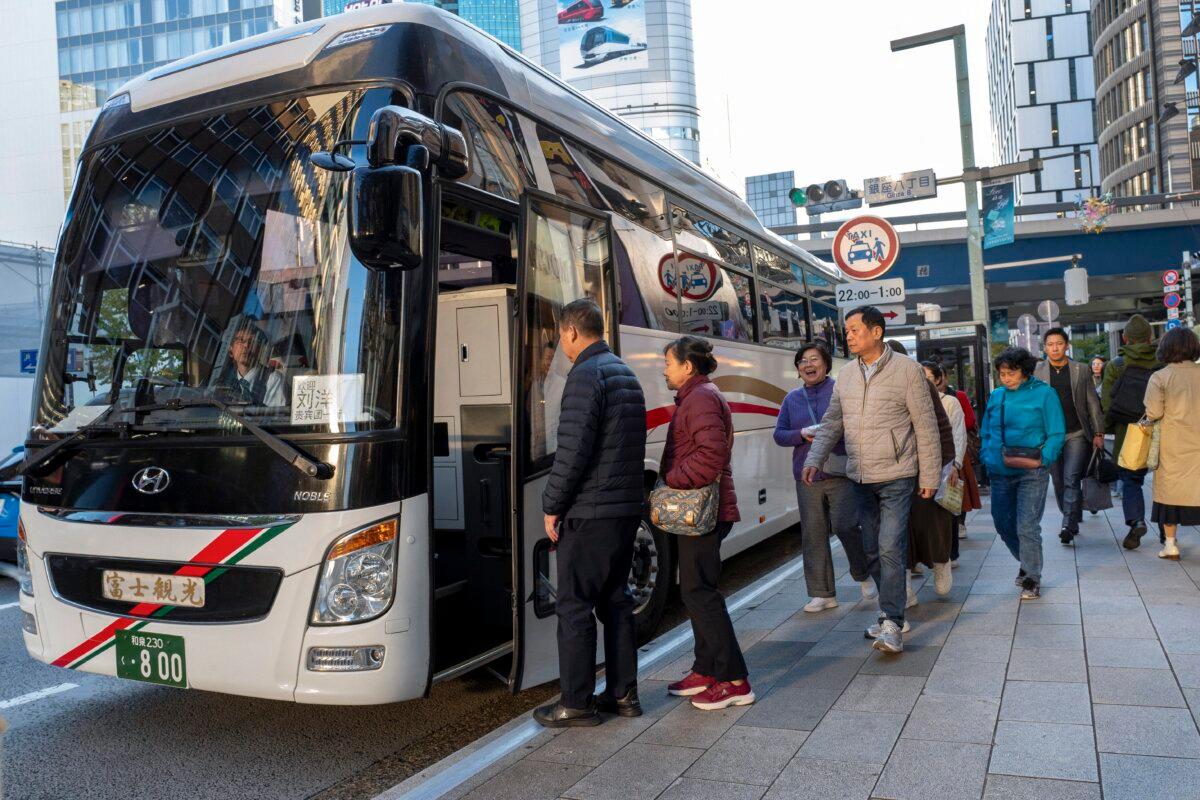
Asian tourists board a bus after sightseeing in Tokyo’s shopping district Ginza on Nov. 19, 2025. Kazuhiro Nogi/AFP via Getty Images
.
Following a barrage of harsh criticism and
threats aimed at Takaichi, the CCP has already resorted to economic measures to compel Japan to retract the statement on Taiwan. The regime’s foreign ministry warned tourists against traveling to Japan, while its education ministry
cautioned Chinese students to plan their studies in Japan with caution. After delaying the release of some Japanese movies, Beijing has threatened that there is “no market” for Japanese
seafood in China.
‘Refusing Coercion Is Not Escalation’
Kazuya Shimba, general-secretary of Japan’s major opposition Democratic Party for the People, criticized Beijing’s reaction to Takaichi’s comments as “excessive,”
saying on Nov. 21 that such a response is not what a big country should do.
Hei Seki, a Chinese-born legislator with the ruling Japan Innovation Party, brushed off the threats from the CCP.
“What would happen to Japan if China expelled all Japanese companies out of China?” he said in an
interview with Bloomberg on Nov. 20. “Japanese companies would suffer losses, but the Chinese government couldn’t possibly do that. Why? Because those Japanese companies employ a large number of Chinese people.”
Seki, the first Japanese legislator
sanctioned by Beijing due to his outspoken criticism of the CCP, emphasized the need for Japan to stand firm against such intimidation.
“Having studied the CCP regimes for many years, I understand their habits well,” he said in Japanese, according to Bloomberg’s translation. “They always become arrogant and adopt an intimidating attitude toward those who yield or appear weak. Conversely, they treat strong opponents with politeness. That’s China.”
Naoki Hyakuta, who heads the minor opposition Conservative Party, denounced the regime’s advisories to Chinese nationals against traveling and studying in Japan,
telling reporters on Nov. 18 that such warnings are “bullying” and “harassment.” But he
added that he welcomed Beijing’s decision to discourage Chinese tourists from visiting Japan.
Yasuhide Nakayama of the largest Liberal Democratic Party said that Beijing’s targeting of Takaichi was intended to “unsettle Japan’s domestic security debate.”
“This is not merely a diplomatic dispute. It goes to the heart of Japan’s sovereignty: Can Japan continue to make its own security decisions—free from foreign pressure and influence operations?” Yasuhide
wrote on X on Nov. 19.
.
Japan’s State Minister of Foreign Affairs Yasuhide Nakayama (R) listens at the White House Summit to Counter Violent Extremism at the State Department in Washington on Feb. 19, 2015. Mandel Ngan/AFP via Getty Images
.
Yasuhide, Japan’s former deputy defense minister, described the prime minister’s comments on Taiwan as a recognition of security realities rather than a provocation.
“Refusing coercion is not escalation,” he said. “Japan must continue to discuss its security calmly, responsibly, and with confidence.”
.





 Like
0
Like
0
 Dislike
0
Dislike
0
 Love
0
Love
0
 Funny
0
Funny
0
 Wow
0
Wow
0
 Sad
0
Sad
0
 Angry
0
Angry
0












Comments (0)