

Pro-Democracy Activist Faces Repatriation as Beijing Tightens Grip on Dissidents in Thailand


.
Chinese political dissident Zhou Junyi was arrested four months ago in Thailand for alleged visa violations. He now faces the risk of deportation back to China—a development that has alarmed the overseas Chinese pro-democracy community.
Many Chinese dissidents and activists, when facing threats to their lives in China due to their political views or human rights work, have chosen to flee to Thailand. Some crossed borders on foot through remote, rugged terrain, in desperate attempts to escape persecution. Thailand, once viewed as a relatively accessible and neutral transit point, offered a glimmer of hope for those seeking asylum or United Nations protection.
However, in light of recent arrests and extraditions, many activists now fear that Thailand is no longer the safe haven it once was for Chinese exiles.
Zhou, 53, is a member of the China Democracy Party, an exiled group. He had previously traveled to the United States in 2015 to attend a conference organized by pro-democracy activists. Upon returning to China, he was arrested and had his passport confiscated. Later that year, he fled through Laos and made his way to Thailand, where he has remained ever since.
In June of this year, Zhou attended a public event organized by the China Democracy Party in Bangkok commemorating the Tiananmen Square Massacre. Just days later, on June 11, he was arrested at his residence by Thai police for overstaying his visa.
.
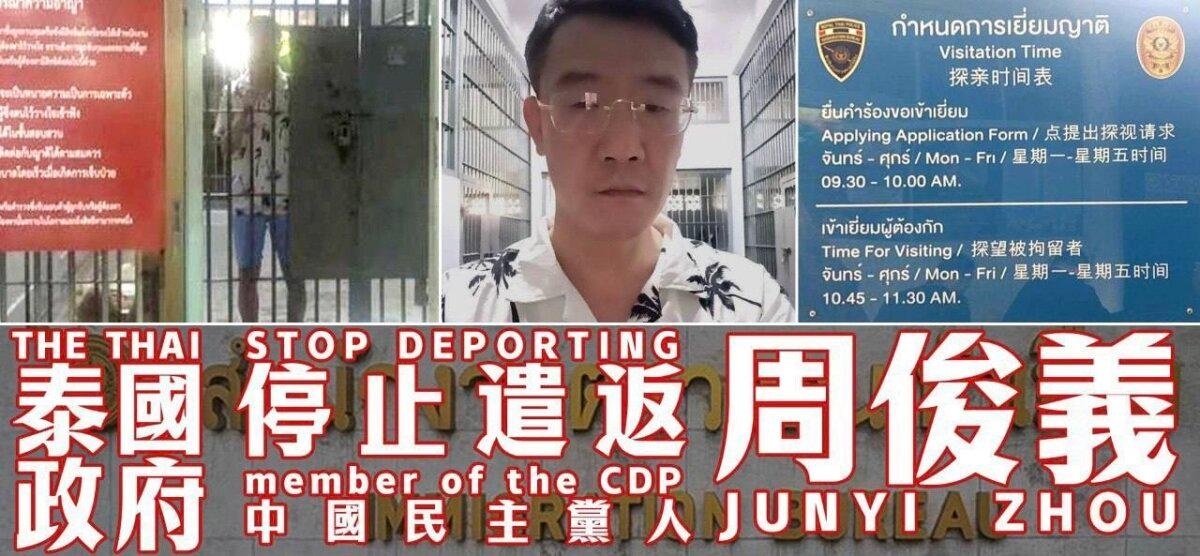
Over the years, Zhou had organized multiple Tiananmen memorials and openly supported high-profile political prisoners currently imprisoned in China or Hong Kong. Last year, he launched efforts to establish a Tiananmen Massacre Memorial Museum in Thailand, which may have drawn the attention of Chinese authorities.Shortly after his arrest, members of the China Democracy Party in Los Angeles launched a campaign calling for support to rescue him.
Jie Lijian, chairman of the China Democracy Party International Alliance, told the Chinese-language edition of The Epoch Times on Oct. 8 that party members in Los Angeles submitted a petition to the Thai Consulate back in June, urging Thai authorities to treat Zhou humanely. Jie emphasized that Zhou is a human rights defender and could face harsh punishment if repatriated to China.
“The Thai officials who received our letter assured us they would do everything in their power to help and handle the matter properly,” Jie said.
.
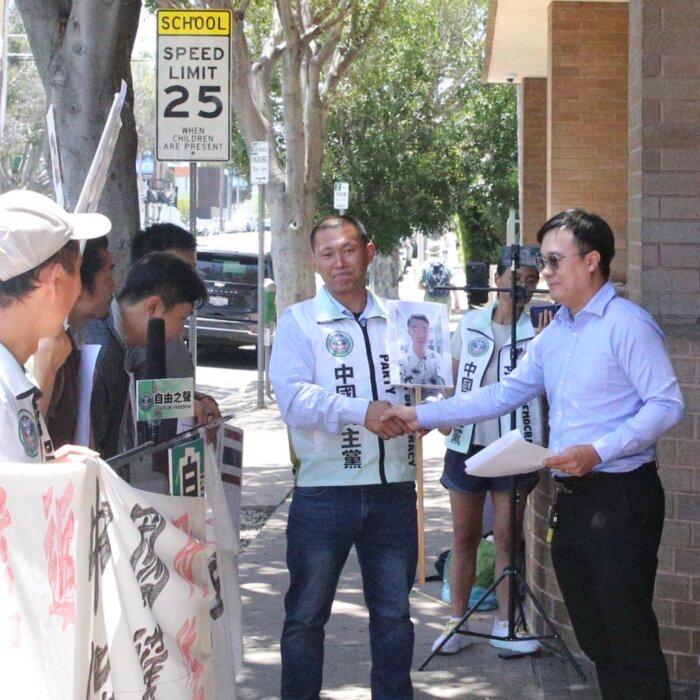
The China Democracy Party in Los Angeles has vowed to continue mobilizing support, promising further actions if Chinese authorities escalate their efforts.
Thailand No Longer a Safe Haven
On Feb. 27 of this year, a group of Uyghurs who had been detained in Thailand for more than a decade were forcibly deported to China, drawing widespread condemnation from human rights organizations, the United Nations, and several Western governments.Xing Jian, a rights activist and former detainee in Thailand, told the Chinese-language edition of The Epoch Times that the country is no longer a safe refuge for Chinese exiles.
“The CCP’s infiltration in Thailand is severe,” he said. “There are many intelligence agents operating there, and some have even infiltrated refugee communities.”
Xing, who now lives in New Zealand, fled to Thailand in 2015 and applied for asylum through the United Nations. In November 2019, he nearly faced deportation to China when police from Lianshui County, Jiangsu Province, attempted a cross-border arrest in collaboration with Thai authorities. Before the Chinese police could take further action, Xing had a phone interview with New Zealand’s refugee office. He was granted protection and arrived in New Zealand on Jan. 18, 2020.
According to Xing, when the Thai police arrested him in 2019, they immediately made a phone call to Chinese security officers. He was handed the phone and told to speak to the person on the line. The Chinese side confirmed his identity and said, “Wait there. We’re on our way.” The Chinese officers arrived shortly afterward.
“One of them told me, ‘If we kill you in Thailand, no one will know or find out,’” Xing recalled. “It was outrageous.”
He said that the Thai authorities bow to Beijing partly due to fear of retaliation from the Chinese Communist Party (CCP). Furthermore, Thailand’s economic reliance on Chinese tourism complicates the situation.
As of the time of publication, the Royal Thai Embassy in the United States did not respond to a request for comment by The Epoch Times.
Jie Lijian echoed these concerns, noting that many Chinese political refugees in Thailand now live in fear upon realizing the extent of the CCP’s influence in the country. They avoid public protests and struggle with basic survival.
“After you apply for asylum, no one helps you,” Jie said. “Even securing housing and food is a challenge. Many refugees have no choice but to take jobs that locals don’t want, just to survive.”
Jie added that much of Southeast Asia has effectively become China’s political backyard. Many prominent Chinese dissidents now avoid traveling to the region altogether, viewing it as highly unsafe and firmly under Beijing’s influence.
In recent years, the CCP’s pressure has led to a growing number of Chinese dissidents being arrested and repatriated from Southeast Asia.
In 2022, longtime human rights advocate Dong Guangping was arrested in Vietnam and sent back to China.
In 2023, Qiao Xinxin, a co-initiator of the “Wall Removal Movement” aimed at dismantling China’s internet censorship, was captured by Chinese agents in Laos and is now detained in Hunan, China.
What's Your Reaction?
 Like
0
Like
0
 Dislike
0
Dislike
0
 Love
0
Love
0
 Funny
0
Funny
0
 Wow
0
Wow
0
 Sad
0
Sad
0
 Angry
0
Angry
0














Comments (0)