

Poilievre Says US and Canada Should Confront Beijing’s Threat Together

.
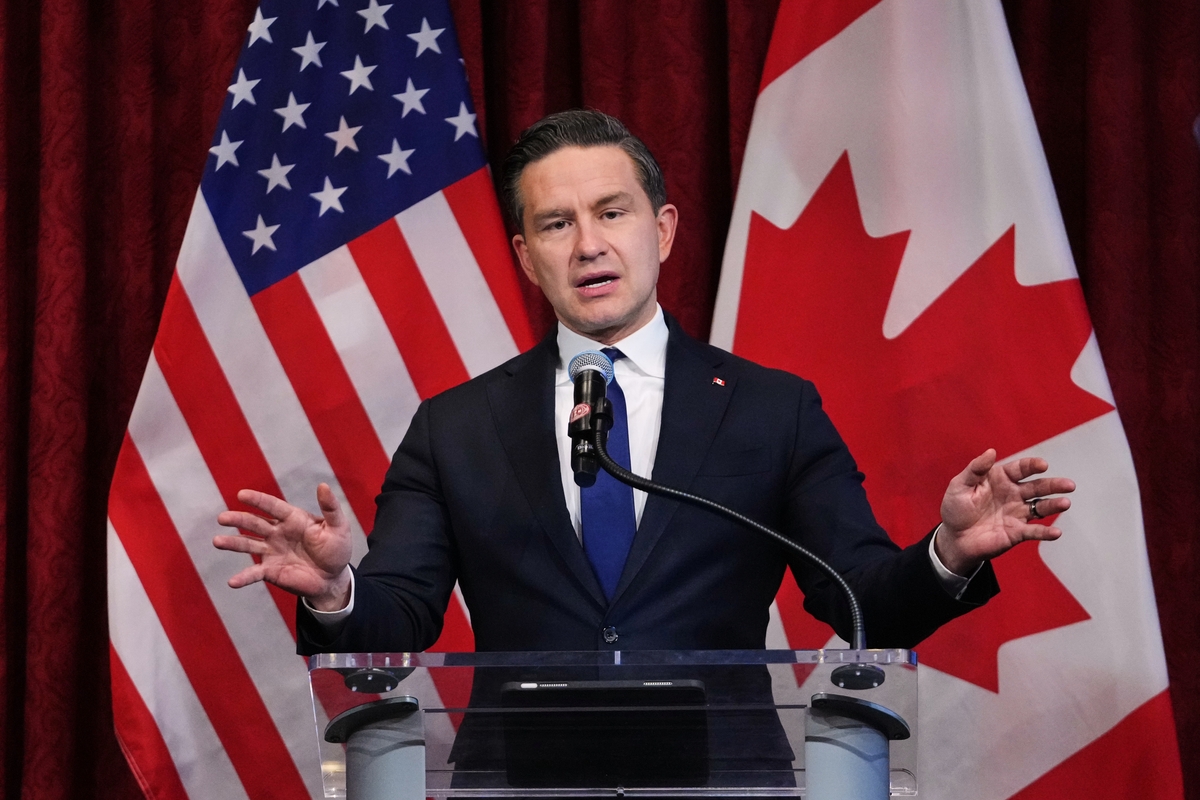
Conservative Leader Pierre Poilievre says the Chinese regime is a threat to both Canada and the United States, and the two countries should “look at the big picture” instead of treating each other as rivals.
The Tory leader noted that the West erred in allowing the Chinese communit regime to “sneak up on us” shortly after the collapse of the Soviet Union.
“Beijing’s communist regime was able to pursue economic enrichment without the corresponding political liberalization that the West had expected. And then one day, the West woke up, and we found that much of our industrial cart lands had been hollowed out,” Poilievre said.
Poilievre said Canada and the United States can’t “ignore the ways in which Beijing’s communist regime has used its growing economic power to threaten our vital interests.”
He noted that U.S. President Donald Trump’s “efforts to prepare and protect” the United States from the Chinese regime is “fully founded,” adding that Prime Minister Mark Carney called China the “single biggest threat” to Canada during the 2025 election campaign. The Tories have criticized Carney for later saying he is seeking a “strategic partnership” with Beijing, while Carney says he’s just addressing some ongoing trade tensions.
Poilievre said that in U.S. administration’s effort to protect itself from Beijing, Canada “should be seen as a friend, and not as a foe,” noting that Canada and the United States should “look at the big picture,” instead of treating each other as “rivals.”
“The real threats to our economies and to our security come not from each other, but from Beijing, from Moscow, from Tehran, and from their proxies,” he said, adding that Canada and the United States should be “tearing down tariff walls” and forging closer ties, instead of “fighting tariff wars” with each other.
Trade With China
In a fireside chat after his speech, Poilievre was asked what the differences are between trade with China and with the United States, given Carney’s vision for foreign policy.Poilievre said he would not “disparage [his] prime minister on foreign turf” by countering Carney’s position, but noted that Canada trades significantly more with the United States than it does with China, and that the two neighbous have much in common.
“We’ve got to trade and talk with China, and we have to engage with that country... But there is no getting away from the fact that we sell 20 times as much to the United States as we sell to China,” he noted.
“Our historic alliance with the United States is far more important and far more immediate, and we must do everything we can to preserve it,” he added.
Poilievre said Canada can both diversify its trade relationships and continue to engage with the United States on trade, instead of replacing U.S. trade with exports to other countries. “When we increase exports overseas, it’s not to subtract them from the United States, it’s to add to them,” he said.
Strengthening Canada-US Ties
In his speech, Poilievre said that strengthening Canada-U.S. relations is in the interest of both countries. He also pitched free trade between the two countries and ending tariffs on aluminum, automobiles, and lumber as a means to benefit both countries.“I’m here today to restore and renew our friendship and to bring affordability, security, and strength to the peoples of both of our two separate countries,” Poilievre said.
He also said Canada and the United States should establish a “full exemption from Buy America” so that Canadian construction companies can sell into American procurement markets, and that the two countries should relaunch the Keystone XL pipeline so Canada can export more oil to the United States.
Meanwhile, Canada is “vital” for U.S. economic and security interests, he said, noting Canada controls the biggest airspace, sea, and land mass in the Western hemisphere, and produces 10 of the 12 NATO-defined critical minerals for defence.
“We are the only thing between you and Russia,” he said.
.
What's Your Reaction?
 Like
0
Like
0
 Dislike
0
Dislike
0
 Love
0
Love
0
 Funny
0
Funny
0
 Wow
0
Wow
0
 Sad
0
Sad
0
 Angry
0
Angry
0












Comments (0)