

PNG Cabinet Backs New Defence Pact, Elevating Ties With Australia to Full Ally Status


.
Australia has scored a major victory in its Indo-Pacific diplomacy efforts after the Papua New Guinea (PNG) Cabinet, by “an absolute majority,” agreed to ratify a new defence pact.
The signing of the “Pukpuk Treaty” was postponed two weeks ago amid confusion and mixed messages from PNG’s leaders, and will now go ahead despite threats from the Chinese Communist Party (CCP).
The Pukpuk treaty obliges both countries to “act to meet the common danger” if either comes under attack, effectively elevating PNG’s status to that of an ally on a par with the United States or New Zealand.
Pukpuk will also enable Papua New Guineans to serve in the Australian Defence Force (ADF) and require Australia to spend billions to enhance the capabilities of the PNG Defence Force as part of making the two nations’ militaries interoperable.
“Last month, Prime Minister Albanese and Prime Minister Marape signed a joint communique for a Papua New Guinea–Australia mutual defence treaty,” it said. “As the leaders said at the time, that treaty would be signed following cabinet processes in both countries.
.

“This treaty will elevate our relationship with PNG to an alliance—the first in over 70 years and only our third overall.
“It puts our relationship with PNG on the same level as we have with the United States and New Zealand and builds on the already strong bonds between our defence forces, our economies, and our people.”
It’s likely PNG Prime Minister James Marape will announce the final deal sometime before attending the NRL Grand Final in Australia on Oct. 5.
.
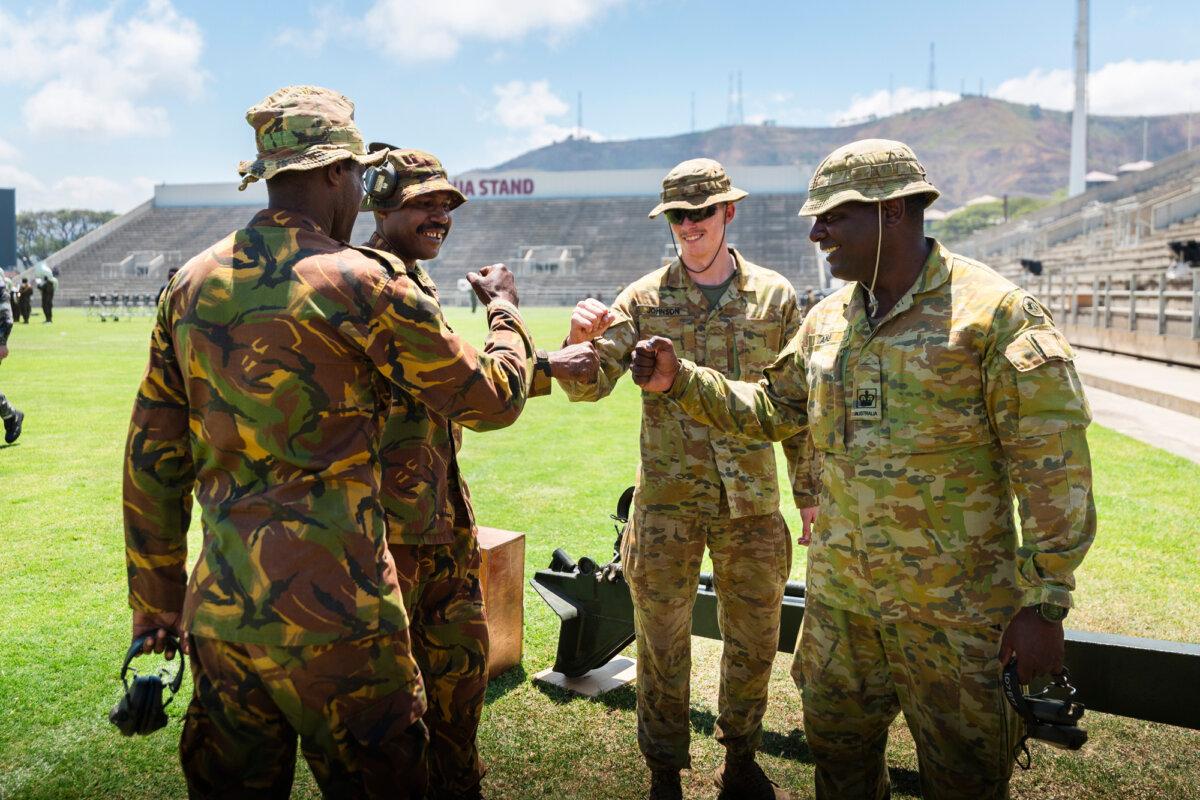
Papua New Guinea Defence Force and Australian Army soldiers congratulate each other after the completion of a M2A2 Howitzer gun live firing serial at Sir Hubert Murray Stadium in Port Moresby, Papua New Guinea during celebrations commemorating PNG's 50th anniversary of independence on 16 September 2025. (Australian Defence Force).
.
After years of negotiation between Australia and the PNG, Prime Minister Anthony Albanese flew to PNG in mid-September to join celebrations of that country’s 50th anniversary of independence, saying he expected a signing ceremony to be part of the itinerary.
The Albanese government had made overtures to PNG for several months prior, agreeing to fund a $600 million NRL team and ministerial wing for its parliament.
His counterpart, Prime Minister James Marape, signalled that his cabinet would consider the treaty at its regular meeting on Sept. 15, but that failed for want of a quorum after ministers returned to their home provinces to celebrate.
Hopes were raised again two days later when gold pens appeared at a joint press conference, but that turned out to be for the signing of a communique between the two prime ministers.
PNG was the first Pacific island country to sign up to the Belt and Road Initiative (BRI), which is a significant part of the CCP’s strategy to become the dominant power in the region.
It is also the largest recipient of Chinese aid in the Pacific.
PNG Defence Minister Joseph is reportedly scheduled to visit Beijing as part of a “regional roadshow” to explain the agreement.
Meanwhile, Australia is still hoping to secure a similar agreement with Vanuatu, but faces similar hurdles and stronger internal opposition.
It failed to seal the $500 million Nakamal agreement in Port Vila last month, with Vanuatu’s internal affairs minister, Andrew Napuat, expressing concern about the effect of the deal on his country’s ability to accept infrastructure funding from third parties.
Weeks later, Prime Minister Jotham Napat’s government announced plans to sign a memorandum of understanding (MoU) with Beijing to expand policing cooperation.
What's Your Reaction?
 Like
0
Like
0
 Dislike
0
Dislike
0
 Love
0
Love
0
 Funny
0
Funny
0
 Wow
0
Wow
0
 Sad
0
Sad
0
 Angry
0
Angry
0














Comments (0)