

"Sovereignty Is Not Merely Claimed — It Is Exercised": The Philippines Stands Firm Against Beijing's Sea Grab


..
China tried to rewrite history with a social media post. The Philippines answered with international law. But behind the war of words lies a far more dangerous reality — one of water cannons, naval collisions, and a flashpoint that could drag the entire Indo-Pacific into conflict.
A 36-Year-Old Letter and a Very Modern Dispute
It began with a social media post. On March 14, 2026, the Chinese embassy in Manila published a message on X claiming that a former Philippine ambassador, Bienvenido A. Tan Jr., had written to a German amateur radio operator back in 1990 — acknowledging that the disputed Scarborough Shoal "does not fall within the territorial sovereignty of the Philippines."
Manila's response was swift and unsparing.
Philippine foreign ministry spokesperson Rogelio Villanueva told a press briefing that the Philippines had "indivisible, incontrovertible and longstanding sovereignty" over Scarborough Shoal and the islands Manila holds in the Spratly archipelago, adding that "China must be reminded that maritime and territorial claims are subject to established international legal procedures and dispute settlement mechanisms, not through unilateral proclamations or social media posts."
As for the letter: the Philippine government refused to dignify it. Officials said they would not engage with "a document of uncertain origin and authenticity" presented by a third party with "vested interests." "Sovereignty is not merely claimed," Villanueva said. "It is exercised."
What Is Scarborough Shoal — and Why Does It Matter So Much?
To understand why this dispute generates such heat, you have to understand the geography.
Scarborough Shoal lies approximately 200 kilometers off the Philippine coast, well inside Manila's exclusive economic zone as defined by international law. It sits strategically close to major global shipping lanes linking East Asia to the Strait of Malacca and onward to the Indian Ocean, the Middle East, and Europe — making it one of the most commercially and militarily valuable maritime features in the world. Its sheltered lagoon also provides a natural safe haven for vessels during storms, and its surrounding waters are among the richest fishing grounds in the South China Sea.
For the Philippines, control of the shoal is tied to sovereignty, resource access, and national security. For China, it represents a forward position that reinforces its broader claims across the South China Sea — a position it now effectively controls through the continuous deployment of its coast guard.
China's claim rests on what it calls "historical and legal evidence" — a sweeping assertion of sovereignty over virtually the entire South China Sea, encoded in its so-called "nine-dash line" and "ten-dash line," which carve out enormous swathes of ocean that overlap with the exclusive economic zones of the Philippines, Vietnam, Malaysia, Brunei, and Indonesia.
The Hague Said No. Beijing Said It Doesn't Care.
In 2016, the Permanent Court of Arbitration in The Hague issued a landmark ruling in a case brought by the Philippines: China's nine-dash line claims were incompatible with international law, and its historical rights claims had no legal basis under the United Nations Convention on the Law of the Sea.
Beijing has consistently rejected the ruling, instead asserting historical rights and maintaining a continuous physical presence in contested areas. This divergence reflects two competing frameworks: Manila is leaning on legal adjudication and multilateral norms, while Beijing is asserting claims through sustained physical presence and administrative control.
The result is a structural imbalance that legal scholars describe as one of the central dilemmas of modern international law: a country can win in court and still lose on the ground, if the opposing power simply refuses to comply and no enforcement mechanism exists to compel them.
From Words to Water Cannons
The dispute has long since moved beyond diplomatic statements.
On August 11, 2025, Chinese law enforcement and naval vessels collided with a Philippine coast guard ship near Scarborough Shoal during an interception operation. Chinese coast guard vessels fired water cannons and conducted a joint ramming operation against the Philippine coast guard vessel Suluan — one of a series of escalating physical confrontations that have become almost routine in these waters.
In 2025 alone, the China Coast Guard doubled its presence at Scarborough Shoal and nearly tripled its patrols around Sabina Shoal. The People's Liberation Army Navy dispatched aircraft carriers — Liaoning and Shandong in June and Fujian in September — to demonstrate its growing military capacity in the region, and conducted a live fire exercise near Scarborough Shoal in October specifically timed to coincide with a major Philippine-U.S. joint exercise.
The August collision made clear that China's South China Sea strategy is shifting toward higher risk tolerance — with the involvement of a naval destroyer signaling a willingness to assume greater dangers, while simultaneously exposing Beijing to heightened international criticism.
The Alliance Tightens
The Philippines has not been standing alone.
U.S. military engagement with the Philippines intensified dramatically in 2025, including one bilateral and seven multilateral joint exercises, the deployment of NMESIS coastal defense missiles during Exercise Baliktan in April, and a major multinational naval exercise in October involving Australia, Canada, France, Japan, Italy, New Zealand, and the United Kingdom. The U.S. Navy also conducted two freedom of navigation patrols and deployed four carrier strike groups for routine presence patrols in the region.
In January 2026, Philippine and U.S. forces conducted the 11th joint "maritime cooperative activity" since November 2023, sailing together at the disputed Scarborough Shoal in what both sides described as an exercise to boost interoperability between the two treaty allies.
Japan has also moved closer. In January 2026, the Philippines and Japan signed a new bilateral defense pact allowing their forces to exchange supplies and services in support of joint exercises — a significant step toward a formal trilateral security architecture in the western Pacific.
2026: The Philippines in the Chair
There is an additional dimension to this year's tensions that makes the situation particularly consequential. The Philippines holds the ASEAN chairmanship in 2026 — giving Manila an unprecedented opportunity to shape the regional agenda and push for progress on a long-delayed Code of Conduct in the South China Sea. Negotiations on that framework between ASEAN and China have dragged on for years, with major disagreements over its geographic scope and enforcement mechanisms.
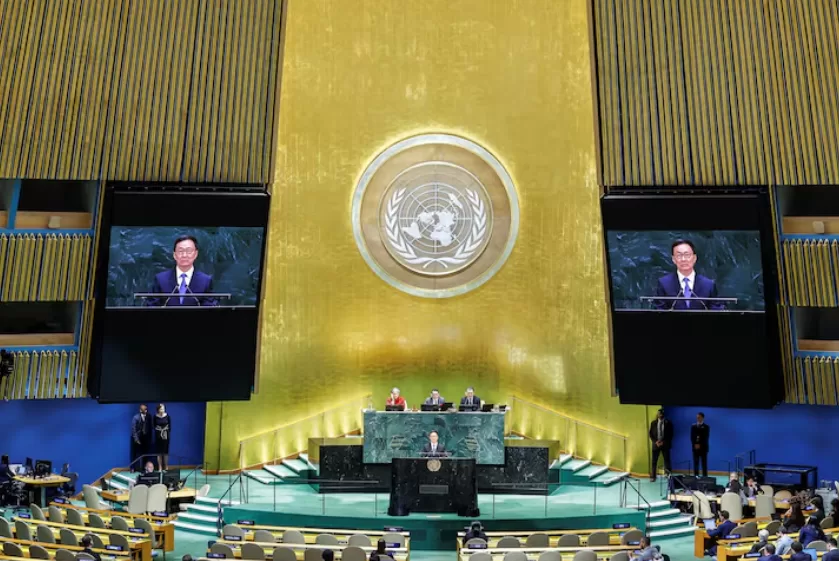
Analysts argue that Manila's chairmanship year offers a rare opening to build a coordinated regional diplomatic pushback against China's nine-dash line — using forums such as ASEAN and the United Nations General Assembly to build international pressure and promote joint support for UNCLOS-based maritime rights among states that share territorial grievances with Beijing.
Whether Manila can convert that diplomatic capital into concrete progress — or whether Beijing will use its economic leverage over ASEAN members to water down any meaningful outcome — remains the central question of the year.
The Deeper Stakes
The dispute over Scarborough Shoal illustrates the limits of legal rulings in the absence of enforcement mechanisms. While the Philippines holds a favorable international judgment, China's control on the ground has not changed. This creates a structural imbalance where law and power operate on parallel tracks — and where the steady normalization of confrontation increases the risk of miscalculation, particularly as more actors become involved and the strategic value of these waters grows.
In the worst-case scenario, China's confrontational posture could result in an incident causing loss of life — prompting the Philippines to invoke Article IV of its Mutual Defense Treaty with the United States and triggering a conflict that neither side officially wants but neither side is currently structured to prevent.
The broader implication, as analysts at Johns Hopkins SAIS and the East Asia Forum have noted, is that the South China Sea is moving further from resolution and closer to managed, permanent tension. As positions harden, the dispute is no longer simply about specific reefs, shoals, or fishing grounds. It is about competing visions of how power, law, and sovereignty will be ordered in the twenty-first-century Asia Pacific — and who will have the final word.
China says its history entitles it to the sea. The Philippines says the law does not agree. And between those two positions, a body of water the size of the Mediterranean is becoming one of the most dangerous places on Earth.
.
Sources:
- Reuters / Honolulu Star-Advertiser – "Philippines Rejects China's Claim to Entire South China Sea" (March 16, 2026): https://www.staradvertiser.com/2026/03/16/breaking-news/philippines-rejects-chinas-claim-to-entire-south-china-sea/
- Taipei Times – "Manila Rejects PRC Sovereignty Claim in South China Sea" (March 17, 2026): https://www.taipeitimes.com/News/front/archives/2026/03/17/2003853955
- Modern Diplomacy – "Philippines Rebuffs China Claim as South China Sea Tensions Harden" (March 17, 2026): https://moderndiplomacy.eu/2026/03/17/philippines-rebuffs-china-claim-as-south-china-sea-tensions-harden/
- East Asia Forum – "Drifting Through Dispute in the South China Sea" (February 2026): https://eastasiaforum.org/2026/02/27/drifting-through-dispute-in-the-south-china-sea/
- East Asia Forum – "Scarborough Collision Triggers Beijing's Strategic Hardening" (September 2025): https://eastasiaforum.org/2025/09/27/scarborough-collision-triggers-beijings-strategic-hardening/
- SAIS Review of International Affairs – "A Calm Before the Storm: South China Sea Powder Keg" (February 2026): https://saisreview.sais.jhu.edu/a-calm-before-the-storm-south-china-sea-powder-keg/
- Modern Diplomacy – "Maintaining a Deterrence Strategy for the Philippines in the Scarborough Shoal" (March 2026): https://moderndiplomacy.eu/2026/03/04/maintaining-a-deterrence-strategy-for-the-philippines-in-the-scarborough-shoal/
- China-Global South Project – "Philippines, U.S. Hold Joint Sail at Scarborough Shoal" (January 2026): https://chinaglobalsouth.com/2026/01/27/philippines-us-joint-exercises-scarborough-shoal/
- Permanent Court of Arbitration – South China Sea Arbitration Award (July 2016): https://pca-cpa.org/en/cases/7/
.
What's Your Reaction?
 Like
0
Like
0
 Dislike
0
Dislike
0
 Love
0
Love
0
 Funny
0
Funny
0
 Wow
0
Wow
0
 Sad
0
Sad
0
 Angry
0
Angry
0













Comments (0)