Prime Minister Mark Carney says his government will seek to expand commercial relations with Beijing, given China’s position as Canada’s second-largest trading partner. He adds that any expanded cooperation will be consistent with the values and interests of Canadians.
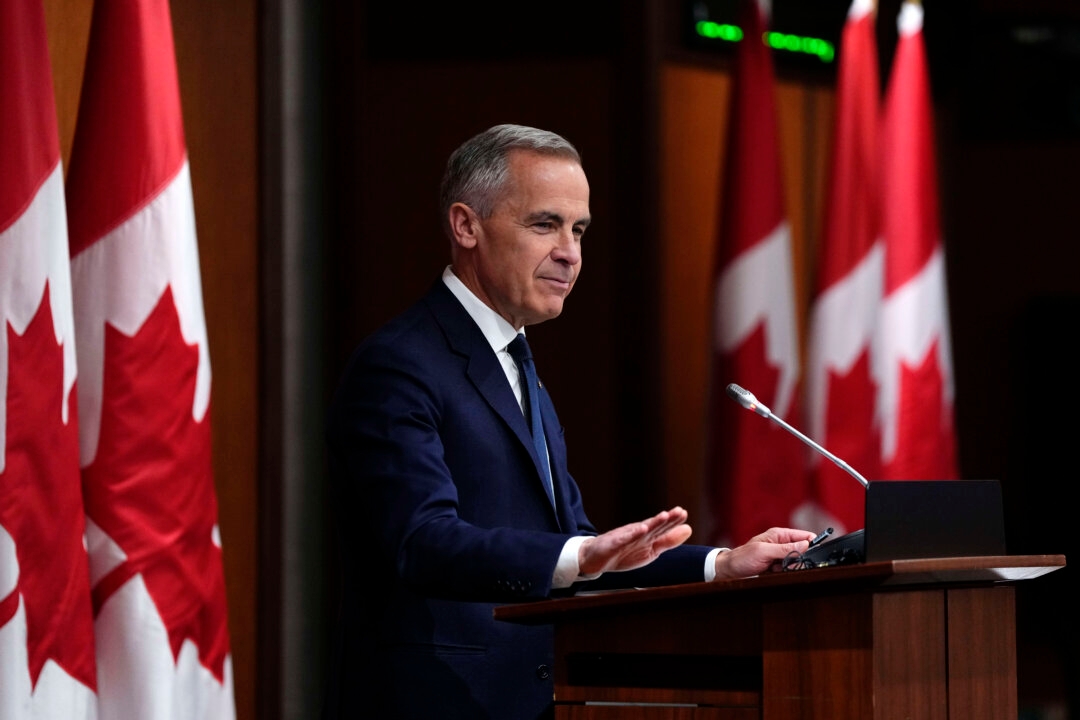
Carney made the comments during a Sept. 3 press conference as a two-day meeting with his cabinet kicked off in Toronto ahead of Parliament’s return. He was asked by reporters whether the apparent alignment between the regimes of China, Russia, and North Korea–following a meeting of their leaders in Beijing that day–would affect his approach to trade with China.
“We have differences with China, different approaches to a variety of things, but they are our second-largest trading partner, and there are areas where we can cooperate,” Carney said.
“We will look to potentially expand those areas for cooperation in ways that are consistent with our values and are in the interests of Canadians.”
Trade tensions between Ottawa and Beijing have intensified in recent months, after China imposed new tariffs on Canadian agricultural products, with Chinese officials voicing displeasure with Canada’s tariffs on Chinese electric vehicles, steel, and aluminum.
Diplomatic relations have also been strained following revelations of China’s interference in Canada’s democracy and Ottawa’s condemnation of Beijing’s escalating transnational repression of dissidents in Canada.
Carney said Canada can expand its trade with China in certain areas while safeguarding its sovereignty.
“There may be areas where ... respecting and protecting Canadian sovereignty [and] Canadian security, we can expand the commercial relationship with things that China does well,” he said.
Carney said at the Sept. 3 press conference that in the case of canola, his government is working to maintain agricultural trade with China, which he described as a “good relationship.”
“We’re coordinating with the provinces, our minister of international trade has been engaged, our foreign minister is engaged, I will be engaged to work to find a solution for our agricultural relationship,” he said. “It’s a good relationship–it’s a relationship that [has] existed for more than five decades.”
Meanwhile, Conservative Leader Pierre Poilievre has called for a strong response to Beijing’s targeting of Canada’s agricultural products, describing Beijing’s tariffs as an “unjustified attack on our farmers.”
“I think instead of trying to give in, we have to toughen up,” he said during an interview with The Elev8 Podcast, aired on Aug. 28.
“We should cancel the billion-dollar taxpayer-funded loan that the Carney government is backstopping to buy Chinese-made ferries, and we should take other similar steps to punish these latest Chinese tariffs on canola, pork, seafood, etc., and defend our producers.”
The Conservatives have called for the cancellation of a $1 billion loan the federal infrastructure bank is providing to BC Ferries, a publicly owned ferry operator, to purchase four new vessels from a Chinese state-owned company. The Tories say the ships should be built in Canada to support domestic industries.
The Tory’s shadow minister for transport, MP Dan Albas, who has been a vocal critic of the BC Ferries deal, says the Conservatives want Ottawa to respond to China’s tariffs with countermeasures, instead of supporting a ferry deal that would benefit the Chinese regime through a state-owned company.
“Conservatives want to retaliate against Beijing’s tariffs on our seafood and farmers, not reward them,” he said in a Sept. 2 social media post.
According to recently released documents, International Trade Minister Maninder Sidhu was briefed by Global Affairs on Canada’s efforts to diversify away from China when he assumed the ministerial role in March. The document, which details Sidhu’s mandate and responsibilities, cites Beijing’s “economic coercion” and “pervasive” non-market practices. It also informs Sidhu that Canada’s trade commissioner services “have focused on diversifying away from China, into the broader Indo-Pacific,” noting that trade with Beijing in certain sectors is risky and requires “caution.”
Tariff Tensions
China last month imposed 75.8 percent tariffs on Canadian canola, weeks after Ottawa announced additional tariffs on steel originating from China with the aim of protecting domestic industry from trade diversion.
.
The new Chinese tariffs added to the 100 percent duties China imposed earlier this year on Canadian canola products and other agricultural items, and stemmed from an “anti-dumping” investigation the regime initiated last year after Ottawa imposed 100 percent tariffs on Chinese EVs and 25 percent tariffs on Chinese aluminum and steel.
Beijing has on various occasions targeted the Canadian canola industry during periods of diplomatic or trade tension with Ottawa, including in 2019 when it imposed a three-year ban on Canadian canola imports following the arrest of Huawei executive Meng Wanzhou in Vancouver.
.
After Canada announced its latest tariffs on Chinese steel, Beijing filed a complaint with the World Trade Organization arguing the tariffs are inconsistent with international trade rules. Meanwhile, Ottawa has stood by the tariffs, saying that Beijing’s non-market practices threaten the domestic industry.
.
Following an Aug. 21 meeting on Canada’s response to Chinese tariffs on canola, government representatives said a delegation of Canadian officials will travel to China in the coming weeks to advocate for a resolution to the ongoing canola trade dispute and explore opportunities to expand trade with the country.
Zhuan Falun (Revolving the Law Wheel) is the main book of Falun Dafa. It is suitable for readers at all levels. To achieve a holistic comprehension, first-time readers should read the book page by page without skipping. Each subsequent read will elevate one’s understanding.



 Like
0
Like
0
 Dislike
0
Dislike
0
 Love
0
Love
0
 Funny
0
Funny
0
 Wow
0
Wow
0
 Sad
0
Sad
0
 Angry
0
Angry
0












Comments (0)