

France Calls Out Beijing: Europe Pushes China to Step Up on Hormuz Crisis
France's top naval officer has delivered one of the most direct public challenges yet aimed at Beijing over the Strait of Hormuz crisis. Admiral Nicolas Vaujour, Chief of Staff of the French Navy, told the War & Peace security conference in Paris on April 1 that China will at some point have to engage more directly on how to restore oil traffic flows in the strait, because the number of vessels it has managed to pass through is probably insufficient.

.
A Blunt Message From Paris
France's top naval officer has delivered one of the most direct public challenges yet aimed at Beijing over the Strait of Hormuz crisis. Admiral Nicolas Vaujour, Chief of Staff of the French Navy, told the War & Peace security conference in Paris on April 1 that China will at some point have to engage more directly on how to restore oil traffic flows in the strait, because the number of vessels it has managed to pass through is probably insufficient.
Vaujour also said France was actively working to bring a number of countries to the table at a political level to determine the conditions under which the strait could be reopened in a lasting way.
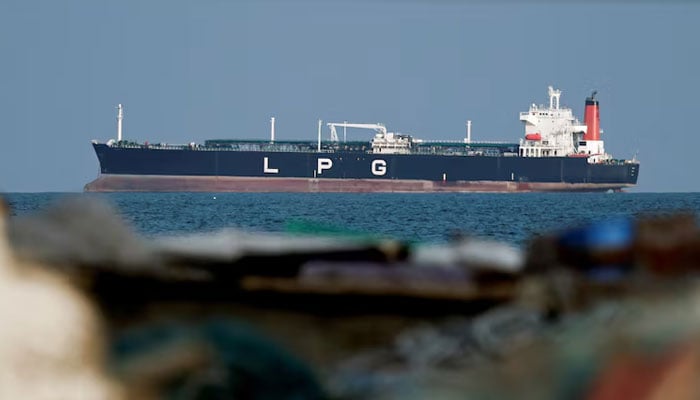
The Strait of Hormuz — a narrow waterway between Iran and the Arabian Peninsula — is one of the world's most critical energy chokepoints. During 2023–2025, roughly 20 percent of the world's liquefied natural gas and 25 percent of seaborne oil trade passed through it annually. Since late February, Iran has effectively shut the route to most international shipping in retaliation for U.S. and Israeli military strikes.
.
Why China Is in the Spotlight
Beijing's position in this crisis is unique — and uncomfortable. China imports as much as 40 percent of its oil and 30 percent of its liquefied natural gas through the strait. At the same time, China has maintained close ties with Tehran, providing diplomatic support and purchasing the bulk of Iran's oil exports.
Yet despite that leverage, Beijing's influence has proven limited. Ship-tracking data shows that Chinese tanker and container ships have all but ceased transits since the conflict began, leaving dozens of Chinese ships trapped in the Persian Gulf.
The limits of China's sway became starkly visible in late March. At least three Chinese-linked vessels, including two ships owned by China's state-run Cosco Shipping — the CSCL Indian Ocean and CSCL Arctic Ocean — turned back abruptly after being warned by Iran's Islamic Revolutionary Guard Corps (IRGC) Navy near Larak Island. The ships had even broadcast messages on their identification systems signaling Chinese ownership in hopes of being waved through — it wasn't enough.
According to analyst Edmund Fitton-Brown of the Foundation for Defense of Democracies, while Iran does not seek to alienate China — which has been broadly sympathetic to Tehran — access through the strait may be affected by a range of considerations, and the incident could reflect lower-level or more localized decisions by Iranian forces.
.
Europe's "Binding" Strategy
Vaujour's remarks were not an invitation for China to expand its military footprint in the Middle East. Analysts describe the statement as a deliberate diplomatic tactic — publicly cornering Beijing into taking responsibility.
By calling out China's private dealings with Iran in a public forum, France is essentially signaling that Beijing cannot keep reaping the benefits of its relationship with Tehran while avoiding the costs of resolving the crisis it has helped sustain. The CCP has long supplied Iran with military hardware, components, and diplomatic cover, while simultaneously benefiting from discounted Iranian oil exports.
France has pushed back against Trump's pressure on NATO, arguing that the military alliance was designed to ensure security in the Euro-Atlantic area — not to launch offensive operations in the Strait of Hormuz. This framing allows Europe to deflect American demands while still maintaining pressure on China to step up.
.
A Fractured Western Response
The backdrop to Vaujour's statement is significant transatlantic discord. U.S. President Donald Trump announced that the Strait of Hormuz would need to be "guarded and policed by other nations" who use it, declaring that the United States does not need to be involved. He has also escalated rhetoric against NATO allies, at one point calling European nations "cowards" for not joining the war effort against Iran.
British Prime Minister Keir Starmer announced on April 1 that the UK would convene a virtual meeting of 35 countries — not including the United States — to assess diplomatic and political measures to reopen the strait "after the fighting has stopped."
That meeting went ahead on April 2, chaired by UK Foreign Secretary Yvette Cooper, who accused Iran of blockading the waterway to "hold the global economy hostage." The coalition has since grown: 40 countries participated in that virtual session.
The United States was not among the countries attending.
.
The UN Front: Stalled
Efforts to secure a binding UN Security Council resolution have also run into obstacles. Bahrain, which holds the rotating presidency of the Security Council for April, circulated a revised draft resolution calling for "all necessary means" to protect commercial shipping in and around the strait.
A UN diplomat confirmed that China, Russia, and — notably — France each raised objections to the draft before it could advance under the council's silence procedure. France's opposition underscores its preference for a negotiated, multilateral political solution over a potentially escalatory UN mandate authorizing force.
.
The Stakes: Energy, Economy, and Global Supply Chains
The human and economic consequences of the blockade are already severe. Oil and gas prices have surged since the start of the war, as the near-collapse of Hormuz transits has tightened global supply.
In 2025, roughly 15 million barrels per day of crude oil and 5 million barrels per day of refined petroleum products were being exported through the strait. Fertilizer shipments have also been disrupted — a particular concern for global food security as the Northern Hemisphere spring planting season begins.
At least 18 vessels have been attacked in Gulf waters since the outbreak of the conflict, and traffic through the strait has dropped precipitously since early March.
.
What Comes Next
Whether China can — or will — use its influence to help broker a resolution remains uncertain. Beijing has publicly urged all parties to keep the strait open. But its leverage over Tehran appears more limited than many assumed, and any deeper Chinese engagement risks drawing it further into a conflict that Beijing has so far managed to observe from a careful distance.
French President Emmanuel Macron said on April 3 that launching a military operation to force the strait open is not feasible. Europe's preferred path appears to be multilateral diplomacy — and part of that strategy now involves making clear to Beijing that neutrality is no longer a cost-free option.
.
Sources
- Reuters / U.S. News: French Navy Chief Says China Will Have to Engage More in Strait of Hormuz Discussion — https://www.usnews.com/news/world/articles/2026-04-01/french-navy-chief-says-china-will-have-to-engage-more-in-strait-of-hormuz-discussion
- Al Jazeera: UK-led coalition of 40 countries vows action on Hormuz Strait closure — https://www.aljazeera.com/news/2026/4/2/uk-led-coalition-of-35-countries-vows-action-on-hormuz-strait-gridlock
- CSIS (Center for Strategic and International Studies): No One, Not Even Beijing, Is Getting Through the Strait of Hormuz — https://www.csis.org/analysis/no-one-not-even-beijing-getting-through-strait-hormuz
- Chatham House: Conflict in the Strait of Hormuz Is Spilling into the Indian Ocean — https://www.chathamhouse.org/2026/03/conflict-strait-hormuz-spilling-indian-ocean
- Foundation for Defense of Democracies (FDD): Iran Blocks 2 Chinese Vessels From Transiting Strait of Hormuz — https://www.fdd.org/analysis/2026/03/27/iran-blocks-2-chinese-vessels-from-transiting-strait-of-hormuz/
- Al Jazeera: UK to host meeting of 35 countries on reopening Strait of Hormuz — https://www.aljazeera.com/news/2026/4/1/uk-to-host-meeting-of-35-countries-on-reopening-strait-of-hormuz
- Reuters / MarketScreener: Bahrain's Hormuz resolution runs into fresh obstacles at UN — https://www.marketscreener.com/news/bahrain-s-hormuz-resolution-runs-into-fresh-obstacles-at-un-ce7e51dcd88df127
- Wikipedia: 2026 Strait of Hormuz Crisis — https://en.wikipedia.org/wiki/2026_Strait_of_Hormuz_crisis
.
What's Your Reaction?
 Like
0
Like
0
 Dislike
0
Dislike
0
 Love
0
Love
0
 Funny
0
Funny
0
 Wow
0
Wow
0
 Sad
0
Sad
0
 Angry
0
Angry
0













Comments (0)