

China's Politburo Loses Third Member to Purge: The Fall of Ma Xingrui
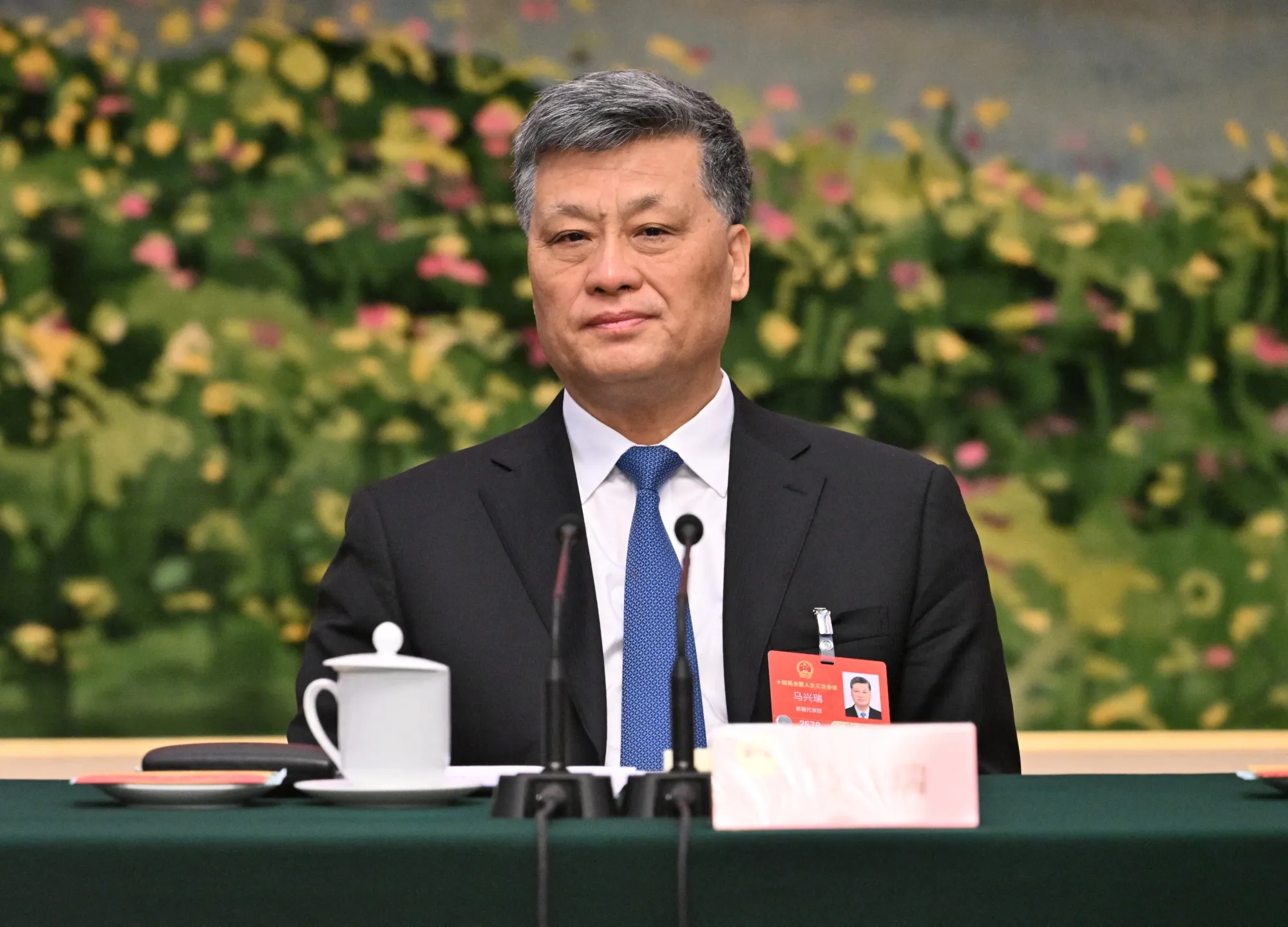
Ma Xingrui, former party secretary of China's western Xinjiang region, was placed under investigation for "severe violations" of unspecified laws and party discipline, the Xinhua News Agency reported Friday. The announcement was brief, clinical, and devastating. Ma, who also serves as deputy leader of the central rural work leading group, is undergoing a disciplinary review and supervisory investigation, according to the Central Commission for Discipline Inspection (CCDI) — the party's powerful internal watchdog. No details about the specific allegations were disclosed.

.
Beijing's anti-corruption machine has reached into the very top of the Communist Party. Again.
.
A Rocket Scientist Brought Down to Earth
Ma Xingrui, former party secretary of China's western Xinjiang region, was placed under investigation for "severe violations" of unspecified laws and party discipline, the Xinhua News Agency reported Friday.
The announcement was brief, clinical, and devastating. Ma, who also serves as deputy leader of the central rural work leading group, is undergoing a disciplinary review and supervisory investigation, according to the Central Commission for Discipline Inspection (CCDI) — the party's powerful internal watchdog. No details about the specific allegations were disclosed.
The timing is striking: China is stepping up its years-long fight against corruption with the purge of sitting members of the Politburo, the ruling Communist Party's decision-making body.
Third in Line: A Purge Without Modern Precedent
Ma is the third member of the ruling party's elite political body to come under investigation in the current term that began in 2022 — a situation unseen in decades.
The two who fell before him were both top military figures. He Weidong, former vice-chairman of the powerful Central Military Commission (CMC), was also investigated and expelled from the party and military in October. Another CMC Vice-Chairman, Zhang Youxia, was placed under investigation for suspected serious violations of party discipline and law in January.
The Politburo is now down to 21 members.
Analysts say this level of elite-level purging is extraordinary. The scale surpasses anything seen since the political turmoil following the 1989 Tiananmen Square crackdown, when then-General Secretary Zhao Ziyang was removed from power after expressing sympathy for pro-democracy protesters.
From Moon Missions to Party Politics
Who is Ma Xingrui, and how did he rise so high?
Ma advanced his professional and political career largely through the aerospace industry, where he worked for 25 years. As a rocket scientist, he served as chief commander for several space missions, including the Chang'e 3 mission — China's first lunar surface exploration.
He previously served as vice president of the Harbin Institute of Technology, general manager of China Aerospace Science and Technology Corporation, director of the China National Space Administration, and chief commander of Chang'e 3. Colleagues gave him the nickname "Aerospace Young Marshal" — a nod to both his youth and his outsized influence in China's space program.
His career then took a sharp political turn. Ma later served as party secretary of Shenzhen and governor of Guangdong province — two key economic hubs that played central roles in China's reform and growth trajectory. He was appointed Xinjiang party secretary in 2021 and elevated to the Politburo in 2022.
The Xinjiang Chapter — and Its Complications
Ma's appointment to lead Xinjiang in late 2021 was a significant moment. He replaced Chen Quanguo, a figure notorious internationally for overseeing a sweeping crackdown on Uyghurs and other Muslim minorities in the region — including mass internment camps that the United States and others have labeled a genocide.
Ma is a member of the party's Central Committee and served as party secretary of the Xinjiang region in China's northwest from 2021 to 2025. He also previously served as director of the National Ethnic Affairs Commission and deputy party chief in Guangdong province.
Since his accession to the post, Xinjiang saw relative normalization in some aspects, such as turnstiles between residential areas being removed and two-day weekend breaks for public officials being restored. Whether these were genuine reforms or cosmetic changes aimed at easing international pressure remains debated.
Ma was removed from his previous role as Xinjiang party chief in July 2025, signaling potential shifts within the party's internal hierarchy. The official announcement said he would be "reassigned," but no new role ever materialized — an ominous silence by CCP standards.
The Disappearing Act Before the Fall
In the months leading up to Friday's announcement, Ma's absence from public life had become impossible to ignore.
Ma missed the November 28, 2025 Politburo study session, the December Central Economic Work Conference, and the late-December Politburo "democratic life meeting." He remained absent from the CCDI's fifth plenary session in January 2026 and from a high-level seminar at the Central Party School later that month.
Ma was last seen in public in October 2025. His name was quietly removed from the presidium of the National People's Congress without explanation.
Analysts at Trivium China noted that Ma has deep links to China's defence and aerospace industries, which have been caught up in the sweeping anti-corruption purge rocking the armed forces — and warned that if Ma had been caught in a corruption scandal, further shake-ups within the Politburo could follow, with at least two other members also having deep ties to the defense-industrial system.
Xi's Consolidation of Power — or Something Deeper?
Beijing officially frames all of this as part of an anti-corruption drive. But many analysts see something more complex at work.
The latest probe reflects the continued centralization of authority under Xi, as well as the use of anti-corruption mechanisms to enforce political discipline. Critics argue that Xi's anti-graft campaign — now in its second decade — has become an instrument of political control as much as a genuine fight against corruption.
Both Ma and Zhang technically retain their positions while investigations are ongoing. In practice, however, a CCDI investigation at this level rarely ends in anything other than expulsion.
What happens next could reveal much about the state of power inside the world's most opaque major government. With three Politburo members now under investigation in a single term, Beijing's ruling circle is shrinking — and becoming harder to predict.
.
Sources
- Reuters / Nikkei Asia – Chinese Politburo member Ma Xingrui under investigation (April 3, 2026): https://asia.nikkei.com/politics/chinese-politburo-member-ma-xingrui-under-investigation
- South China Morning Post – Ma Xingrui the third Politburo member investigated by China's graft-busters (April 3, 2026): https://www.scmp.com/news/china/politics/article/3348968/ma-xingrui-third-politburo-member-investigated-chinas-anti-corruption-bodies
- NPR / AP – China's Communist Party investigates ex-Xinjiang leader Ma Xingrui (April 3, 2026): https://www.npr.org/2026/04/03/g-s1-116327/chinas-communist-party-investigates-ex-xinjiang-leader-ma-xingrui
- Bloomberg – China Probes Politburo Member in Xi Jinping's Anti-Corruption Campaign (April 3, 2026): https://www.bloomberg.com/news/articles/2026-04-03/china-probes-politburo-member-in-widest-purge-since-1976
- Brookings Institution – Ma Xingrui: Career Profile (John L. Thornton China Center): https://www.brookings.edu/wp-content/uploads/2022/10/20thpartycongress_ma_xingrui.pdf
- The Diplomat – The Re-emergence of an 'Aerospace Clique' in Chinese Politics (Feb. 2022): https://thediplomat.com/2022/02/the-re-emergence-of-an-aerospace-clique-in-chinese-politics/
- Asia Society Policy Institute – Aerospace Engineers to Communist Party Leaders (2023): https://asiasociety.org/policy-institute/aerospace-engineers-communist-party-leaders-rise-military-industrial-technocrats-chinas-20th-party
.
What's Your Reaction?
 Like
1
Like
1
 Dislike
0
Dislike
0
 Love
1
Love
1
 Funny
0
Funny
0
 Wow
1
Wow
1
 Sad
0
Sad
0
 Angry
0
Angry
0














Comments (0)