

China’s 3 Food Delivery Giants Report Huge Drop in Profits in 2nd Quarter


The second quarter financial reports of China’s three major food delivery platforms have been released, showing a significant drop in profits.
While the companies say the hit to their profits is the result of their fierce price competition to attract customers, analysts say a deteriorating business environment and structural problems in China’s planned economy are the root cause, with many Chinese people reducing their discretionary spending, such as dining out, amid a sluggish economy.
Meituan, the Chinese e-commerce giant that has dominated the domestic meal and food delivery market for years, reported an 89 percent drop in second-quarter net profit on Aug. 27, following another Chinese e-commerce titan, JD.com, reporting a 50.8 percent net profit drop earlier in August.
Alibaba, which owns online food delivery service Ele.me, reported on Aug. 29 that its adjusted net profit had also dropped 18 percent to 33.51 billion yuan ($4.68 billion).
Unlike Meituan, whose core online retail business is meal service and delivery, Alibaba’s AI sector makes up a significant portion of its revenue, which saw the company suffer less of a drop in profits. Despite Alibaba reporting revenue of 247.65 billion yuan in the 2nd quarter, it’s a disappointing 2 percent year-on-year increase—much lower than the expected 18.4 percent rise by international analysts.
It’s unclear if Ele.me made any profit in the 2nd quarter, as Jiang Fan, CEO of Alibaba’s e-commerce business group, said in an earnings call for the 2nd quarter, “We don’t look at the profit of food delivery separately.” He added that “our peers are doing very well in food delivery, especially in terms of efficiency, and we are working hard to catch up.” He acknowledged that the food delivery price war will be a protracted battle.
Meituan has long been China’s leading online food service and delivery business, commanding nearly 70 percent of the food delivery market while facing increasingly intense competition from Alibaba and JD.com in the already low-margin sector.
Meituan’s chief financial officer, Chen Shaohui, stated on an earnings call that the company expects its core local e-commerce business (including food delivery) to experience “significant losses” in the third quarter as the intense price competition continues.
The profit drop affecting all three of China’s major food delivery companies shows the intense competition in China’s food delivery market, as observed by both domestic and international media. The food delivery companies have been offering deep discounts and even subsidies to attract customers to increase their market share but that has also severely eroded their profits.
China’s white collar workers, who make up a large proportion of China’s food delivery consumption, have reduced their spending including on food services amid China’s sluggish economy and high unemployment, according to Chinese media reports and posts on social media. For example, office workers in Beijing’s financial district are now bringing their own lunches, a sign of tightening consumption, as many Chinese are cutting back on eating out and significantly reducing spending.
Meanwhile, as China’s high unemployment persists with more businesses closing down amid China’s trade war with the West, not only young people but also many middle-aged people in the middle class who have lost their jobs are working as food delivery drivers.
These three major food delivery companies have hired a large number of delivery drivers, Frank Xie, professor in Business at University of South Carolina Aiken, noted. “Sadly, many postgraduate students are joining this profession.”
Vicious Competition, Distorted Economic Development
On July 18, the Chinese regime’s State Administration for Market Regulation summoned the representatives of Meituan, JD.com, and Ele.me, for a meeting and asked the three major platforms to make rectifications, including completely removing “zero-yuan purchase” promotional activities and significantly reducing the scope of “free orders” marketing.Although Meituan, JD.com, and Alibaba all said that they would reduce the discounts being offered after the meeting, they have continued offering subsidies to orders placed.
In August, the three companies issued statements, describing the food delivery price war in the 2nd quarter as “disorderly” or “vicious” competition.
Davy J. Wong, a U.S.-based economist, told The Epoch Times that price competition among food delivery platforms is primarily driven by “pressure from capital and shareholders.” Despite regulatory calls to halt discount operations, none of the companies can stop. “Because whoever stops first would be admitting defeat, and all previous investments would be lost.”
He pointed out that this unstoppable vicious price competition shows that “China’s current economic environment and market management are both relatively poor.”
He added that this kind of vicious competition will cause the “bad players to drive out the good ones,” making it harder for the businesses that prioritize product quality and legitimate operations to survive.
While consumers may temporarily benefit from subsidies and enjoy cheaper food, he said, “some businesses may cut corners to survive, even offering counterfeit, substandard, or toxic food. This is detrimental to both businesses and consumers.”
.
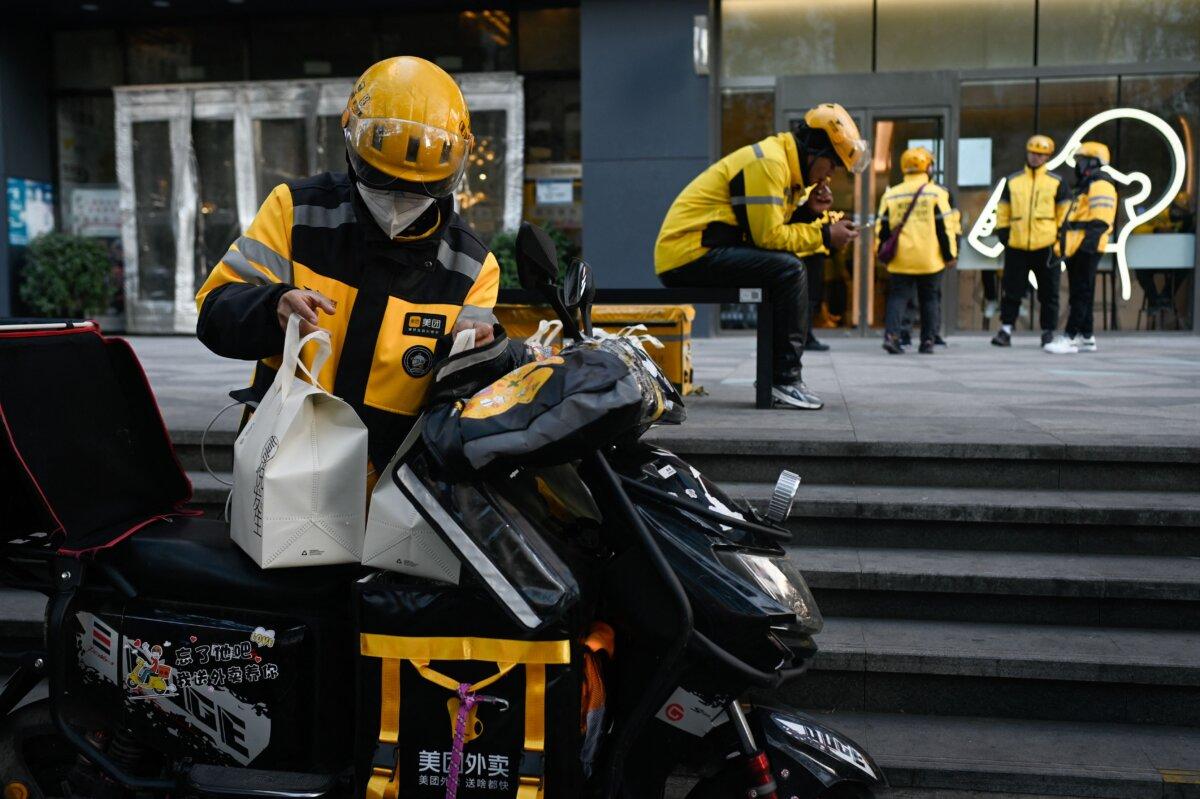
The major Chinese food delivery platforms have continued to offer heavy discounts because they need to capture market share, and the result of such practices naturally leads to massive profit losses, Xie said.
The piece completion among China’s food delivery giants reflects the deterioration of China’s business environment and the slowdown of the Chinese economy that are both caused by the Chinese regime’s distorted economic development, Xie said.
“These CCP officials, through various corrupt practices, have seized the largest profits of the past decades of China’s economic reform, resulting in a high concentration of wealth in their hands,” he said.
Expanding to Other Countries
This year, Meituan has expanded into Saudi Arabia with its food delivery platform Keeta and its grocery delivery brand Keemart. JD also launched an express delivery service in Saudi Arabia.
Meituan is also launching business in Brazil through its Keeta food delivery brand. It plans to invest $1 billion over five years in Brazil. JD is also expanding its e-commerce business in Brazil.
“Some Chinese companies are bringing vicious competition and some of their bad practices in China to other countries, which will undoubtedly have a negative impact on overseas markets,” Xie said.
He noted that the Chinese companies’ overseas operations are largely concentrated in big cities or areas that have larger Chinese and Asian populations.
“This is where they have some advantages. However, this market is not large, and they don’t have the ability to truly enter mainstream Western markets such as in the United States and Canada,” he said.
What's Your Reaction?
 Like
0
Like
0
 Dislike
0
Dislike
0
 Love
0
Love
0
 Funny
0
Funny
0
 Wow
0
Wow
0
 Sad
0
Sad
0
 Angry
0
Angry
0















Comments (0)