

China Was Never Singapore at Scale


.
For 30 years, one of the most comforting stories told in boardrooms, Davos panels, and foreign-policy salons was about China. Beijing had simply copied the “best model”: Lee Kuan Yew’s Singapore, then scaled it up.
China, the story went, was Singapore with 1.4 billion people: disciplined, meritocratic, technocratic, allergic to ideology, and obsessed with long-term growth. Domestic savings were very high, corruption was supposedly under control, and the Chinese Communist Party (CCP) had transformed itself into a giant, rational civil service. Investors loved the narrative because it made China’s ascent feel inevitable and, crucially, safe. If China were just Singapore on a larger scale, then betting on it would be the smartest move of the century. That story is now collapsing before our eyes.
The Parts That Looked the Same
We should give optimists their due. In the 1990s and 2000s, the parallels were hard to miss. Deng Xiaoping openly admired Singapore. In 1992, he declared: “Thanks to a strict administration, Singapore has good public order. We should learn from its experience and surpass it in this respect.” Thousands of Chinese officials were dispatched to the city-state.China copied Singapore’s public-housing model (the HDB), studied its Central Provident Fund, and even built an entire industrial park in Suzhou with Singaporean partners. Lee Kuan Yew visited China 33 times and privately briefed Jiang Zemin, Zhu Rongji, Hu Jintao, and others. Multiple generations of Chinese leaders treated him almost as a mentor.
The Parts That Were Always Different
However, the problem was structural. Singapore is rule-bound; China is CCP-bound. In Singapore, contracts are enforced by courts, regulations are predictable years in advance, and even the ruling People’s Action Party operates within a legal framework it cannot casually rewrite. In China, the CCP sits above the law. Courts, regulators, and local officials ultimately answer to political directives, not statutes. When ideology shifts (as it does whenever the Communist Party is in trouble, or when leadership changes), rules can and do change overnight.Singapore earns obedience through legitimacy and trust. Under the CCP, China enforces obedience through authority and fear. That difference is most obvious in the savings story many people got wrong.
China’s savings are a symptom of insecurity, not prosperity. In good times, fear-driven savings fuel investment booms. In bad times, they freeze consumption, exactly what has happened since 2022.
Also, the “growth miracle” was never funded only—or even mainly—by those famous domestic savings. From 1990 to 2010, China was the world’s largest recipient of foreign direct investment, attracting a cumulative $2.2 trillion (in current U.S. dollars). Foreign direct investment (FDI) routinely covered 10–15 percent of total fixed investment (which was around 30 percent of GDP) in the boom years and brought technology, management know-how, and global market access.
Singapore never needed anything like that volume of foreign capital because it was a small, open trading hub. China’s model was different: authoritarian direction, forced domestic savings, and massive foreign capital and export markets. Strip away the FDI and the export boom, and the “self-reliant savings story” doesn’t hold water.
Finally, Singapore benefited from globalization without ever becoming existentially dependent on it. China became the single most important node in the global supply chain system. That gave it tremendous leverage when the world needed cheap goods; the flip side is that it now exposes it to lethal risk when the world decouples.
.
The 2020s Stress Test
The late 2010s and early 2020s delivered the first sustained adverse shock since Deng Xiaoping’s reforms began. The results have been brutal.- Net foreign direct investment turned negative in 2024 for the first time in modern history. Capital is not slowing; it is leaving.
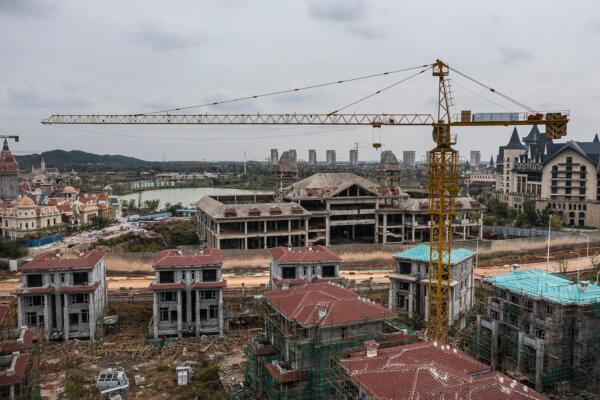
- Real estate, directly and indirectly responsible for roughly 25 percent of GDP, has entered a Japanese-style stagnation. Evergrande is gone, Country Garden is restructuring under distress, and local governments have lost their main revenue source (land sales).
- Total debt almost certainly exceeds 300 percent of GDP once hidden local-government and shadow-bank liabilities are included.
- The fertility rate has fallen to around 1. The working-age population is shrinking by millions every year.
- Supply chains are relocating to Vietnam, India, Mexico, and Eastern Europe faster than Beijing can build industrial parks to replace them.
The End of the Inevitability Narrative
For decades, the world assumed China’s trajectory was linear: more growth leads to more stability, which in turn leads to more global power. The new reality is fragility that breeds uncertainty, which, in turn, yields a reactive, often self-damaging policy.Reform now carries political risk. Easing up on the private sector could be portrayed as ideological backsliding; doubling down risks killing the semi-golden goose. Local governments are functionally insolvent yet politically untouchable. Entrepreneurs who once raced ahead now lie low or emigrate.
The Deeper Lesson
Systems built on fear can rise faster than systems built on trust. Fear mobilizes resources, suppresses dissent, and allows breakneck construction. But when the external environment turns hostile, trust builds resilience while fear leads to paralysis.Singapore’s real genius was never authoritarianism; it was creating predictability, the rule of law, and alignment between state and society within an authoritarian framework. China achieved speed and scale, but never predictability, both by riding a once-in-history wave of foreign capital and export demand that is now receding. The features that once looked like strengths, massive mobilized savings, total CCP control, and dependence on the property sector as a growth engine have turned into liabilities. Once seen clearly, China’s current troubles are not surprising; they were inevitable.
One more thing. There are other kinds of policy beyond economic policy. It does seem that, in recent decades, Singapore has increasingly aligned itself geopolitically with the CCP. This is another kind of systemic risk Singapore is now facing, as globalization bifurcates and it becomes harder and harder “to step on two boats at once,” as the old Chinese idiom goes.
What's Your Reaction?
 Like
0
Like
0
 Dislike
0
Dislike
0
 Love
0
Love
0
 Funny
0
Funny
0
 Wow
0
Wow
0
 Sad
0
Sad
0
 Angry
0
Angry
0













Comments (0)