.
The Chinese communist regime on Oct. 14 sanctioned five U.S.-linked units of South Korean shipbuilding giant Hanwha Ocean and threatened further retaliatory actions against entities supporting the U.S. government’s investigation into its maritime sector.
The affected subsidiaries are Hanwha Shipping LLC, Hanwha Philly Shipyard Inc., Hanwha Ocean USA International LLC, Hanwha Shipping Holdings LLC, and HS USA Holdings Corp, according to a
notice from China’s Ministry of Commerce.
Chinese entities and individuals are prohibited from doing business and engaging in transactions with the targeted units of Hanwha Ocean, the ministry said.
Shares of Hanwha Ocean closed down 5.8 percent following Beijing’s announcement.
Hanwha did not immediately respond to The Epoch Times’ request for comment.
South Korea’s foreign ministry said in a statement to Reuters that it was currently determining the impact of the sanctions, and planned to communicate with China, relevant ministries, and industry to minimize their impact.
Possible Further Retaliations
Chinese Minister 0f Commerce Wang Wentao said the sanction is a direct response to Washington’s Section 301
investigation into China’s maritime, logistics, and shipbuilding sectors.
“Hanwha Ocean’s subsidiaries in the United States assisted and supported the relevant investigative activities by the U.S. government, thereby endangering China’s sovereignty, security, and development interests,” the commerce ministry said in a notice.
The U.S. Office of the United States Trade Representative (USTR) in
April 2024 opened a Section 301 trade investigation into how China achieved dominance in the maritime sector following a petition filed by five major labor unions. In a January report, the USTR
announced its determination that the regime’s trade policies and practices were “unreasonable” and severely damaging to U.S. companies, workers, and the economy.
As a result, the Trump administration imposed
port fees on ships built in China, beginning on Oct. 14.
.
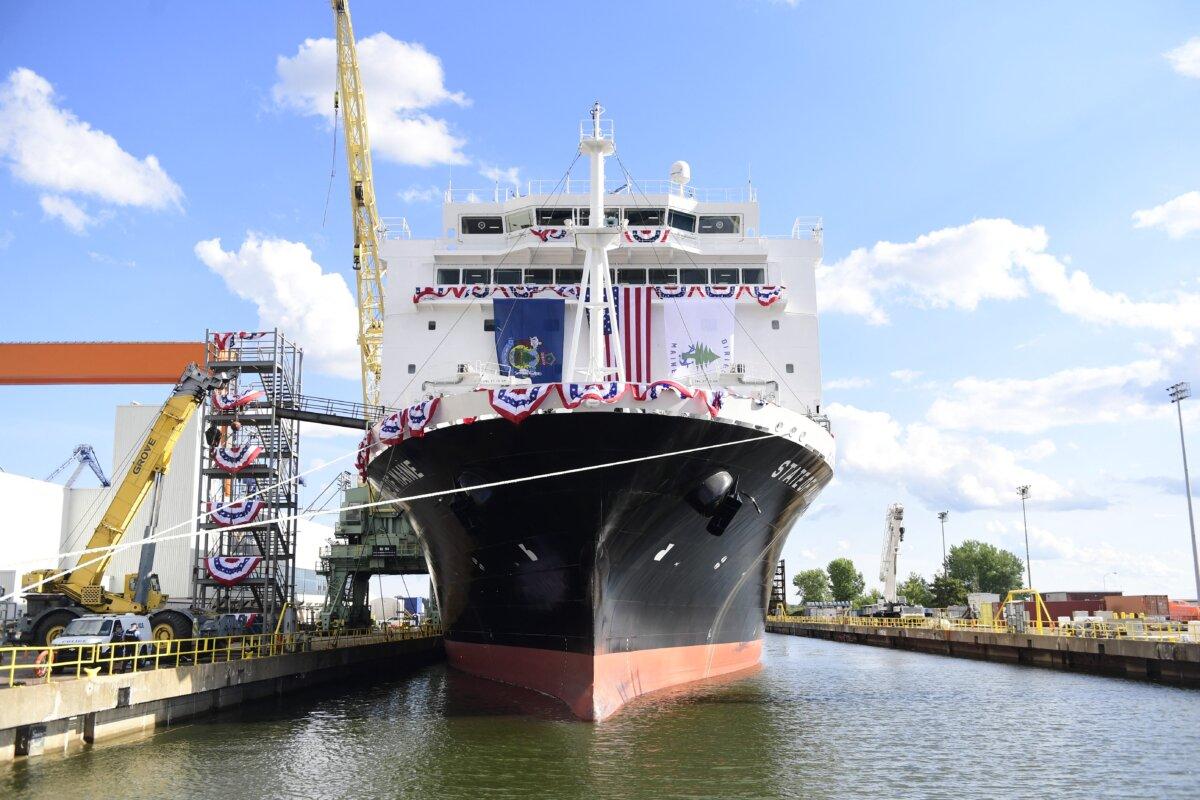
The TS State of Maine is pictured at the Hanwha Philly Shipyard in Philadelphia on Aug. 26, 2025. Matthew Hatcher/AFP via Getty Images
.
In retaliation, China
announced last week that it would impose additional charges on U.S. ships docking at its ports.
The communist regime’s transport ministry confirmed on Oct. 14 that the port fees have come into force. U.S.-owned or operated vessels, as well as ships built in the United States and flying the U.S. flag, are now subject to a fee of 400 yuan ($56) per net ton of cargo, according to the statement.
In a separate notice, China’s transport ministry said it’s assessing the potential impact of the U.S. Section 301 probe on China’s domestic maritime, shipbuilding, and related industries.
The ministry also said it’s looking into companies, organizations, and individuals that had assisted the U.S. government in what it described as the targeting of China’s shipping supply chains, warning that further countermeasures may be introduced based on its findings.
US-South Korea Shipbuilding Cooperation
The Trump administration’s decision to impose the port fees on China-built vessels is part of a broader effort to
revive domestic shipbuilding capability amid growing concerns over communist China’s dominance in the maritime sector.
As of 2024, China has claimed more than half of the global commercial shipbuilding market, largely due to massive state subsidies and other policy support, while the U.S. share has dwindled to a mere 0.1 percent, according to the
assessment by the Center for Strategic and International Studies (CSIS).
.
In the last year alone, a single Chinese state-owned shipbuilder built more commercial vessels by tonnage than the entire U.S. shipbuilding industry has built in the 80 years since the end of World War II, CSIS said in a March
report.
That corporation, the China State Shipbuilding Corporation, has been sanctioned by the United States for its central role in building naval vessels for the Chinese Communist Party’s (CCP) military.
.
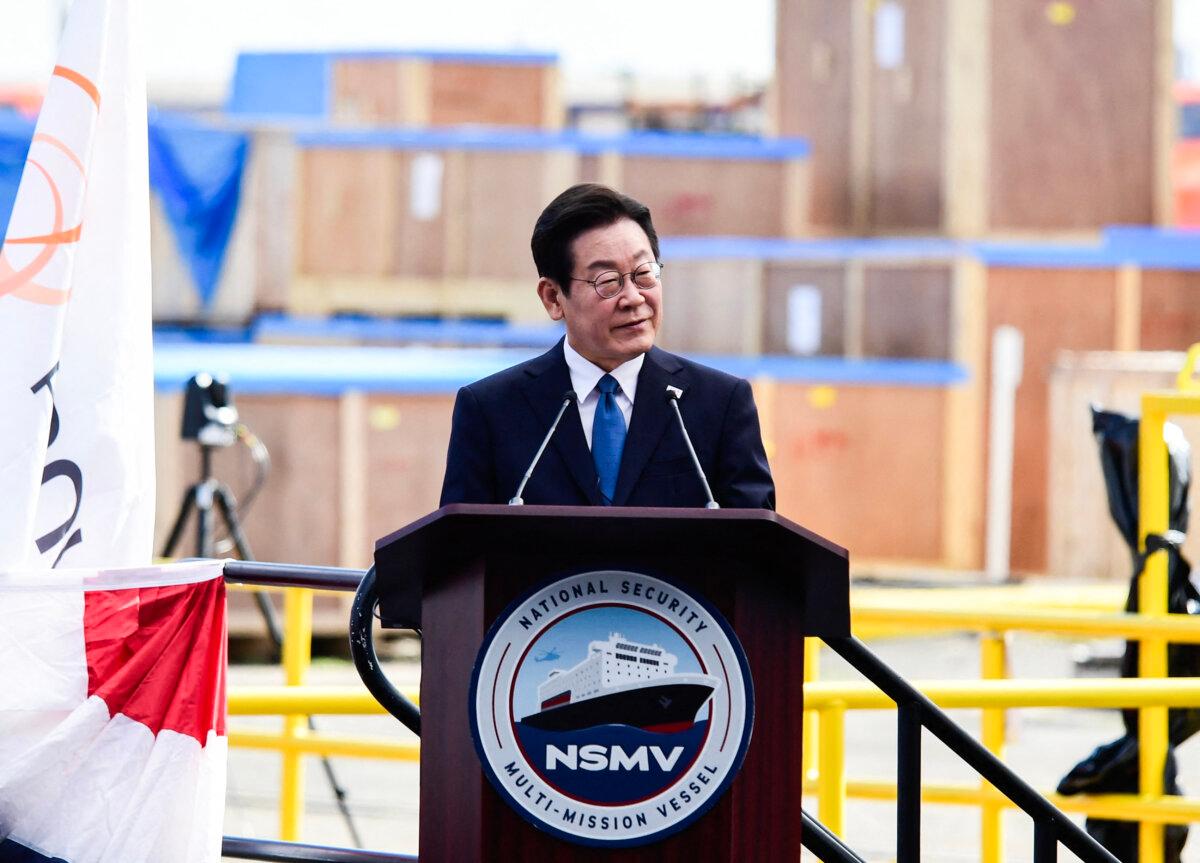
South Korean President Lee Jae Myung speaks during a visit to a shipyard owned by South Korean business conglomerate Hanwha Group in Philadelphia on Aug. 26, 2025. Matthew Hatcher/AFP via Getty Images
.
To address the national security and economic challenges posed by the CCP’s shipbuilding capabilities, the United States has been strengthening ties with allies, particularly South Korea, which is the world’s third-largest shipbuilder. One major cooperative shipbuilding project between Washington and Seoul is the Hanwha Philly Shipyard in Philadelphia,
acquired by Hanwha Ocean in December 2024.
.
South Korean President Lee Jae Myung visited the shipyard and attended its naming ceremony during his
first official trip to the United States in August.
.
As part of South Korea’s $150 billion investment plan into the U.S. shipbuilding sector, Hanwha Ocean committed to spending $5 billion at Hanwha Philly Shipyard to install two additional docks and three quays, the company said in an August
statement. The expansion is aimed at increasing its annual output from fewer than two vessels to as many as 20, according to the statement.
.
Andrew Thornebrooke and Reuters contributed to this report.
.




 Like
0
Like
0
 Dislike
0
Dislike
0
 Love
0
Love
0
 Funny
0
Funny
0
 Wow
0
Wow
0
 Sad
0
Sad
0
 Angry
0
Angry
0












Comments (0)