

China Enforces Mandarin-Language Instruction in Inner Mongolia Schools, Sparking Fears of Cultural Loss

.
Chinese authorities have implemented a sweeping language policy shift in China’s Inner Mongolia region, mandating Mandarin as the main language of instruction across all school curricula. Some ethnic Mongolians recently expressed deep concern to The Epoch Times, fearing the loss of their language, culture, and identity.
All the interviewees withheld their full names out of fear of reprisal by the authorities.
Ethnic Mongolian teachers who previously taught these subjects in their native language are being reassigned or required to undergo retraining to teach in Mandarin.
“I taught math in Mongolia for over a decade. Since last fall, I’ve had to switch entirely to teaching in Mandarin. The training was rushed, and many of us are struggling to adapt. It’s even harder for the students to keep up in class,” Saren, a local primary school teacher, said in an interview with the Chinese-language edition of The Epoch Times.
At a primary school in Ordos, another teacher, Naren-Gowa, observed that students who had excelled academically saw their grades drop suddenly after the language switch.
She said she knew a third-grader who was doing well in math until it was taught in Mandarin.
“His parents thought he was slacking off,” she said.
Some expressed concern about the long-term cultural consequences.
“If national textbooks in Mandarin are used from first grade, our mother tongue will gradually disappear. And if our language disappears, so will our ethnic identity,” said Adma, a parent from Hulun Buir.
“That’s what frightens us the most. What will happen to our children and to the Mongol ethnic group in the future?”
Furthermore, ethnic Mongolian civil servants are now expected to speak Mandarin at all public events.
“This atmosphere makes us afraid to speak Mongolian, even among ourselves,” a local official told The Epoch Times. “We worry people will think we’re backward or incompetent.”
In some schools, staff offices now mix Han and Mongolian teachers to promote integration. One teacher said the policy has created tension.
Longstanding Cultural Assimilation Efforts
This language policy is the latest effort in a decades-long campaign of the Chinese Communist Party (CCP) to assimilate ethnic minorities in China.The CCP has imposed similar Mandarin-only education policies in Xinjiang and Tibet—regions with large non-Han populations—drawing condemnation from international critics, including lawmakers and human rights groups.
“Our children come home speaking only Mandarin,” a father in Xilingol said in an interview with the Chinese-language edition of The Epoch Times, speaking anonymously for fear of retribution.
“They can’t write Mongolian anymore, and they don’t want to speak it. We try to use Mongolian at home, but the school environment is too dominant.
“We’re not against them learning Mandarin. But it shouldn’t come at the cost of our mother tongue.”
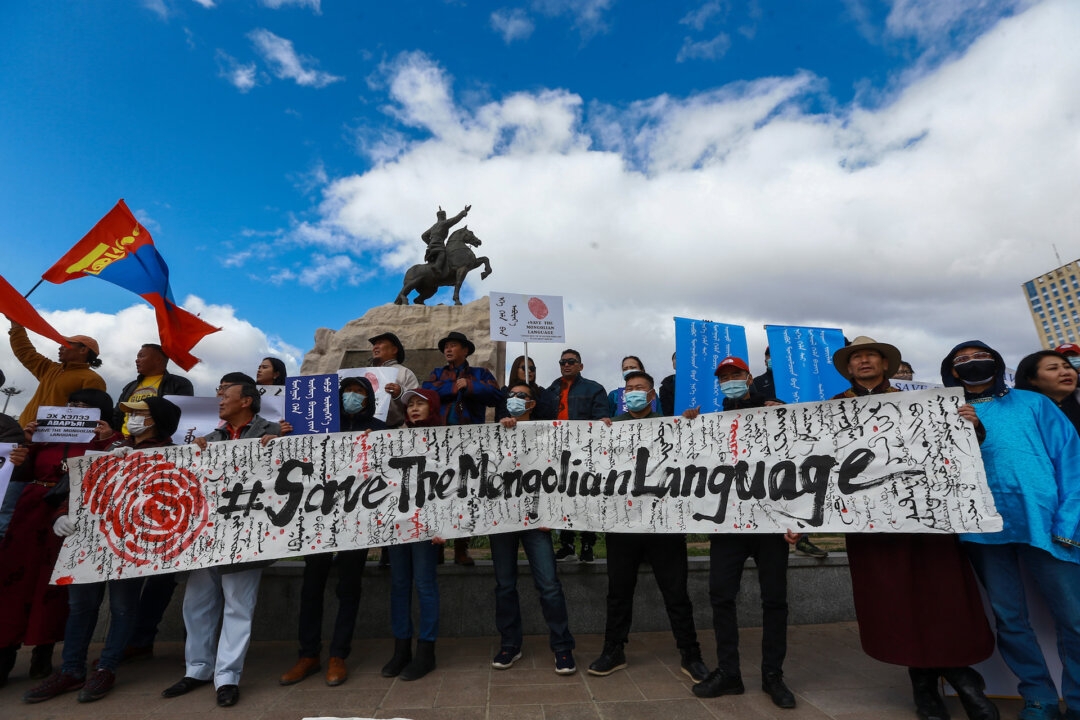
Authorities responded with surveillance, arrests, and censorship. Online discussions were quickly removed from Chinese social media. In the years since, as state control has intensified, many parents now remain silent—fearful of repercussions that could affect their children’s futures, according to rights groups.
.

“Five years ago, people went on strike, pulled their kids from school, and petitioned the government,” Baolerima, a Mongolian activist now living in the United States, said in a recent interview with The Epoch Times. “The police arrested many. We protested abroad too, but nothing changed.”
Mongolians, as a traditionally nomadic people, have developed a rich vocabulary in their language, particularly in relation to horses. They have numerous terms to describe different horse breeds, colors, markings, temperament, and behavior, reflecting the animal’s vital role in their daily lives.
In addition, the Mongolian language includes specific words for landscapes, weather patterns, and animal behavior—essential knowledge for surviving in the harsh steppes and deserts that have been their home for centuries.
For many Mongolians, the fight for their language is not just about communication; it is also about identity, survival, and dignity.
“Mongolian is not just a language,” said Adma. “It’s who we are.”
What's Your Reaction?
 Like
0
Like
0
 Dislike
0
Dislike
0
 Love
0
Love
0
 Funny
0
Funny
0
 Wow
0
Wow
0
 Sad
0
Sad
0
 Angry
0
Angry
0














Comments (0)