

CCP Using Massive WW2 Parade to Propel False Historical Narrative, Analysts Say


The Chinese Communist Party (CCP) has held two large rehearsals for a massive military parade in Beijing on Sept. 3 to mark the 80th anniversary of Japan’s surrender, ending World War II.
Analysts say the CCP is using the parade to push false claims that it led the fighting against Japan’s invasion on China during the war rather than the Republic of China (ROC) government, which at the time ruled China.
The large parade, which includes some weaponry that hasn’t been seen before, not only aims at showing off regime’s military strength for intimidation but also at continuing its rewriting of World War II history, analysts say.
Approximately 40,000 people participated in the parade’s second round of rehearsals from Aug. 16 to Aug. 17, following a first round on Aug. 9. The official parade will involve 12,000 Chinese soldiers and is expected to feature a variety of new land and water-based weapons systems, including anti-ship missiles, drones, new tanks, weapons with hypersonic capabilities, and early-warning aircraft to protect China’s aircraft carriers, according to state media.
New Weapon Resembles Russian Tech
The parade will also show hundreds of aircraft including fighter jets, bombers, and precision-strike weapons capable of traveling at five times the speed of sound, the regime’s officials said at a press briefing earlier last week.Videos of the rehearsal running through Chang’an Avenue in Beijing posted by Chinese state media and by Chinese citizens on social media show new tanks and trucks fitted with new devices.
Among them, an oversized AJX002 underwater drone resembling Russia’s “Doomsday” Poseidon nuclear torpedo caught the attention of international observers.
Shen Ming-shih, director of the Division of National Security Research at Taiwan’s Institute for National Defense and Security Research, told the Epoch Times that theAJX002—estimated to be up to 65 feet long with a five-foot diameter—could have very large tonnage.
“This suggests that it has long-range or long-distance navigation capabilities but its specific functions are still unclear,” Shen said.
But, he said, “its large size raises questions about whether it can effectively evade underwater and aerial detection.”
He pointed out that these images of weapons are not indicative of their true performance, nor can they rule out the possibility that the weapons on display are “completely empty shells, purely for the purpose of intimidation.”
Su Tzu-yun, researcher and director of Division of Defense Strategy and Resources at Taiwan’s Institute for National Defense and Security Research, told The Epoch Times on Aug. 22, that the Chinese regime is sending signals to Taiwan, the United States, and even Europe by showing off the new weapons.
“Besides tactical weapons like armored vehicles, the main strategic weapon is the large nuclear-powered torpedo, also known as an underwater intercontinental missile because it can travel tens of thousands of kilometers, posing a threat to the United States,” he said.
CCP leader Xi Jinping is expected to inspect the parade, according to Chinese state media.
Promoting CCP’s False Historical Narrative
The CCP will also use the parade to double down on its false narrative of World War II history, Su noted.Shen pointed out that “the victory of World War II against Japanese aggression was led by the Republic of China and the nationalist (KMT) government, and now the communist regime tries to dominate the historical narrative and establish itself as the leader of the nation through such World War II commemoration activities.”
“The Republic of China was a legitimate nation that fought against Japan’s aggressors in World War II along with other major nations like the United States and the UK. The CCP is using this method [the parade] to distort the public’s understanding of that part of history,” Su said.
He said that the CCP’s narrative that it led the anti-Japanese invasion during the war is part of its attempt “to claim the legitimacy of the regime.”
Hung Tzu-Chieh, director of Division of Chinese Politics, Military and Warfighting Concepts at Taiwan’s Institute for National Defense and Security Research, shared a similar assessment. He told The Epoch Times on Aug. 22 that the CCP’s attempt to control the historical narrative over World War II against Japan’s invasion is for internal propaganda to brainwash the Chinese people, who don’t have access to independent information.
“The CCP’s actual contribution to the war was minimal but in order to play the nationalist card, it resorted to various ‘glorified’ stories and tactics. The nationalist sentiment is a crucial tool used by the CCP to consolidate its power and divert public attention from its internal issues, so the struggle for narrative control over the World War II anti-Japanese invasion is crucial to the CCP,” Hung said.
Su also noted that “only authoritarian countries like Russia and China would use the anniversary of the end of a war to demonstrate their military might. Mainstream Europe uses peaceful commemorations and never holds military parades to celebrate the end of a war. The CCP’s actions simply highlight Beijing’s aggressive nature.”
By contrast, Taiwan (ROC) is holding artistic exhibits and a concert, among other commemorative events, to mark the end of World War II in Asia.
.
ROC Led the War, Not CCP
The Republic of China (ROC) ruled mainland China from 1911 to 1949. After World War II, Taiwan, which was occupied by Japan from 1895 to 1945, was returned to the ROC; the formal handover was completed on Oct. 25, 1945.“During the eight-year war, there were 22 large-scale battles between China and Japan, each of them involving more than 100,000 troops,” Epoch Times columnist Li Jian wrote after examining the major battles against Japan during World War II.
“The CCP army only participated in two battles,” he wrote. The rest were fought by the nationalist troops.
.
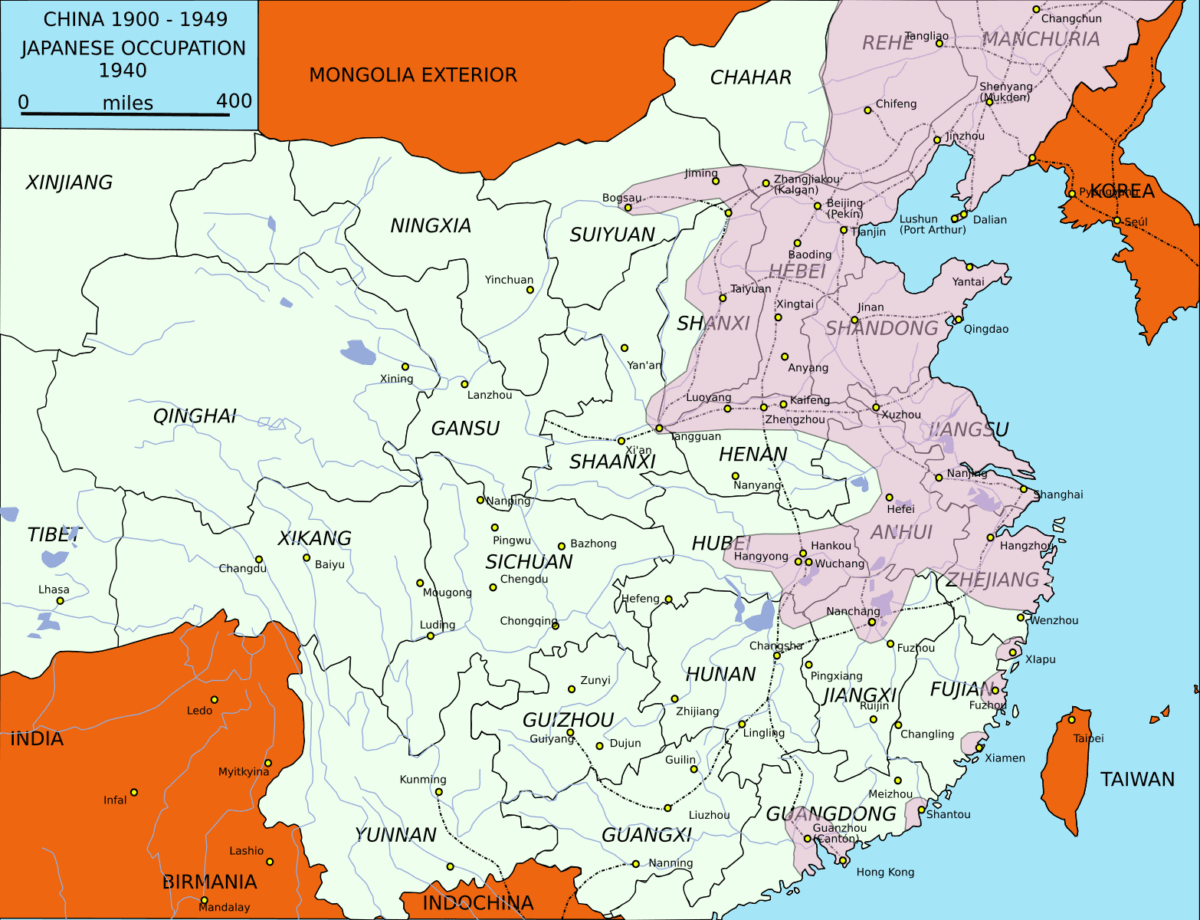
While nationalist troops fought the Japanese invasion, the CCP largely remained in its base in Yan’an in northwest China, away from the northeast, eastern, and southern China that were occupied by Japan and where the main battles took place during World War II in China and Asia.
“The ROC’s nationalist army led by Chiang Kai-shek was the main force in the decisive battles and the core of the war of resistance,” he wrote.
In 1945, when the war with the Japanese ended, China’s civil war broke out. After being defeated by the CCP in 1949 on the mainland, the ROC’s nationalist government, led by Chiang Kai-shek, retreated to the island of Taiwan. The Republic of China has remained Taiwan’s official name since then. Meanwhile, the CCP established the Chinese communist regime, also known as the People’s Republic of China (PRC), on the mainland in 1949.
Taiwan’s Mainland Affairs Council Minister, Chiu Chui-cheng, pointed out in a video released by his office on Aug. 15 that the PRC did not exist during World War II.
“The Chinese Communist regime has repeatedly distorted the facts in recent years, claiming that the war against Japan was led by the Communist Party, and has even fabricated the notion that Taiwan belongs to the People’s Republic of China,” Chiu said.
He called on Taiwanese people to “unite and jointly defend national sovereignty and dignity” to participate in Taiwan-led events instead of taking part in the PRC’s war commemorations, such as the military parade.
What's Your Reaction?
 Like
0
Like
0
 Dislike
0
Dislike
0
 Love
0
Love
0
 Funny
0
Funny
0
 Wow
0
Wow
0
 Sad
0
Sad
0
 Angry
0
Angry
0













Comments (0)