

The Morning After Beijing: Stability, Stalemate — and China Says "Not So Fast"
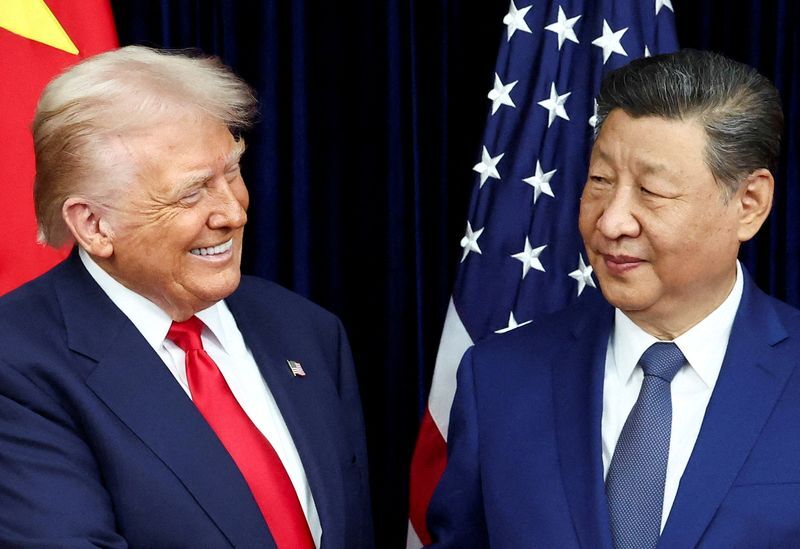
Two days after Donald Trump left Beijing calling his visit a huge success, a sobering picture is emerging. China's commerce ministry quietly described all summit deals — trade, agriculture, Boeing jets — as merely "preliminary," with details still to be negotiated. Analysts on both sides of the Pacific are reaching the same conclusion: the summit produced stability, not transformation. And in this particular standoff, stability benefits Beijing more than Washington.


.
Beijing's Verdict: "Preliminary"
While Trump was still calling his Beijing trip a triumph, China's commerce ministry quietly released its own assessment — and the language could not have been more different.
In a statement published Saturday, the ministry described the tariff reductions, agricultural agreements, and aircraft purchases announced during the summit as "preliminary." It confirmed that both sides had agreed to establish a Board of Trade and a Board of Investment — frameworks to negotiate future deals — but provided no timelines, no specific volumes, and no company names.
On Boeing, the ministry confirmed only that "arrangements on Chinese purchases of U.S. aircraft and U.S. assurances on the supply of aircraft engines and parts to China" had been discussed, adding that "discussions on the details are continuing" and that agreements would be "finalised as soon as possible."
That is a significant retreat from Trump's announcement that China had agreed to buy 200 jets — with an option up to 750. As we reported in our previous article, Boeing shares had already fallen more than four percent when the 200-jet figure was announced, well below the 500 that markets had anticipated. Now Beijing is saying even that number is not yet locked in.
On agriculture, the ministry said both sides would work to resolve "non-tariff barriers and market access issues" — bland diplomatic language that commits neither side to anything specific. It did highlight some concrete technical irritants Washington agreed to address: automatic detention of Chinese dairy and seafood exports, bonsai plant regulations, and avian influenza zone certifications for Chinese poultry. In return, Beijing said it would work on beef facility registration and U.S. poultry export access. The details are real — but they are the fine print of trade, not the headlines.
"A Counterrevolution Back to Stability"
American analysts have been equally direct in their assessment.
"Compared to where we were a year ago, with 145% tariffs and the U.S. really trying to push China and the rest of the world to fundamentally change, we've had a counterrevolution and we're back at stability," said Scott Kennedy, China expert at the Center for Strategic and International Studies in Washington.
That is a striking phrase — counterrevolution — and it cuts to the heart of what the summit revealed. Trump's aggressive tariff campaign of early 2025, once framed as a historic realignment of U.S.-China economic relations, ended in an uneasy truce. The Beijing summit did not build on that pressure — it consolidated a retreat from it.
"The summit projected stability but it left the stalemate intact," said Craig Singleton of the Foundation for Defense of Democracies. It "produced modest, marketable and managed outcomes, which is about all the U.S.-China relationship can bear right now."
The commercial results underscore how far the summit fell short of earlier ambitions. When Trump visited Beijing in 2017, companies accompanying him signed deals and memorandums worth $250 billion. This week's visit produced no breakthrough on Nvidia's H200 AI chips, a Boeing deal still marked "preliminary" by Beijing, and agricultural agreements with no published timelines or volumes. Wendy Cutler, a former acting deputy U.S. Trade Representative, called the economic deliverables "way below expectations."
Xi Got What He Came For
While the outcome was thin for Washington, Beijing's calculation looks considerably more comfortable.
Xi proposed a new framing for the relationship — "constructive strategic stability" — and Trump did not push back. Gone was any public mention of long-standing U.S. demands: China's industrial overcapacity, its export-driven trade model, structural economic reforms. These were central talking points of previous administrations. They did not appear in any U.S. readout from this summit.
For Xi, as Chinese academic Cui Shoujun of Renmin University put it, the summit confirmed that Washington and Beijing are "no longer aspiring to pull relations back to a cooperative golden age, but instead acknowledging the long-term nature of competition and disagreement." That is a framework China can work with. It provides breathing room to navigate a weak domestic economy, shore up strategic technologies, and continue expanding influence in the Indo-Pacific — without facing the kind of maximal economic pressure Trump threatened a year ago.
Beijing also retained its leverage intact. The rare earth export controls that rattled U.S. chipmakers and aerospace companies remain in place — the truce that has kept minerals flowing was not formally extended. Trump told reporters he and Xi "did not discuss tariffs." Whether that truce continues past its expiration in five months is now the central open question in the relationship.
A source familiar with the negotiations told Reuters that China had wanted a longer extension of the truce than Washington was willing to grant, and that some commercial deals may be deliberately held back for Xi's expected reciprocal visit to the White House later this year. The next summit, in other words, is already being set up — with Beijing holding cards it chose not to play this week.
What Was Missing
Several issues Trump had flagged before the trip produced nothing publicly visible.
On Iran, China issued a statement calling the war one that "should never have happened" — pointed language directed as much at Washington as at Tehran. But there was no Chinese commitment to pressure Tehran, no agreement to reduce oil purchases from Iran, and no path to reopening the Strait of Hormuz. Trump's patience, he said, is running out. Oil prices rose three percent on Friday to near $109 a barrel — the market's verdict on the summit's Iran outcome.
On Taiwan, Trump revealed in his Air Force One press conference that Xi had directly asked whether the U.S. would defend the island. Trump refused to answer. He made no commitments on arms sales either way, saying a decision on a pending package was coming "shortly." Secretary of State Rubio repeated the formula: "U.S. policy on Taiwan is unchanged as of today." That answer satisfies no one completely — which, in Taiwan diplomacy, may be precisely the point.
On human rights, the cases of media tycoon Jimmy Lai — serving 20 years under Hong Kong's national security law — and Pastor Jin Mingri remain unresolved. Trump said Xi may be considering releasing the pastor. Lai, he acknowledged, is "a tough one." For Beijing, Hong Kong is a closed file. For the millions who watched the dismantling of that city's freedoms, a presidential summit changed nothing.
On Nvidia's H200 chips — one of the most closely watched technology questions of the trip — there was no breakthrough. This was, analysts noted, likely welcomed by China hawks in both parties who had warned the administration against feeding Beijing's AI development with American semiconductor technology.
Stable, Not Solved
The White House, for its part, pushed back on the "underwhelming" narrative. A White House official said Trump "leveraged his positive relationship with President Xi in order to bring home deliverables for the American people," citing the Boeing deal and agricultural agreements. China's embassy in Washington called the talks "candid, in-depth, constructive and strategic."
Both descriptions are technically accurate — and both obscure as much as they reveal.
What this summit produced is a relationship reset to a manageable baseline: competitive, guarded, but no longer careening toward open economic war. For the world's two largest economies — whose rivalry touches every supply chain, every technology sector, and every regional alliance — that is not a trivial outcome.
But "stability" is not the same as "progress." The fundamental tensions — over trade imbalances, Taiwan, technology, Iran, and human rights — remain exactly where they were when Trump's motorcade rolled up to the Great Hall of the People on Thursday morning.
Xi called the U.S.-China relationship "the most important in the world" and said it must never be "messed up." Trump called the visit "incredible." The trees in the Zhongnanhai garden, some of them a thousand years old, have seen many such moments come and go.
(For the full context of the summit and its lead-up, see our complete six-part series at udumbara.net/news.)
.
Sources:
- Reuters – "Trump returns from China with stability and a stalemate" (May 16, 2026): https://www.reuters.com/world/china/trump-returns-china-with-stability-stalemate-2026-05-16/
- Reuters – "China says Trump visit deals are 'preliminary'" (May 16, 2026): https://www.reuters.com/world/china/china-says-trump-visit-deals-are-preliminary-2026-05-16/
.
What's Your Reaction?
 Like
0
Like
0
 Dislike
0
Dislike
0
 Love
0
Love
0
 Funny
0
Funny
0
 Wow
0
Wow
0
 Sad
0
Sad
0
 Angry
0
Angry
0









Comments (0)