

Beijing Holds Special Meeting to Expel 3 Senior Defense Industry Officials Amid Ongoing Military Purge


.
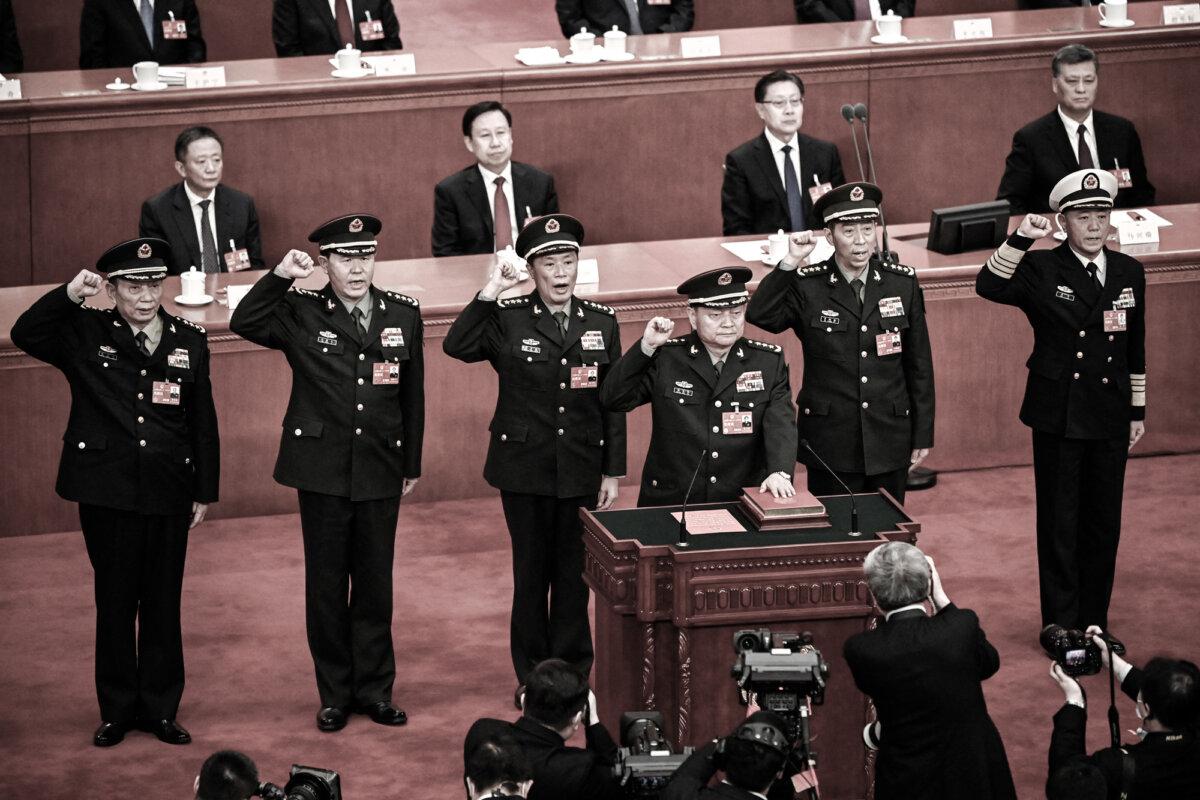
The Chinese Communist Party’s (CCP) Standing Committee of its rubber-stamp legislature has held a special session to expel three senior military-industrial officials amid the ongoing military purge.
Analysts told The Epoch Times that although the removal of the three technocrats exposes the Chinese regime’s systemic corruption, they were not the primary target of the special meeting, as infighting among the top echelons of the CCP persists.
The three technocrats who were removed from the National People’s Congress on Feb. 4 include Zhou Xinmin, former chairman of Aviation Industry Corporation of China; Luo Qi, former chief engineer of China National Nuclear Corporation and a nuclear power expert; and Liu Cangli, former president of the China Academy of Engineering Physics and a member of the Chinese Academy of Sciences and a nuclear weapons expert.
All three men had been absent from important events or had left their positions for unspecified reasons for months before the official announcement at the Standing Committee’s special meeting.
Meanwhile, various departments of the Central Military Commission or major military commands have been silent about CCP leader Xi Jinping’s purge of the two top generals—unlike previous incidents in which they expressed support almost immediately through official statements. The unusual silence indicates that the case is not totally settled and that dissent is growing within the military, according to analysts who recently spoke with The Epoch Times.
This special session of the National People’s Congress (NPC), held outside its regular schedule, suggests it was convened to address specific and important matters, Shen Ming-shih, a research fellow at the Division of National Security Research at Taiwan’s Institute for National Defense and Security Research, told the publication.
However, the outcome was limited to the removal of three technocrats from their NPC delegate positions, he said. “A regular meeting at the end of the month would have sufficed for their removal; this special session was unnecessary,” he added.
Shen said the NPC’s special session was intended to formalize Xi’s purge of Zhang, vice chairman of the CCP’s Central Military Commission, and Liu Zhenli, a member of the Central Military Commission and chief of the Joint Staff Department, and to remove their representative positions in the national legislature. The three technocrats were intended to serve as secondary cases to accompany the main case of Zhang and Liu’s purge, he stated.
Since they couldn’t reach an agreement at the special meeting about Zhang and Liu’s case, “the technocrats’ secondary cases became the only outcome of the meeting,” Shen said.
“When Xi Jinping was purging Zhang Youxia and Liu Zhenli, he did not follow the necessary procedures within the Party. It was only after a few Standing Committee members—Xi Jinping, Cai Qi, and Li Qiang—discussed the matter and they took action,” Shen explained.
Zhang Tianliang, a current affairs commentator and contributor to NTD, the sister media outlet of The Epoch Times, shared the same assessment on his Chinese-language talk show, saying the NPC’s special session was Xi’s failed attempt to legitimize his purge of Zhang from the Central Military Commission and to expel Zhang from the national legislature, and that it met resistance from officials within the Party.
.
Shen noted that in the Jan. 25 PLA Daily editorial in which Zhang’s removal was announced, five charges were listed against him, all of which were political, but in subsequent PLA Daily editorials and commentaries, the charges have been changed to corruption.
“However, it hasn’t been clarified whether this corruption occurred during [Zhang’s] time as minister of the [People’s Liberation Army’s] General Armaments Department or after he joined the Central Military Commission,” Shen said.
Pervasive Corruption, Overestimated Military Capabilities
The analysts said that nearly all CCP officials are corrupt and that they use anti-corruption to attack their political enemies.Over the past three years, key personnel in China’s military-industrial complex have also been frequently implicated in corruption and removed from their positions amid the CCP’s military purge. Since the exposure of the corruption scandal within the Rocket Force in 2023, and the subsequent investigations into equipment procurement corruption, high-ranking officials in military-industrial enterprises have been frequently dismissed.
However, most of these dismissals have not been officially announced; rather, the officials involved have mysteriously “disappeared,” Shen said. Only some officials holding positions as National People’s Congress deputies or Chinese People’s Political Consultative Conference members have had their dismissals officially announced due to procedural requirements.
Regarding the three technocrats being expelled from the legislature, Shen said that “it indicates that the crackdown on corruption in the military industry or the People’s Liberation Army will continue, as it’s unlikely that only these three individuals are corrupt.”
.

Also, the frequent occurrence of corruption cases in the military industry indirectly reflects the CCP’s misrepresentation of its own military capabilities, Shen said.
“These three technocrats were responsible for critical weapons and equipment, which indirectly reflects that the CCP military’s actual combat capabilities are not as impressive as they are portrayed,” he said.
Mark Cao, a U.S.-based military tech analyst, former materials engineer, and host of Chinese-language military news YouTube channel Mark Space, told The Epoch Times that corruption within the Chinese military-industrial complex has persisted for many years.
He cited the example of the conflict along the Sino-Indian border, where it was discovered that Chinese armored vehicles could be damaged by mere stones, as shown in videos of the conflict circulating on social media. Mark said that, based on the online videos, ordinary steel had been used instead of armor-grade steel.
“Military-industrial corruption is widespread, and what’s being exposed now is only a small part of it, which is the result of the factional struggles at play,” he said.
What's Your Reaction?
 Like
0
Like
0
 Dislike
0
Dislike
0
 Love
0
Love
0
 Funny
0
Funny
0
 Wow
0
Wow
0
 Sad
0
Sad
0
 Angry
0
Angry
0













Comments (0)