

Trump Confirms AMD, Nvidia Will Pay 15 Percent Fee for Chip Sales in China


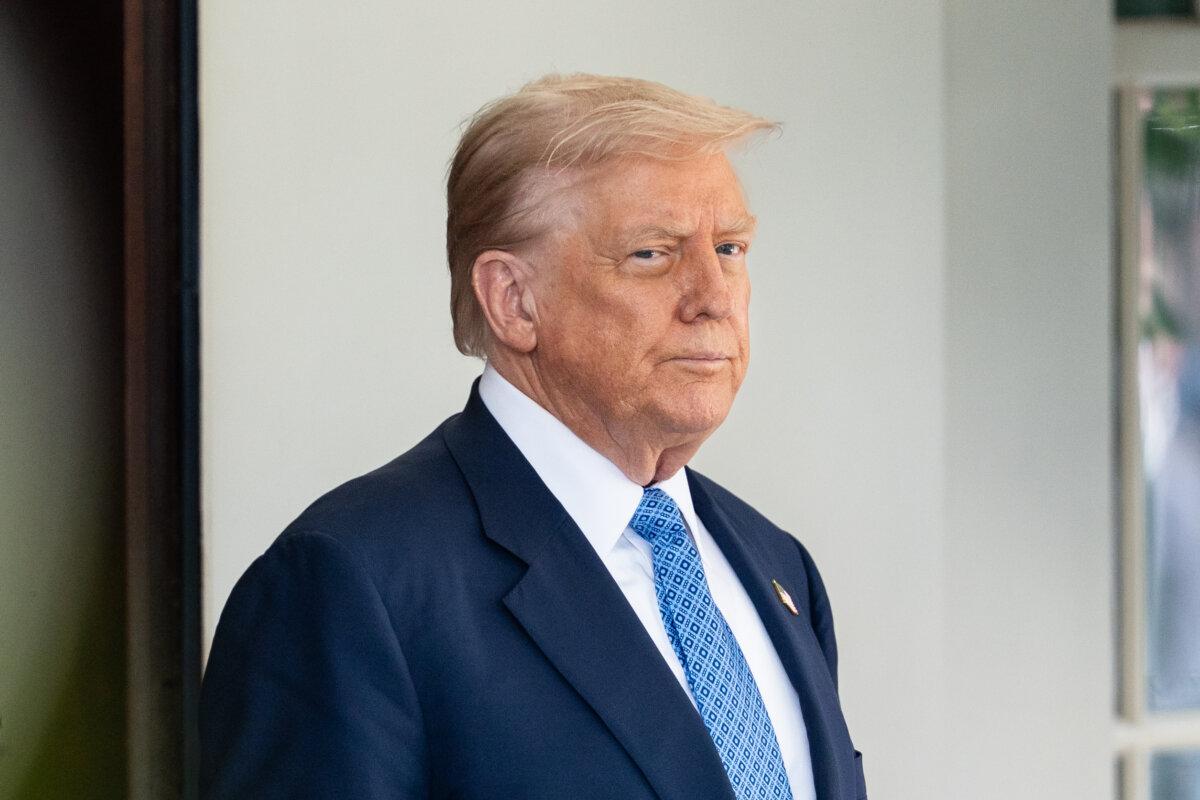
President Donald Trump confirmed that Nvidia and Advanced Micro Devices (AMD) will pay a fee to the U.S. government in exchange for export licenses to ship vital artificial intelligence (AI) chips to China.
At an Aug. 11 press briefing, Trump told reporters that the tech juggernauts will be charged a 15 percent fee on revenues from their chip sales to China, contingent upon receiving U.S. export licenses.
The arrangement effectively unlocks access to one of the companies’ most critical markets following months of regulatory hurdles.
Trump initially proposed a 20 percent levy on chip exports, but after negotiations with Nvidia CEO Jensen Huang, the two parties settled on a 15 percent agreement, he said. Despite the deal, the president downplayed the Nvidia chip’s significance, calling it “obsolete.”
“It’s an old chip. China already has it in a different form, different name—but they have it,” he said.
The H20 chip is a specialized AI processor designed for large-scale AI workloads and data centers. It was explicitly designed to adhere to export rules for China. The White House suspended its sales to China in April over national security concerns, but Nvidia confirmed last month that the administration had approved the resumption of sales to Beijing.
Commerce Secretary Howard Lutnick previously called it Nvidia’s “fourth-best” chip.
“We don’t sell them our best stuff, not our second best stuff, not even our third best,” Lutnick told CNBC in a July 15 interview.
AMD, meanwhile, will be permitted to ship its MI308s, another high-performance chip tailored to AI workloads and data centers, to China.
The federal government is estimated to collect approximately $2 billion from Nvidia as part of the revenue-sharing agreement. This past spring, Huang projected that the company would earn $15 billion from H20 chip sales to China.
Trump also referenced Nvidia’s Blackwell chip, a next-generation AI processor that far outpaces the H20 in performance and capabilities. He indicated that further discussions may take place regarding Blackwell but ruled out any immediate deal.
Market Reaction
Shares of both semiconductor companies rose to kick off the trading week.Shares of Nvidia rose 0.5 percent during the Aug. 11 trading session to around $184. This year, the stock has increased by 33 percent. AMD shares climbed more than 1 percent to nearly $176, bringing their year-to-date gains to almost 46 percent.
Ipek Ozkardeskaya, senior analyst at Swissquote Bank, says the pay-to-play scheme is an “unusual move” as U.S. officials have repeatedly expressed national security concerns.
“The idea of paying the US government to soften export policies—originally designed to control national-security risks—is an unusual move,” Ozkardeskaya said in a note emailed to The Epoch Times. “If the US government is willing to exchange national-security risks for money, that would be good news for Nvidia and AMD.”
.
According to Siebert Financial CIO Mark Malek, this could be the beginning of similar deals in the future, but he warned that shareholders will bear the cost.
“Unfortunately, that tax will ultimately be paid by shareholders of those amazing stocks,” Malek said in a note emailed to The Epoch Times.
This comes as the 90-day U.S.–China tariff pause is set to expire.
“We'll see what happens,” Trump said when asked whether he would extend the Aug. 12 deadline.
In May, both sides negotiated a temporary agreement to suspend and reduce specific levies amid ongoing trade discussions. U.S. tariffs on Chinese imports were lowered from the 125 percent rate, while China’s levies on U.S. goods were reduced from 125 percent to 10 percent.
Treasury Secretary Scott Bessent and Trade Representative Jamieson Greer, who recently met with their Chinese counterparts in Stockholm, said another 90-day extension could be possible.
Chinese stocks were little changed, with the benchmark stock market indexes up slightly.
The Epoch Times has reached out to Nvidia and AMD for comment.
.
What's Your Reaction?
 Like
0
Like
0
 Dislike
0
Dislike
0
 Love
0
Love
0
 Funny
0
Funny
0
 Wow
0
Wow
0
 Sad
0
Sad
0
 Angry
0
Angry
0















Comments (0)