

China Sends Astronauts on Record Mission — With the Moon in Its Sights
China launched three astronauts to its space station on Sunday, marking a new milestone in its space program. For the first time, one crew member will remain in orbit for a full year. The mission is part of Beijing's broader push to land humans on the moon before 2030.

.
A New Record in the Making
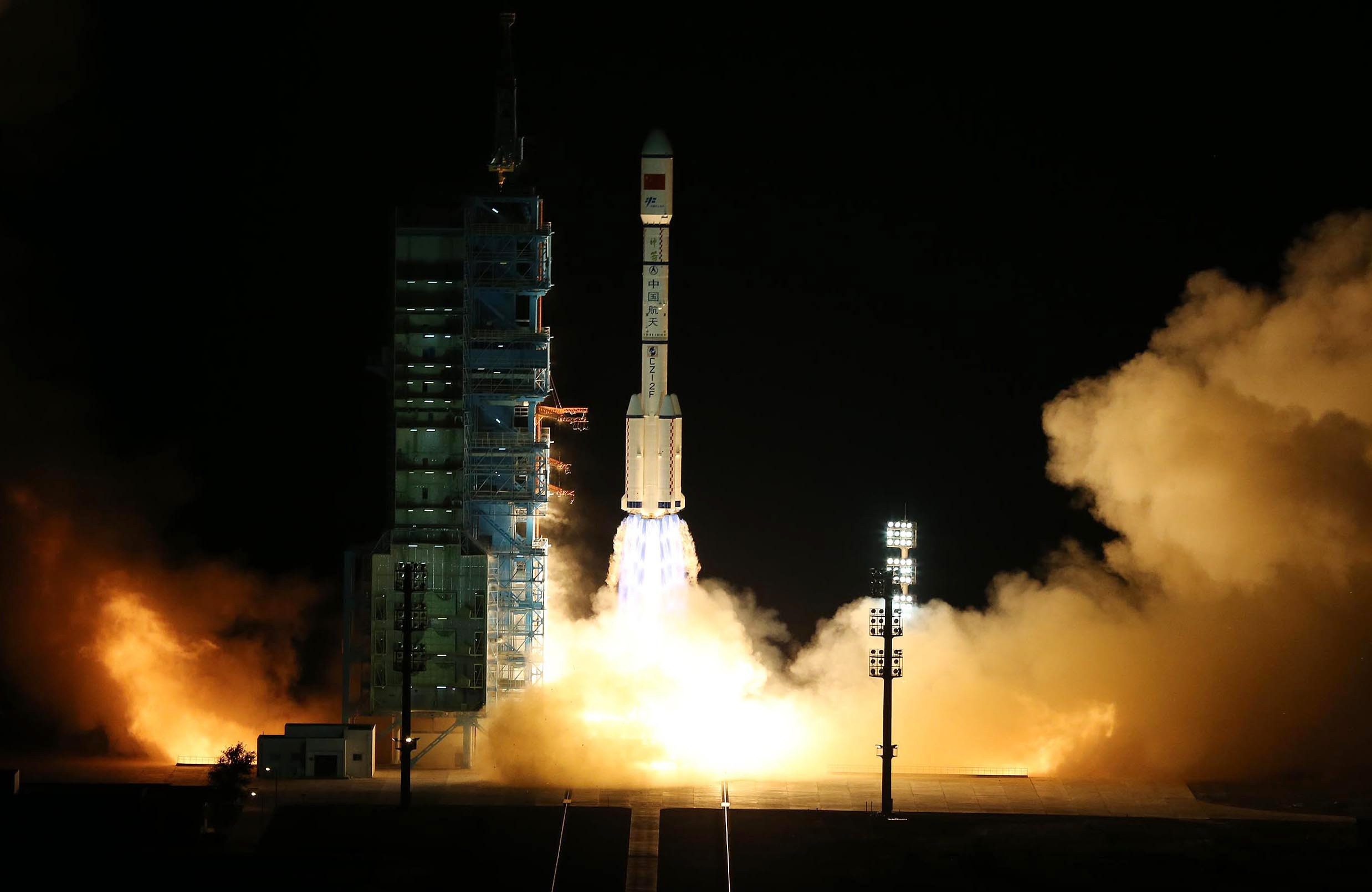
China's space program reached a new milestone on Sunday when the Shenzhou-23 spacecraft lifted off from the Jiuquan Satellite Launch Center in the Gobi Desert at 11:08 p.m. local time. The Long March-2F rocket carried three astronauts to the Tiangong space station — and for the first time in Chinese spaceflight history, one of them will remain aboard for an entire year.
That decision will be made as the mission progresses, the China Manned Space Agency announced. While a full year in orbit falls short of the all-time record — a Russian cosmonaut spent over 14 months in space back in 1995 — it represents a significant step forward for China's human spaceflight capabilities.
Who Is Flying?
The crew includes commander Zhu Yangzhu and pilot Zhang Yuanzhi, both members of the People's Liberation Army's astronaut corps. The third crew member, payload specialist Li Jiaying, is a former police inspector from Hong Kong — making her the first person from the city to participate in a Chinese space mission.
Science at the Heart of the Mission
Long-duration spaceflight takes a serious physical toll on the human body. Astronauts face reduced bone density, muscle loss, radiation exposure and significant psychological stress — challenges that become more severe the longer a mission lasts.
The Shenzhou-23 crew will study these effects in detail, generating data that is critical for any future crewed mission to the moon or beyond. Scientists will monitor the long-term resident's physiological responses closely throughout the year.
In an additional first, China is conducting what state media describes as the world's first human artificial embryo experiment in space. Stem cell samples were sent to the Tiangong station this month as part of research into whether human reproduction and long-term survival are feasible in space environments.
Racing Toward the Moon
The Shenzhou-23 mission is not taking place in a vacuum — politically or scientifically. China has set an ambitious target of landing astronauts on the moon by 2030 and establishing a permanent lunar base alongside Russia by 2035.
That puts Beijing in direct competition with the United States. NASA is aiming for its own crewed lunar landing by 2028, two years ahead of China's deadline. In April, four NASA astronauts completed a historic flight around the moon as part of the Artemis II mission — the first crewed lunar mission in more than 50 years.
Separately, SpaceX conducted a largely successful uncrewed test flight of its Starship rocket on Friday — the vehicle NASA plans to use to land astronauts on the moon's surface.
Technology Under Development
China faces a compressed timeline. With fewer than four years until 2030, engineers are still developing the hardware specific to a lunar mission. Key components include the heavy-lift Long March-10 rocket, the Mengzhou crew capsule and the Lanyue lunar lander — all of which have been undergoing safety testing over the past year.
One technically important element of the current Shenzhou-23 mission is the planned first autonomous rapid docking with Tiangong's core module. This procedure directly mirrors the automated rendezvous that will be required in lunar orbit between the Mengzhou capsule and the Lanyue lander — a maneuver that must work flawlessly for the 2030 mission to succeed.
A Conservative Timeline — By Design
China's chief lunar scientist, Wu Weiren, has indicated publicly that Beijing's stated 2030 deadline is intentionally cautious. The suggestion is that China may be capable of moving faster than it lets on — a recurring pattern in a space program that has often surprised international observers.
In June 2024, China became the first nation to retrieve samples from the far side of the moon using robotic spacecraft — a feat that had never been accomplished before. Each successful Shenzhou mission builds on that momentum, pushing China's capabilities closer to the requirements of a crewed lunar landing.
What was once considered an ambitious long shot is increasingly looking like a realistic race — one that neither Beijing nor Washington intends to lose.
.
Sources:
- Reuters – "China sends astronaut on year-long space mission as it eyes 2030 moon landing" (May 24, 2026): https://www.reuters.com/science/china-send-astronaut-year-long-space-mission-it-eyes-2030-moon-landing-2026-05-23/
- NASA – Artemis II Mission Overview: https://www.nasa.gov/mission/artemis-ii/
- SpaceX – Starship Test Flight Updates: https://www.spacex.com/vehicles/starship/
- China Manned Space Agency (官方): http://www.cmse.gov.cn/
- AP News – China Space Coverage: https://apnews.com/hub/china-space-program
.
What's Your Reaction?
 Like
0
Like
0
 Dislike
0
Dislike
0
 Love
0
Love
0
 Funny
0
Funny
0
 Wow
0
Wow
0
 Sad
0
Sad
0
 Angry
0
Angry
0















Comments (0)