

Train, Air Services Between Beijing, Pyongyang Resume Amid US War on Iran


.
A passenger train connecting Beijing and Pyongyang resumed service after a six-year halt, departing from Beijing Station on March 12 amid the U.S. war on Iran.
Analysts told The Epoch Times that Beijing and Pyongyang are trying to get closer after seeing the United States’ precision strikes against Venezuela and Iran that removed their regime leaders.
According to China’s railway authorities, train K27’s entire journey from Beijing to Pyongyang takes approximately 24 hours and 41 minutes. The train makes a stop in the Chinese border city of Dandong before crossing the Yalu River to reach Pyongyang. Currently, the train runs four times a week in both directions on Mondays, Wednesdays, Thursdays, and Saturdays. However, tickets are currently available only to individuals holding business visas.
Meanwhile, Air China will resume weekly flights from Beijing to Pyongyang from March 30.
Cross-border flights and train service between the two countries were suspended during the COVID-19 pandemic in 2020.
Guo Jiakun, a spokesperson for the Chinese Foreign Ministry, said at a press briefing on March 10 that China and North Korea are “friendly neighbors,” and that maintaining regular train operations between the two countries “holds significant importance.”
The main reason behind the resumption of the train and air services between Beijing and Pyongyang is the sense of crisis felt by both the Chinese Communist Party (CCP) and the North Korean communist regime following the United States’ operations taking out regime leaders in Venezuela and Iran, Mark Cao, a U.S.-based military tech analyst and host of Chinese-language military news YouTube channel Mark Space, told The Epoch Times.
In recent years, North Korean leader Kim Jong Un’s relationship with the CCP has cooled, and he has instead shown a greater inclination toward cultivating ties with Russia, he said.
When the COVID-19 pandemic broke out in Wuhan, Kim Jong Un closed the borders to prevent Chinese nationals from entering.
“However, the virus still made its way into North Korea. This left Kim Jong Un particularly displeased with the CCP, and since then, the two sides have been cooled,” Cao said.
“After the Russia-Ukraine war broke out, Kim Jong Un began providing Russia with substantial military support, supplying artillery shells, rockets, missiles, and other weaponry, and even dispatching troops to assist in the fighting. Putin has reciprocated by providing Kim Jong Un with significant technical assistance in the military sphere,” he said.
Over the past two years, North Korea has suddenly constructed two destroyers with a displacement exceeding 5,000 tons, equipped with numerous modern weapons, radar systems, and other advanced technologies, Cao noted.
“Particularly in the areas of long-range missiles and satellite launch capabilities, North Korea has achieved significant progress. All of these developments are the result of Russian assistance,” he said.
While the U.S. war on Iran is ongoing, driving up international oil prices, the United States and Russia seem to have eased relations, as the Trump administration just issued a temporary waiver to allow countries to buy sanctioned Russian oil and petroleum products stranded at sea.
Under these circumstances, it is logical for the CCP and North Korea to worry that the next target could very well turn out to be one of them, Cao said.
“Consequently, they felt it would be prudent to strengthen their ties. That is why I think Kim Jong Un may have softened his stance and proactively reached out to the CCP in a gesture of goodwill—and that is how the train and flight services are resumed.”
.
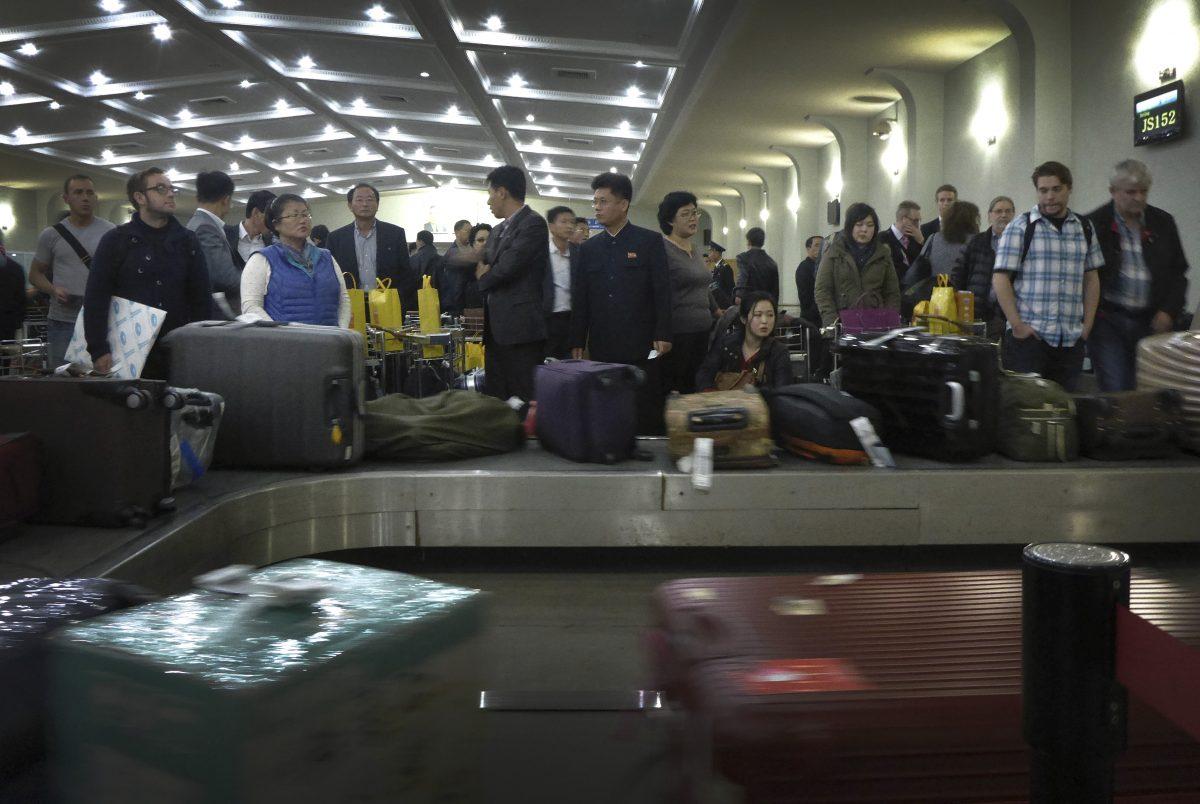
Passengers wait for their luggage upon arrival at the Sunan International Airport in Pyongyang, North Korea. AP Photo/Wong Maye-E, File
.
Multilateral Geopolitics
Although North Korea condemned the U.S. attack on Iran, Kim has taken no other action to aid Iran.Relations between North Korea and the United States are unlikely to worsen in the short term, as the United States is trying to pull Kim closer under the circumstances, Shen Ming-shih, research fellow at the Division of National Security Research at Taiwan’s Institute for National Defense and Security Research, told The Epoch Times.
“Since it touches upon fundamental U.S. interests, it would be detrimental to the United States if North Korea ... [with its] nuclear weapons ... provide support to Russia or China,” he said.
Consequently, the United States seeks to cultivate a better relationship with North Korea, or at the very least, prevent it from aligning with the CCP, he said.
“Should China initiate a conflict in the Taiwan Strait, the United States aims to ensure that Kim Jong Un refrains from supporting or coordinating with the CCP to instigate a conflict on the Korean Peninsula; this constitutes the primary objective of the United States.”
The restart of the train and flight services carries symbolic significance, Shen said. It signals that tensions between China and North Korea have eased.
Cao shares a similar assessment.
The CCP may send more aid to North Korea, and the relationship between the two countries is likely to improve, he said.
“This is a natural reaction on their part in the face of shifting international dynamics, and it won’t have much effect on the Northeast Asian region,” Cao said.
Regarding the economic impact of the resumption of travel services, Shen said that North Korea can seize this opportunity to secure additional energy, supplies, or subsidies from China.
“This opening facilitates the influx of Chinese products—specifically affordable goods—into North Korea, serving as a means to satisfy North Korea’s domestic demand and address the diminished purchasing power and shortages of goods resulting from inflation,” Shen said.
What's Your Reaction?
 Like
0
Like
0
 Dislike
0
Dislike
0
 Love
0
Love
0
 Funny
0
Funny
0
 Wow
0
Wow
0
 Sad
0
Sad
0
 Angry
0
Angry
0










Comments (0)